EUrope: A Psychoanalysis, by Rod Tweedy
Consciousness and Revolution

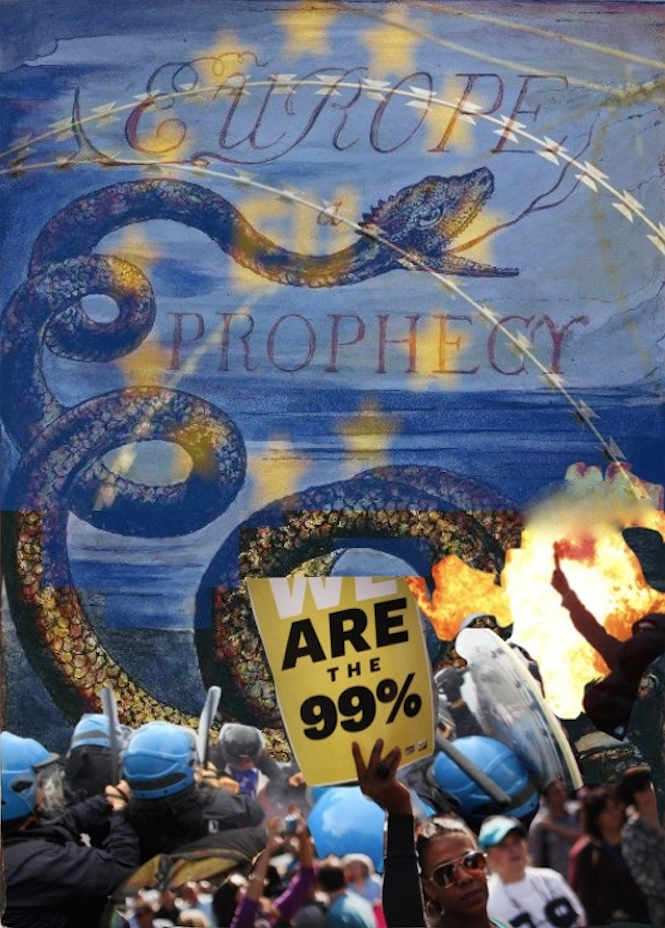
The previous post reprinted Blake’s Europe a prophecy, written shortly after the French Revolution and depicting the political and psychological womb out of which it emerged. His illustrations and text are dense, poetic, and richly ambiguous. Here I unpack some of the main themes of the poem, which revolve around Blake’s critique of materialism, and explore the psychological subtext of the poem. As Paley notes, the function of the prophetic form for Blake was “to expose the otherwise hidden motives and consequences of human decisions”. Blake’s concept of ‘prophecy’ is therefore a form of political psychoanalysis, a powerful new way of going under the skin of contemporary events and accessing the deep psychological and sexual dynamics that lie behind both religious and political structures. This superimposition of different fields of reference (simultaneously political, sexual, religious, psychological) is one of the things that makes Blake’s works so striking and distinct, as well as so dense and multivalent. It is also a feature of his thinking that he has in common with modern psychoanalytic approaches. As Adam Phillips notes:

You can only understand anything that matters — dreams, neurotic symptoms, literature — by overinterpreting it; by seeing it from different aspects as the product of multiple impulses. Authority wants to replace the world with itself. Overinterpretation means not being stopped in your tracks by what you are most persuaded by; it means assuming that to believe one interpretation is to radically misunderstand the object one is interpreting, and indeed interpretation itself.

Blake located the source of contemporary struggle in a specific complex of psycho-social structures and dynamics, which we still see being played out and repeated in contemporary European politics. Until we learn to understand and recognise these processes, Blake believed, we will be doomed to repeat the same underlying cycle again and again: a world where revolution becomes simply endless re-cycling. 
Read More

David Bowie: Alienation and Stardom, by Rod Tweedy

Schizophrenia, Spaceboys, and the Spiders from Mars

The death of David Bowie in 2016 revived both intense media interest in his work and astonishing creative legacy and also a plethora of unthinking and misleading cliches about who he was and what he signified. Foremost amongst these was the description of him as some kind of alien being, or “mysterious extraterrestrial”: “40 years ago, in millions of living rooms across the British isles,” one hagiographic BBC documentary started, “a strange alien creature was beamed onto our television screens”. Online and newspaper headlines were full of references to Starmen, Spaceboys, The Man who Fell to Earth – but there was very little attempt to explore or decode these references or to consider their psychological significance.

Read More

How We See War, by Rod Tweedy

Rod Tweedy reviews the book War against War! by Ernst Friedrich

On May Day 1924 Ernst Friedrich published a collection of photographic images of the atrocities of World War I, hoping to use the relatively new medium of photography as documentary evidence to challenge the orthodox presentation of war. As Douglas Kellner has remarked, “Friedrich hoped that when they actually saw the reality of modern warfare, people everywhere would become more critical of war, the military, and militarism.”

The book was called War against War!, and the photographs made an immediate and lasting impression on his contemporaries, both within and outside of Germany. The images attracted even greater attention when he put them in the window of his newly-opened Anti-Kriegs-Museum in Berlin, the first international anti-war museum (opened in 1925).

Read More

Walking Blake’s London, by Akala and Mr Gee

Hearing the mind-forged manacles

Take a trip around the place that you live. What do you see? What do you feel?

Over 200 years ago, that’s exactly what William Blake did. What happened on that trip – what did he see? what did he feel? – but most importantly, what did it inspire him to write?

He described these “chartered” streets, and even the river Thames as being chartered – he was expressing the sense of ownership, the fact that the streets are owned by someone. Or a river – when you think of a river, you imagine something that flows freely – but he’s pointing to the fact that the river is also owned by someone.

London at that time was starting to assert itself, it was starting to beat its chest. But Blake just peals the veneer behind that image, and speaks about “Weakness” and “Woe”. These are not adjectives that London would use to describe itself to the world.

Read More

William Blake, Brexit and the Re-Awakening of Albion, by Rod Tweedy

Albion versus Britain PLC: The Political Dimension of Albion’s Awakening

1-brexit

In a remarkable article in the Guardian last year, associate editor Martin Kettle argued that “English radicalism needs to recapture the spirit of Blake” – that in a political world dominated by bureaucracy, think-tanking, consumerism, and a small-minded, reductive sense of cultural identity we need a re-infusion of imagination, passion, vision, and integrity. Indeed, he ended his piece with the provocative question, “Without the dream of Albion, how can England arise and Britain come together again in the common cause?” (Guardian)

Read More

The End of Nature:  Blake and Pantheism, by Rod Tweedy

Babylon, Nature-worship, and the Sleep of Albion 

OLYMPUS DIGITAL CAMERA

‘Awake! awake O sleeper of the land of shadows, wake! expand!’

As Kathleen Raine has noted, “the sleep of Albion is in a word the materialist mentality of the modern West.” However, this “materialist mentality”, for Blake, denotes not only the belief in the Newtonian universe of orthodox Science, which many are now questioning, but also the belief in “Nature” itself. For Blake, the “Creation” – the emergence of an apparently objective, natural, and material world – and Albion’s fall into “Sleep” were one and the same event.

Read More