

Introduction: Adam Kadmon
The Dance or Albion, also called Glad Day and Albion Rose, is arguably William Blake’s most recognizable image, at least in terms or his pictorial output. It is a potent and joyous evocation of spiritual ascendancy and as such it provides an excellent starting place for our examination of Blake’s visionary and often obscure iconography.
The figure of Albion represents Blake’s macrocosmic or “Eternal Man” whose “fourfold” division and subsequent reunification provides the underlying theme of Blake’s mythology. As Thomas R. Frosch writes, “Albion is Blake’s Dreamer, akin to the great sleepers of Joyce and Freud, and Blake’s chief purpose as a poet was to foresee his arising from ‘the nightmare or history’.” The original engraving of The Dance or Albion depicts a nude youth suspended with outstretched arms, in a posture resembling that or Leonardo’s Vitruvian Man, surrounded by a radiant light.
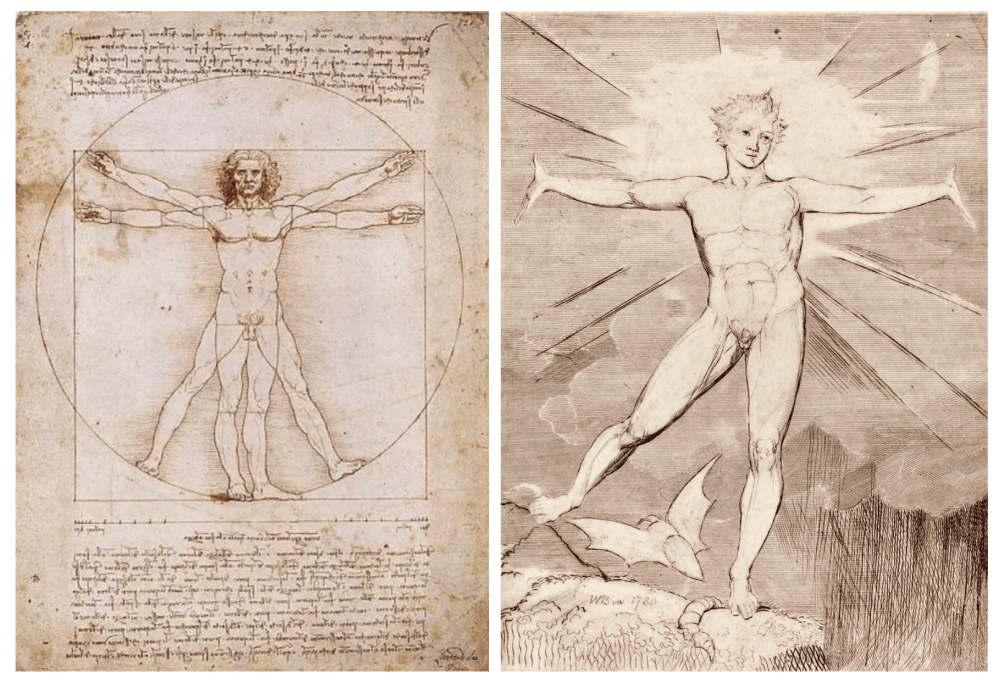
“The Dance or Albion depicts a nude youth suspended with outstretched arms, in a posture resembling that or Leonardo’s Vitruvian Man“. Blake’s image corrects the static ratios and geometry of da Vinci’s figure, trapped within the endlessly recurrent Circle, like a hamster in a Mill. Albion’s gesture is expansive and dynamic, the infinite and imaginative hid within the Vitruvian and rational.
The occurrence of a spiritual regeneration is suggested not only by the presence of light, but by the implicit cruciform pose of the figure which stands above a moth as it emerges from its cocoon, all recurrent Blakean motifs. The overriding emphasis on a spiritual reality which supersedes the specious reality of the “Vegetable” world is to be found throughout Blake’s oeuvre, particularly in the Prophetic Books and in subsequent illuminations and paintings.
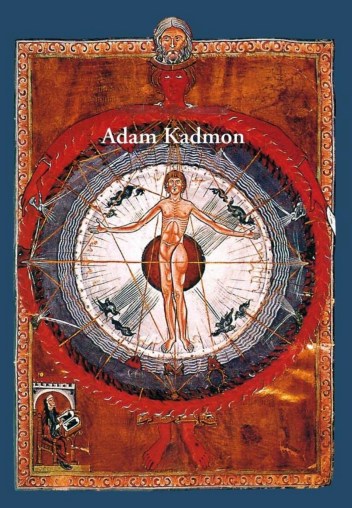
Adam Kadmon, the Kabbalistic “primordial man”
The term “Albion”, which is a common reference to England, is derived rom the mythological giant who conquered the British Isles and renamed them after himself. Numerous scholars have noted the correspondence between the figures of Albion and Adam Kadmon, the kabbalistic “primordial man”, who is described in The Standard Jewish Encyclopedia as “the spiritual prototype of man, existing as an incorporeal intelligence.”
Adam Kadmon represents the unity of the microcosm and macrocosm and is often depicted as an allegorical embodiment or the kabbalistic Tree of Life. The association between Albion and Adam Kadmon was first noted in 1920 by Bernard Fehr in reference to Blake’s Introduction to the second chapter or Jerusalem, entitled “To the Jews”, which states that:
You have a tradition, that Man anciently contain’d in his mighty limbs all things in Heaven & Earth … But now the Starry Heavens are fled from the mighty limbs of Albion.
Other scholars interested in Blake’s esoteric sources concurred with Fehr’s correlation and by the late 1930’s speculation on Blake’s use of the Kabbalah in the development or his mythology was more fully explored by S. Foster Damon, Denis Saurat and Milton 0. Percival.
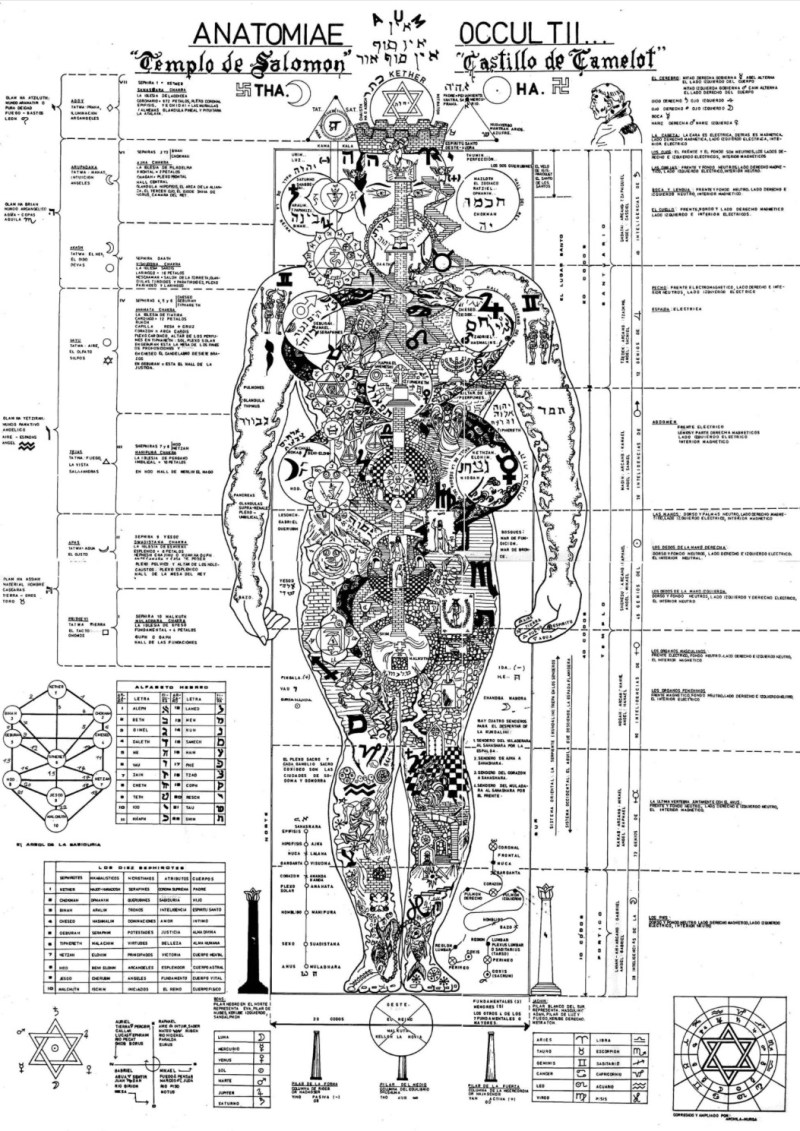
In the esoteric tradition, the human body contained within itself patterns and processes – living archetypes – of the universe through which humanity emerged. Profound correlations could be found to map and access these archetypes, to enable influences to flow from one correlate to the other, thereby opening the portals of perception to reveal the infinite and divine.
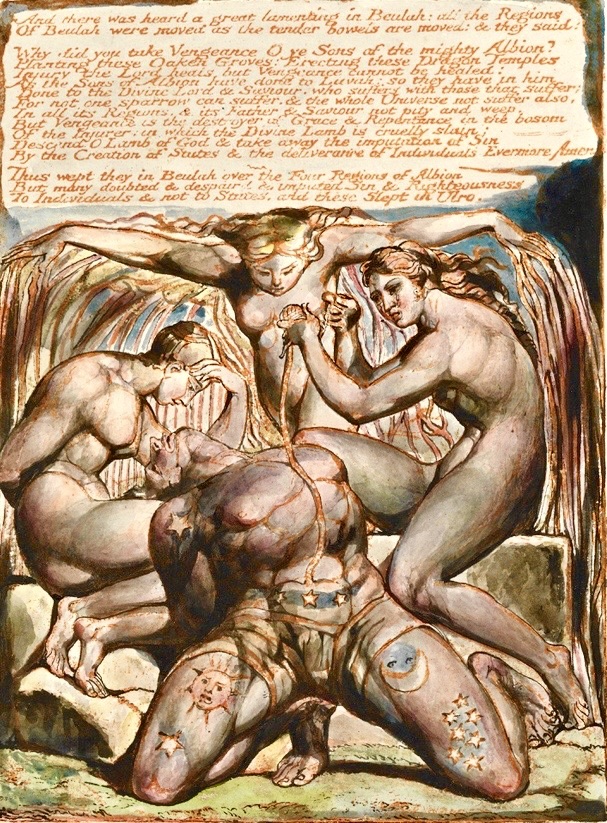
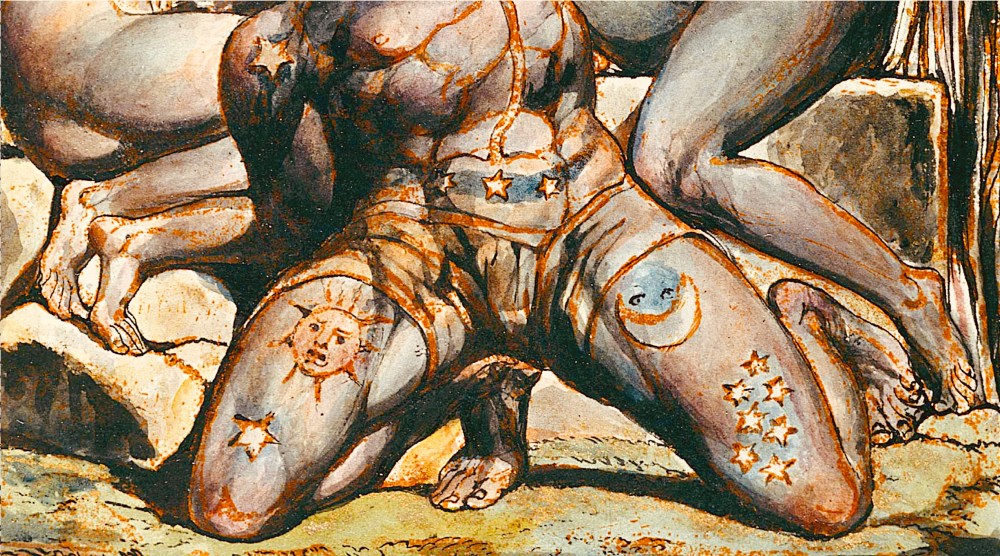
How Primordial Humanity looks, and feels, under the current state of self-division. “But now the Starry Heavens are fled from the mighty limbs of Albion”.
Blake’s specific familiarity with the tradition or the Kabbalah is a matter or speculation, although evidence suggests that he must certainly have been aware of its existence in one of many forms available to him. In Blake and Tradition Kathleen Raine cites works by the Christian kabbalists Robert Fludd, Thomas Vaughan and Agrippa as prevalent examples. Saurat refers to the Kabbala Denudata by Christian Knorr von Rosenroth as an “obvious” source, particularly as it was written in Latin and was widely distributed. In Hidden Riches, Desiree Hirst discusses the influence or Richard Clarke, who was both an Anglican clergyman and a kabbalist, on Blake’s attitudes towards the Jews. Blake may have also been familiar with the teachings of the Kabbalah by way of his great admiration for the seventeenth-century English poet John Milton, who found inspiration in both Neoplatonism and kabbalism.
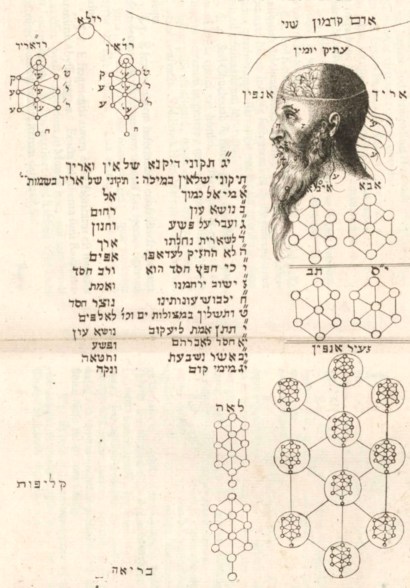
Page from The Kabbala Denudata by Christian Knorr von Rosenroth, suggesting the ways in which human physiognomy patterns and reflects the wider universe, which is its alienated form. As Frye remarks, “when the present body of man was achieved, the universe necessarily appeared to that body in its present shape. Its present shape is a stabilizing of the object-world, made permanent on a basis of ‘mathematic form’ or mechanical order. Therefore the creation of the present body of man must have been part of this stabilization” (Fearful Symmetry).
In an examination or the Zoharic version or original sin, Blumenthal summarizes the story as follows: “Adam sat in the Garden, i.e., he meditated upon the sefirot. He saw unchanging Tiferet and changing Malkhut, and he was drawn to the latter. God warned him not to meditate on Malkhut, but he, following his wife, did so anyway.. .. [Adam’s sin] … consisted in letting himself be distracted from divine unity and simplicity to divine plurality and complexity. ”
Gerschom Scholem describes this kabbalistic notion of “the Fall” as “the exile of the Shekhinah, or, in other words, the separation of the masculine and feminine principles in God.” Unity is to be found in the Supernal Triangle consisting of the Sephiroth Kether, Chokhmah, and Binah, and which is beyond comprehension and separated from the other Sephiroth by the Abyss.
Kether, the Crown, is the Primordial Point, the cause or manifestation whose brilliance is reflected onto Chokhmah, also known as Wisdom or the first duality. Chokhmah is the active male principle who “stimulates” the receptive female principle, Binah, or Understanding. In receiving Chokhmah’s energy, Binah becomes the underlying root of all form – the Mother.
Emanating God: Chokhmah and Binah, the Right and Left Hemispheres
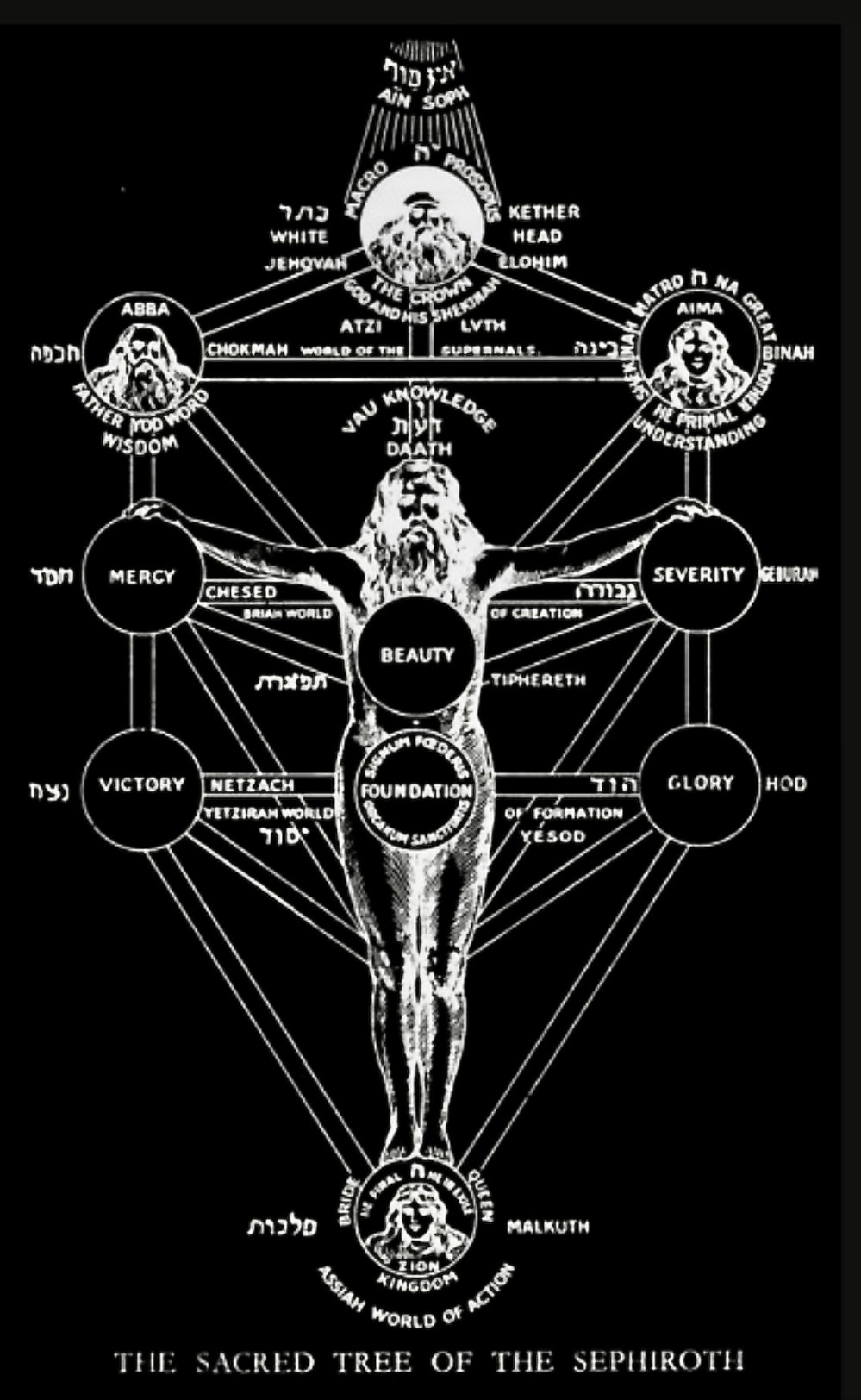
Sephirotic ‘Tree of Life’, which also correlates to the Human Form Divine, with its two asymmetrical sides or aspects. Here Chokhmah is shown correlating with the right hemisphere, the closest sephirot to the divine Presence. As with the hemispheres themselves, the terms ‘right’ and ‘left’ side depend visually on whether we are looking at them, or from them.
In Kabbalah, Chokhmah is the highest of the right side sephirot (kav yamin, the “Column of Mercy”) in the Tree of Life. It is at the bottom right of Keter, with Binah in front. Below it are the sephirots of Chesed and Netzach, and has four paths that go to Keter, Binah, Tifereth and Chesed.
Chokhmah, the second of the ten sefirot, is the first power of the conscious intellect within Creation, and the first point of ‘real’ existence, since Keter represents emptiness. According to the book of Job, “Wisdom comes from nothing. This point is at the same time infinitely small, yet it encloses the whole being, but remains incomprehensible until it is given form and is created in Binah.
Chokhmah appears in the configuration of the sefirot at the top of the right axis, and corresponds in the tzelem Elokim (“the divine image”) to the right hemisphere of the brain.
Chokhmah is associated in the soul with the power of intuition, like a flash of lightning through consciousness, Chokhmah’s “wisdom” also implies the ability to look deeply at aspects of reality and to perceive its conceptual essence until one can discover its truth in the depths. These seeds of truth can then be transmitted to Binah’s level for the sake of analysis and intellectual development.
Chokhmah is the primary force (“beginning”) in the creative process, Creativity. The word Chokhmah itself can be divided into two words: koach (“potential”) and ma (“that which is”). So, Chokhmah means “the potential of what is”, or, “the potential to be”.
— Abrahamic Study Hall
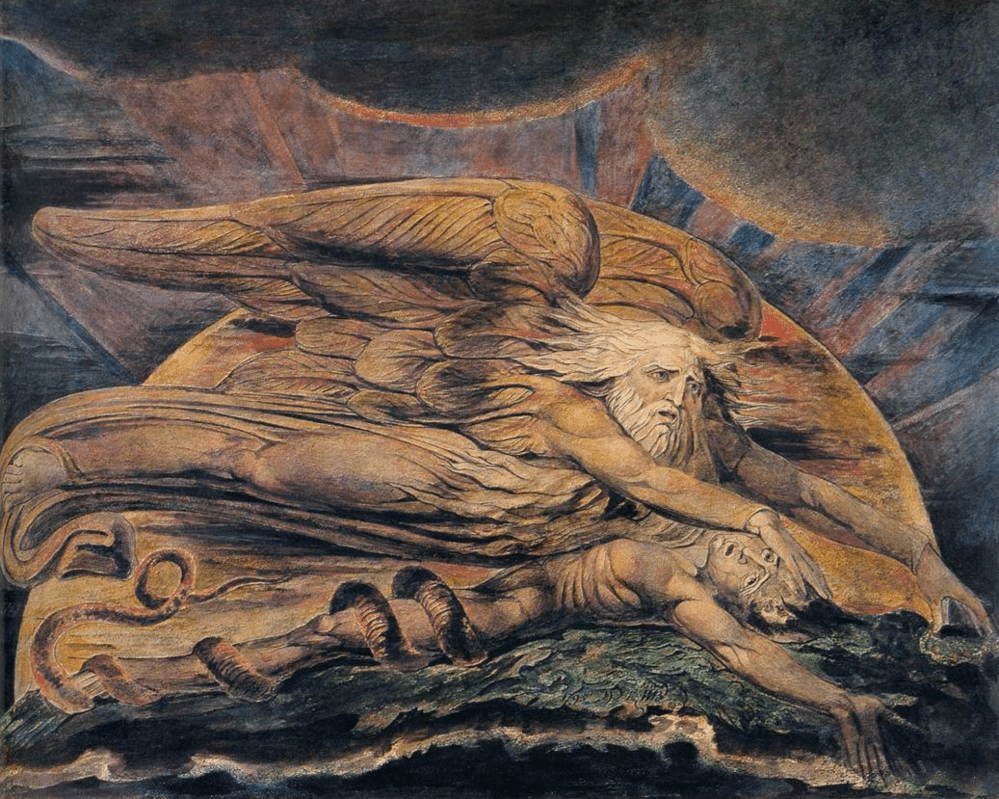
“The Hebrew word for ‘God’ here is Elohim. This alludes to Understanding, the concept that divides and delineates”. Image: Elohim Creating Adam, by William Blake. Note that the Elohim’s right hand (left hemisphere) is targeting Adam’s right hemisphere, to take control of it – the moment of the Emissary becoming the Master, in McGilchrist’s metaphor. Or becoming ‘God’, as Orthodox Jews and Christians tend to refer to this deep and disturbing brain process or movement.
The name Elohim, which is used throughout the first chapter of Genesis, refers to the manifestation of delineation and definition. In general, none of the names of God refer to the Creator Himself. The Creator is only referred to as Ain Sof, which means the Infinite Being, or simply, the Infinite.The first thing that the Infinite Being created was the name Elohim, which is associated with the Constriction. This alludes to Understanding, the concept that divides and delineates. As discussed earlier, Understanding (Binah) involves verbal thought, while Wisdom (Chokhmah) is pure nonverbal thought.Wisdom is associated with the nonverbal right hemisphere of the brain, while Understanding is associated with the verbal left hemisphere.Chokhmah consciousness is fluid, and is represented by water. Memory, on the other hand, is fixed, and is denoted by snow. Binah focuses on a single object, while Chokhmah consciousness encompasses everything.If Chokhmah is the source of giving, then Binah is the source of restraint. Water, which represents Chokhmah consciousness, thus gives birth to Gloom and darkness. …. Fire, which represents Binah consciousness, then give rise to light, since it is in this state that visible images are perceived.
— Sefer Yetzirah: The Book of Creation, by Aryeh Kaplan
McGilchrist explores the fascinating parallels between right hemispheric modes and the Kabbalistic sephirot of ‘Chokhmah’, and the left brain and what it terms ‘Binah’ (from 36.55 in)
“I was astonished when I first read about Chokhmah and Binah, and the right and the left – they were so like the right hemisphere’s capacities and those of the left” (McGilchrist, (39.35 in)
Adam and Eve, and Original Androgyny
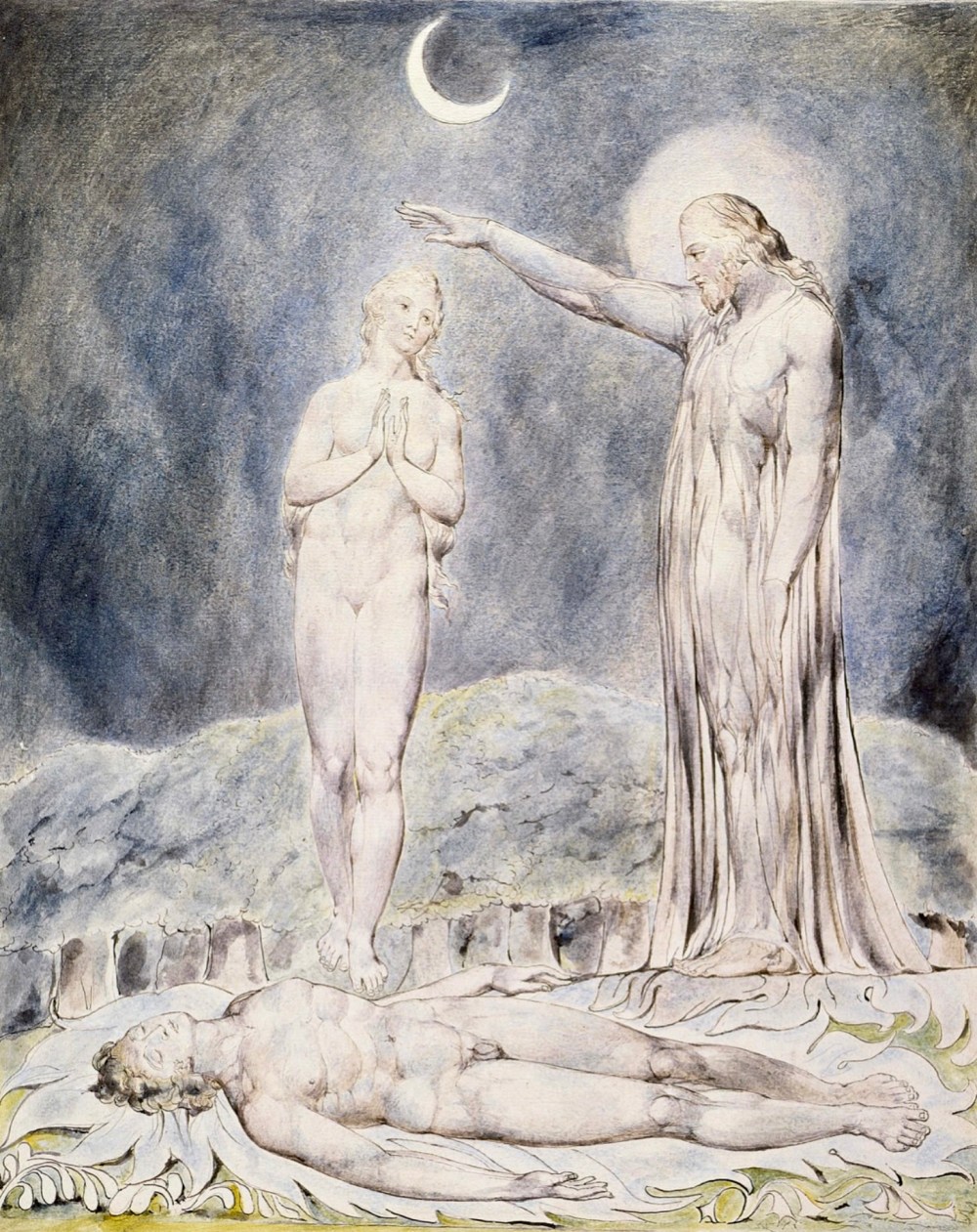
The Creation of Eve by William Blake. This image could almost be called The Separation of Binah from Chokhmah, in kabbalistic terms. As Meister Eckhart notes, according to Augustine, Eve represents or embodies “the rational faculty that is directed to external things” – the world now becomes ‘object’, separated from the observer. The separation of perceived from perceiver, form from former, creates the convincing illusion of the existence of discrete, isolated “subjects” and “objects”. This act or process of mental dissociation can be seen either cognitively (subject-object duality) or affectively (male-female duality), as primal processes of activity and receptivity/passivity are involved in both. In the “Fall into Division”, Adam became a passive perceiver, not an active imaginer, and Eternity was immediately lost to “him” (now a “him”, a “male”, not an androgynous unifier).
Blake’s Fall of the Selfhood is similarly rooted in sexual division and can be illustrated in the relationships between Los and Albion and their respective Emanations. Although implicit in Blake’s notion of Emanations is an androgynous whole, his poetry carries within it not only the prejudices of the times, but his own occasional hostility towards women and his confused attitudes toward the sexual act as being both liberating and, at the same time, an entrapment.
As Anne K. Mellors states, “Blake’s theoretical commitment to androgyny in his prophetic books is … undermined by his habitual equation or the female with the subordinate or the perversely dominant.” Ultimately for Blake, Woman is a symbol for “otherness”, as we see in the following excerpt from The Book of Urizen describing the creation or Enitharmon, the Emanation of Los:
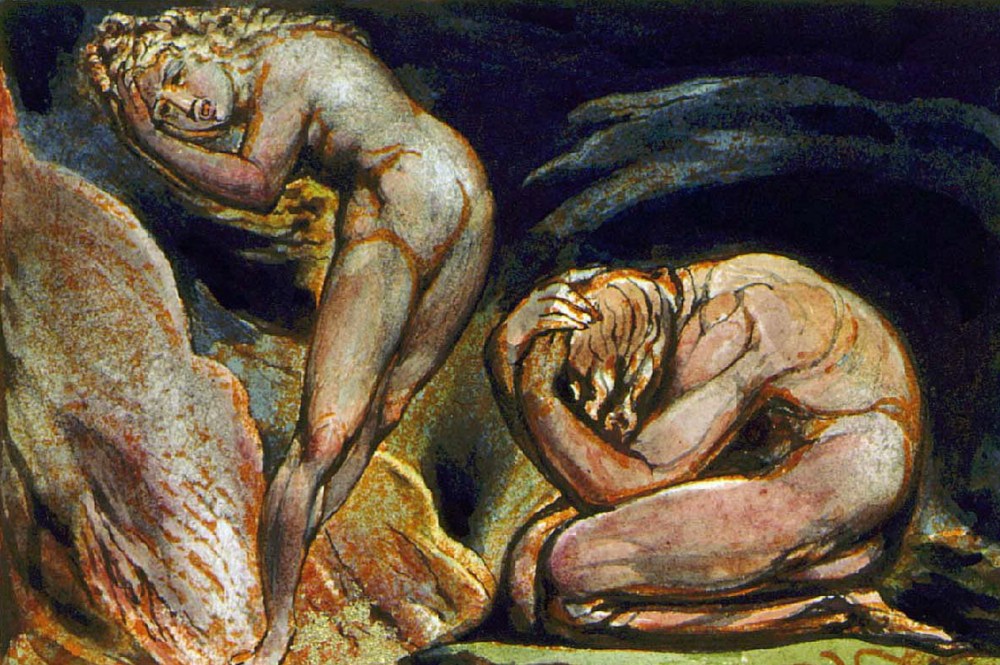
“the first Female form now separate” (The Book of Urizen). The key word, or process, here is not “Female’ but “separate”. The relationship between the (now) “two”, as Blake poignantly and powerfully suggests here, remains the dominant one: an alternate attitude of worship, estrangement, remorse, self-enclosure, and above all unconsciousness.
All Eternity shuddered at sight Of the first female now separate Pale as a cloud of snow
Waving before the race of Los
But Los saw the Female & pitied
He embraced her, she wept, she refused In perverse and cruel delight
She fled from his arms, yet he followed
Eternity shudder’d when they saw, Man begetting his likeness,
On his own divided image.
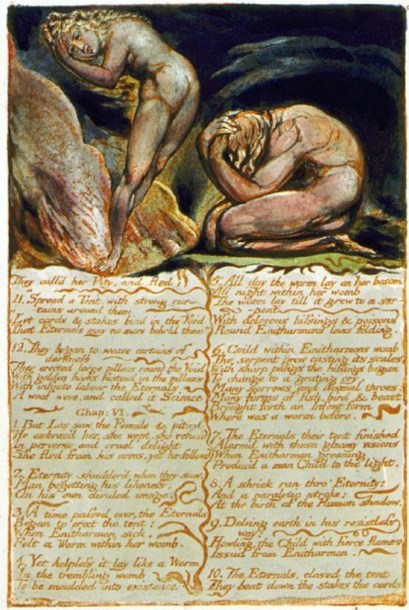
“In Plate 19 of The Book of Urizen Blake underscores his message by dividing the entire page in half, both text and figures”.
In Plate 19 of The Book of Urizen Blake underscores his message by dividing the entire page in half, both text and figures. Arising in a serpentine fashion from the flames of creation, Enitharmon is already turning inward and away from Los, who follows suit. Though he calls her “Pity”, he weeps not for her, but for the separation which has taken place within himself. It is interesting to note that in kabbalistic lore, the spiritual experience that is attributed to Binah is that of a Vision of Sorrow.
Los and Enitharmon, Chokmah and Binah, Adam and Eve all represent the active male and receptive Female principles – Force and Form, Father and Mother. Blake contends that, “In Eternity Woman is the Emanation or Man she has No Will or her own There is no such thing in Eternity as a Female Will.” Similarly, the virtue ascribed to Binah is that of Silence, which may be translated in Blakean terms to mean a lack of Will. Blake’s Female Will derives from sexual repression and the attempt to come to terms with a male dominated (and therefore one-sided) society. Rather than desiring to balance this inherently unbalanced situation, the Female Will attempts to dominate and to control the male. This control is achieved through the Female’s unnatural mystification of the sexual act and through religious and societal constrictures regarding marriage and sexuality.
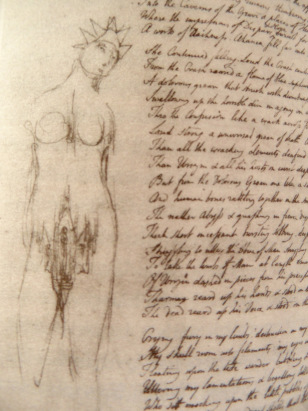
“She stands with a pointed crown upon her head and the sanctum sanctorum between her thighs. This ‘fleshy Tabernacle’ represents the unnatural mystery of sex, which is the most potent tool or the Female Will.” Religion as the product of sublimated sexuality: even its central images, structures, and architectures are perverted projections of the human body. As Blake powerfully countered, in his newly sexually restored Jerusalem, “Embraces are Comminglings: from the Head even to the Feet: And not a pompous High Priest entering by a Secret Place.”
The pencil drawing of Vala for Blake’s unpublished Vala, or the Four Zoas provides an excellent illustration of his identification of sex and religion. Vala is Blake’s whore of Babylon, a Nature Goddess who weaves the “Curtain & Veil & fleshy Tabernacle” which obscures “Divine Vision”. She stands with a pointed crown upon her head and the sanctum sanctorum between her thighs. This “fleshy Tabernacle” represents the unnatural mystery of sex, which is the most potent tool of the Female Will. In this, Vala is strikingly similar to the character or Lilith, an important figure in Jewish demonology. Scholem describes her kabbalistic role as “the seducer of men, from whose nocturnal emissions she bears an infinite number of demonic sons…. In the Zohar [she is known] as the harlot, the wicked, the false, or the black. ”
Asloob Ansari equates Albion’s relationship to Vala with the kabbalistic version or original sin quoted at the beginning of this section wherein Adam looks only at Malkuth (the Bride or the Shekhinah, representing the material world) and is therefore unable to see the totality or the Godhead.
Vala is not Albion’s true Emanation but is “a Negation … and she symbolizes the material aspect of sex as opposed to the spiritual one which is represented by Jerusalem.” Hirst sees a further kabbalistic congruence by comparing Jerusalem and Vala to the Sephiroth Binah and Malkuth who thus represent “the Upper and Lower Gardens … the Shekhinah manifested at different levels.”
Plate 25 of Jerusalem depicts Albion with the “Starry Heavens” of Eternity still present in his “mighty limbs”, however, he is surrounded and contained by three women: Rahab, Tirzah and, above him, Vala, who is hovering in a cruciform pose which suggests not salvation but ensnarement. Her hands emit strands of Vegetation, akin to a spider weaving its web. These strands are similar to the umbilicus which emerges from Albion’s navel, what Paley calls “the basic stuff of natural existence”, thus symbolizing the binding force of the mundane world. Albion’s head is thrust backward so that he can only see the face of the whore, Rahab. The configuration of his arms and legs and the covering of his genitals suggest that he, as the Eternal Man, has been rendered impotent.
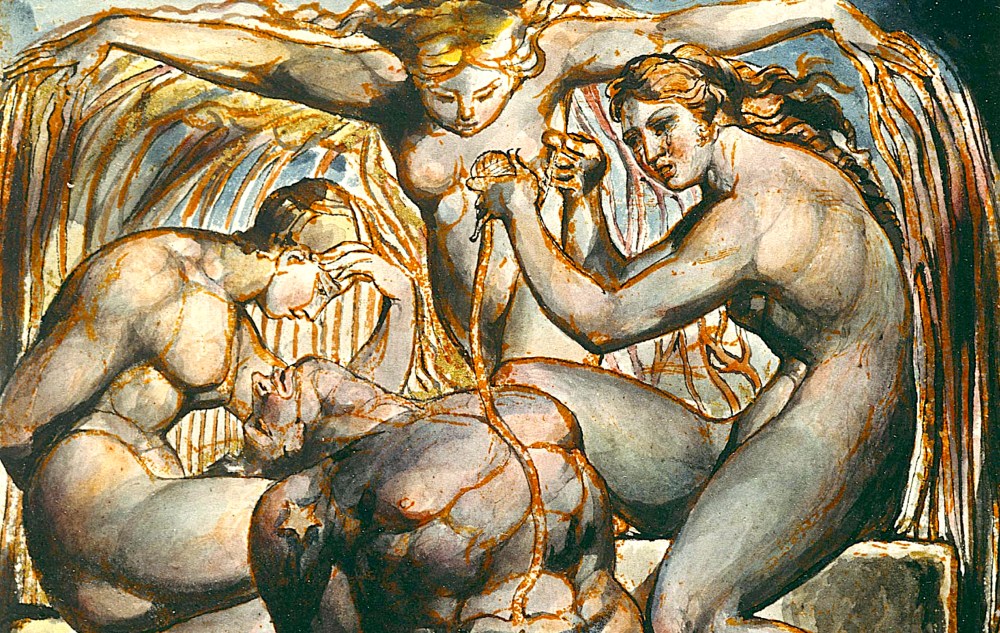
The face of modern ecology. Trapped within the endless repetition machine of ‘Nature’, which has now assumed the Domineering role of Jehovah in human consciousness, there is no way Albion can see beyond Vala’s organic Veil – what Blake terms “Natural Perception” – into the transcendent or infinite.
Vala’s Veil, her “beautiful net of gold and silver twine” is, according to Damon, “the film of matter which covers all reality.” The image of the veil, along with the image of Vegetable or organic fibers (often in the form of intestines), is as central to Blake’s visual vocabulary as it is to the language of his poetry. In Plate 46 of Jerusalem we see both Vala and Jerusalem, who is Albion’s true Emanation. Jerusalem and her daughters are gloriously and unashamedly nude, whereas Vala attempts to cover them with her veil. Although, like the Tabernacle, the veil represents the mystification of sex, it also symbolizes the allure of the material world and the deceitful nature of that world.
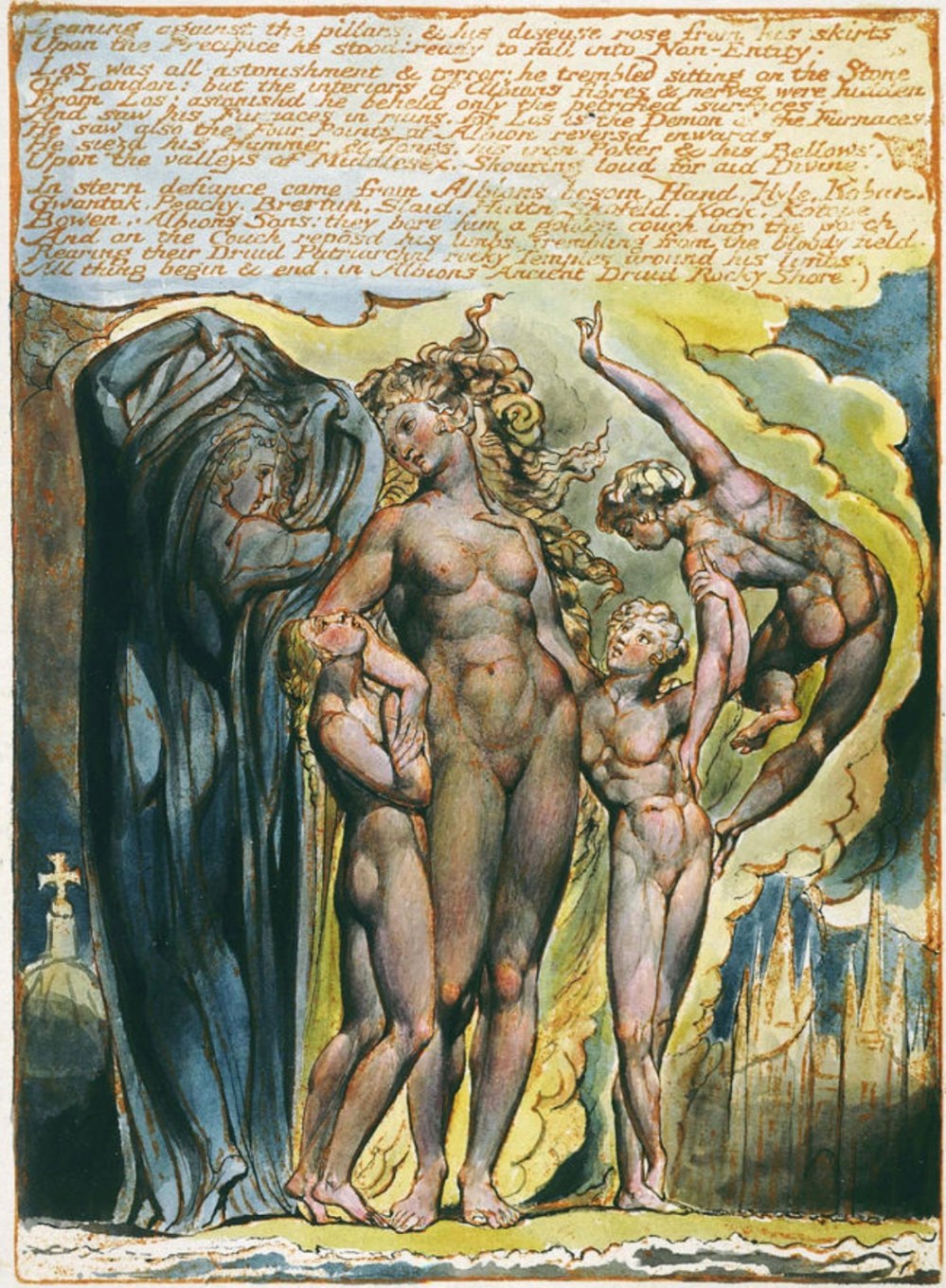
The veil that simultaneously binds and blinds us – preventing us from seeing beyond or through the natural processes and appearances to the infinite divinity rooted in our own consciousness – and which also mystifies us, making us subordinate, slavish worshippers of something the rational, civilised mind in its deep unconsciousness calls “Nature”. As ecological philosopher Timothy Morton notes, the concept of “Nature” is not itself “natural”: it is an “arbitrary rhetorical construct” that “wavers in between the divine and the material. Far from being something ‘natural’ itself, nature hovers over things like a ghost” (Ecology without Nature). This “hovering” aspect to the word is why in some cultures “Nature” is referred to as “Māyā”, a delusory veil woven over our perception of reality to ensnare us to it – what Blake terms “Vala”, or what the Book of Revelations sometimes refers to simply as “Mystery”.
If Vala represents obscurity, falsehood and division, then it is to Jerusalem that Blake looks for salvation.
Blake’s Jerusalem: A New Earth, a New Heaven, and a New Nature
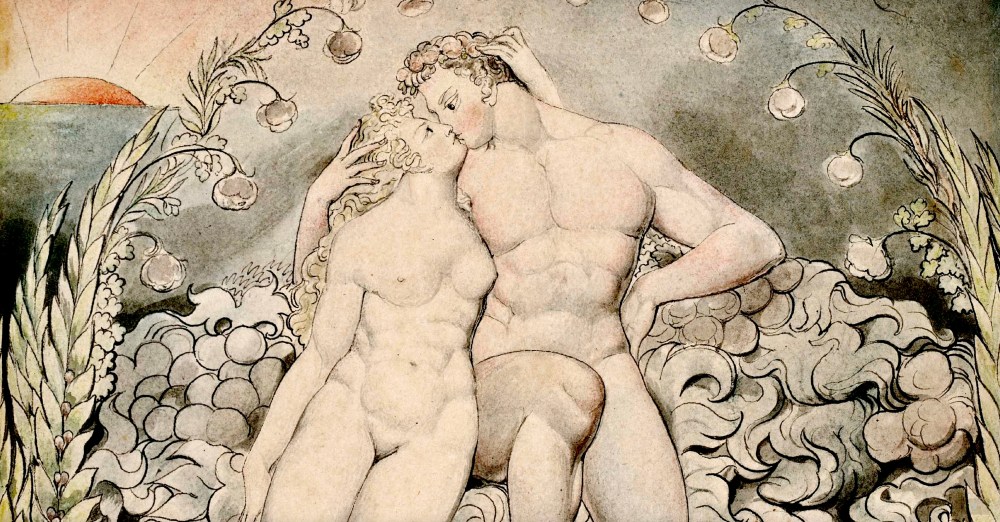
When the natural world was still inside Adamic consciousness.
This epic poem, his longest composite work, concerns the reawakening of Albion, the Eternal Man, by way of his re-unification with his Emanation, or female self. In it, Blake “marries” the English and Hebrew traditions (Albion and Jerusalem), which for him results in the victorious ascendancy of Poetic Vision. Ansari suggests that “the reunion or God and Shekhinah constitutes the meaning of redemption in the kabbalah. Just as the reuniting or Albion and Jerusalem is one of the surest signals or the attainment or paradisial bliss in the Blakean universe.” He further notes a close resemblance between Adam Kadmon and Albion based upon their androgyny. It is written in the Zohar that:
The Blessed Holy One does not place His abode in any place where male and female are not found together. Blessings are round only in a place where male and female are found, as it is written: ‘He blessed them and called their name Adam on the day they were created.’
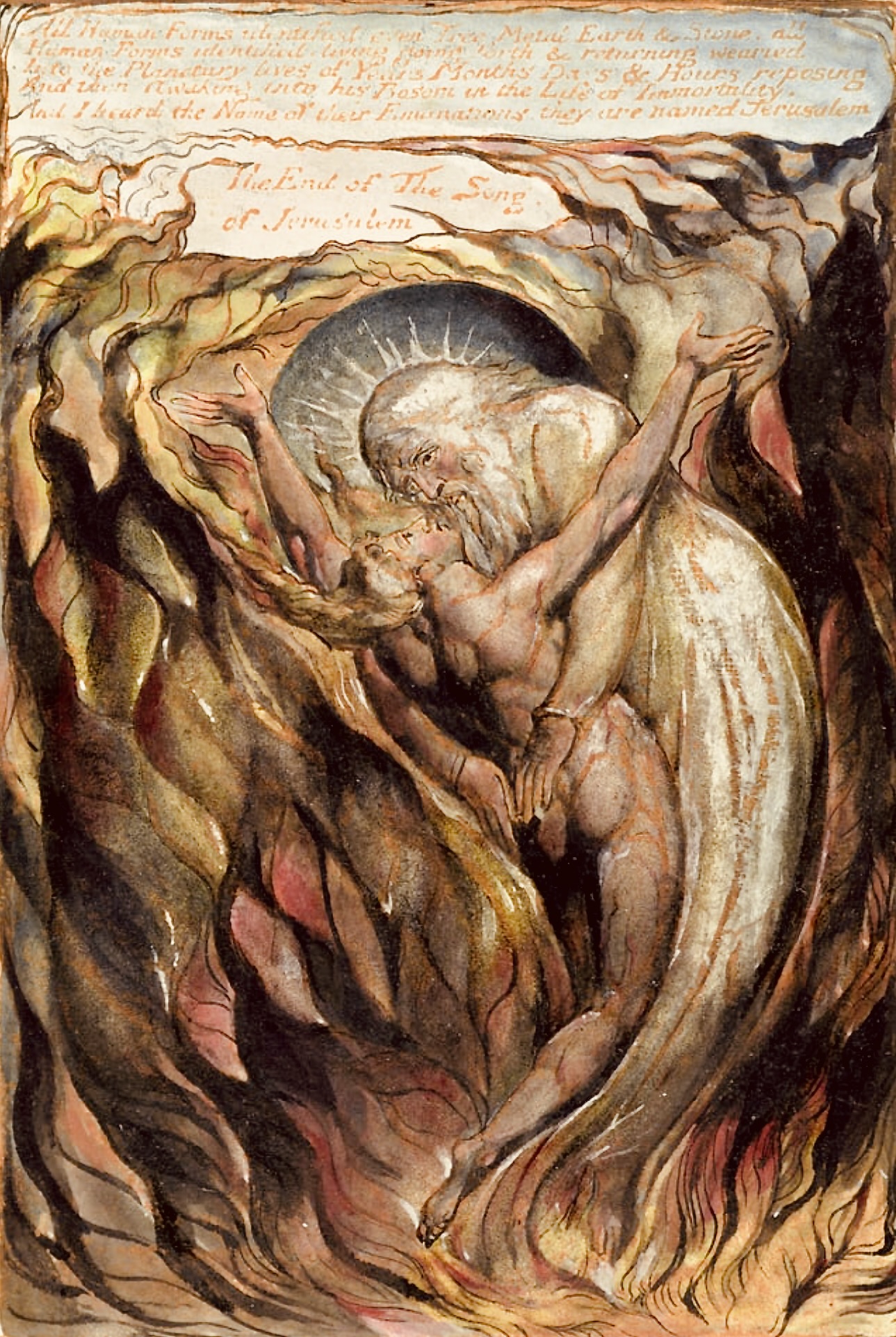
Blake used the image of the Androgyne to suggest the original state or unification (as opposed to the Hermaphrodite, who symbolized sterility and self-contradiction.) Perhaps nowhere is Blake’s use of the androgynous image so effective as in the penultimate plate of Jerusalem in which the figure of Jerusalem is depicted so ambiguously that it has been interpreted by scholars as both male and female. Albion, who now resembles a sighted Urizen, closely embraces Jerusalem so that their bodies take on a singular form. The only clue to Jerusalem’s feminine identity is her hair, which rises up behind her like the cleansing flames that engulf the figures. The positioning of her arms outward and upward underscores the regenerative nature or the image. Jerusalem and Albion are eye to eye, in mutual recognition, for it is at this moment that the male and female aspects or the personality unite to form a whole.
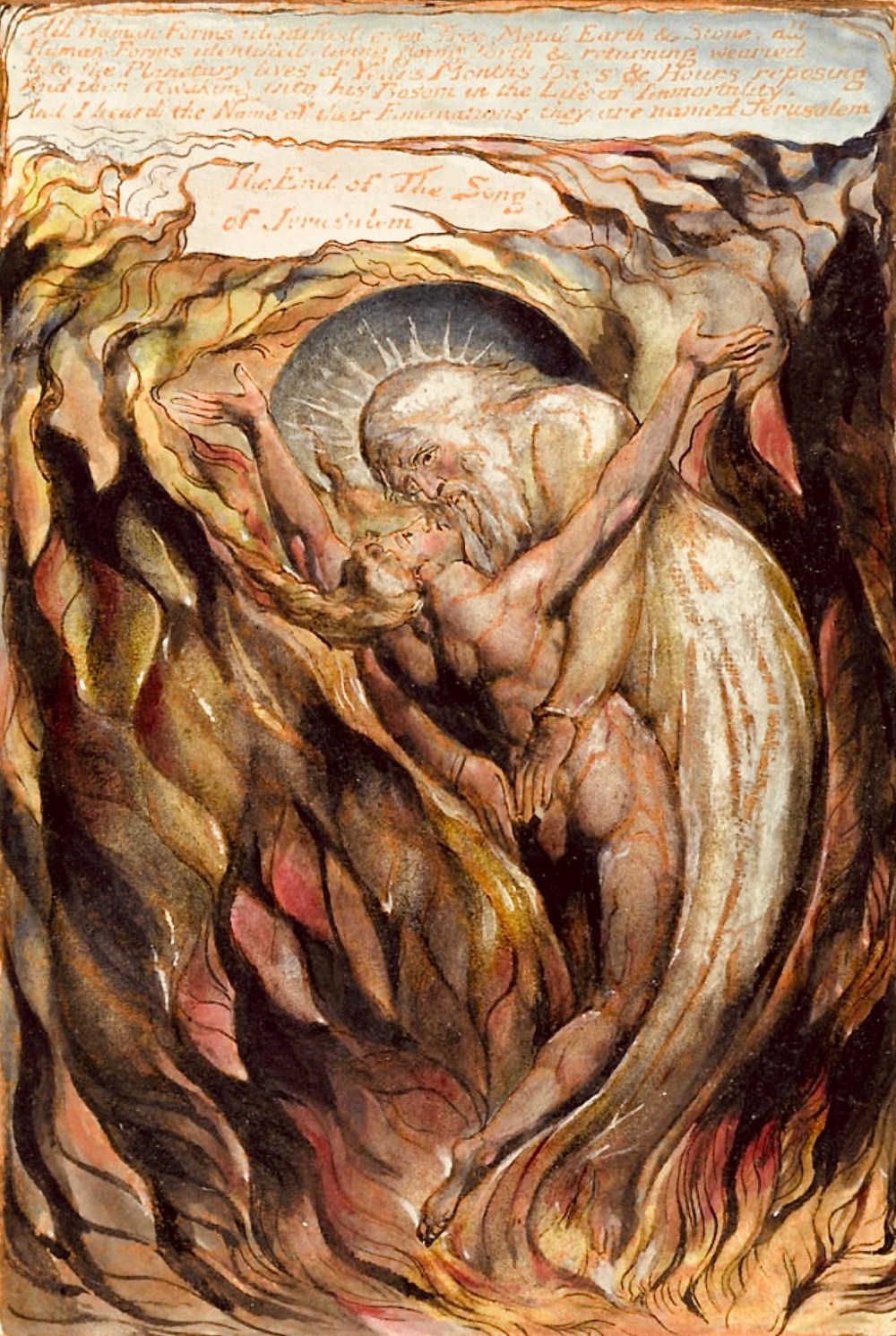
William Blake Jerusalem, Plate 99: “Albion closely embraces Jerusalem so that their bodies take on a singular form”.
The nature or this “creation” scene is better understood when we compare an earlier print entitled The Elohim Creating Adam from 1795. The term “Elohim” (which is actually plural) refers to the Creator in Genesis, who is viewed by Blake in a rather negative light. He wrote in Jerusalem that “… in [Albion’s] Chaotic State of Sleep, Satan & Adam & the whole world was Created by the Elohim.”
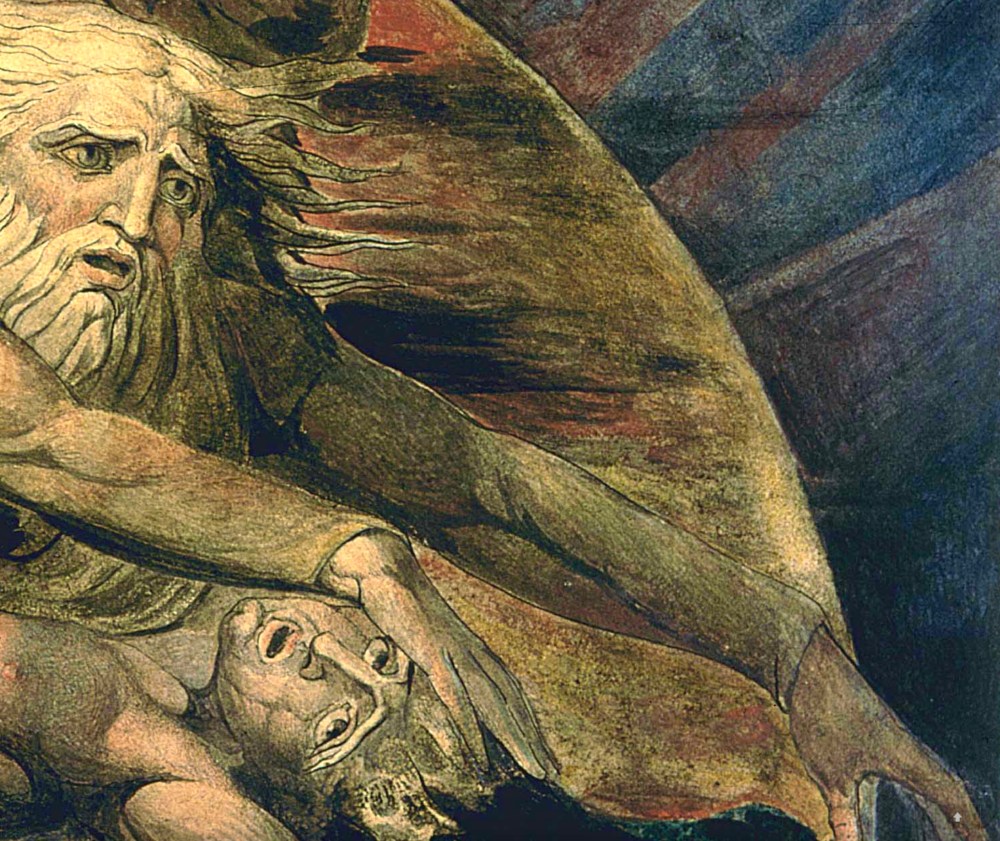
“… in [Albion’s] Chaotic State of Sleep, Satan & Adam & the whole world was Created by the Elohim.” The universe did not create itself. Our mental passivity and imaginative insignificance in it is what creates it.
In the print, the Creator, in his Urizenic aspect, hovers over his creation, who is already bound by the mortal coils or material existence (“The vast form of Nature [is] like a Serpent.”) Rather than rising upward like Albion and Jerusalem, the Creator and Adam are horizontally confined by the semicircular sun whose rays attempt to pierce the dark and cloudy sky. They do not embrace and, in fact, Adam’s arms are flung downward and away from the creative force. They do not look at each other and yet both faces reflect a similar agony. If, as Blake suggested, God resides within the human breast, then we are witness to the creation of man in the material world as the division of man and God. It is only when all aspects of the individual reunite, male and female, human and divine, that an “awakening to Eternal Life” can occur.
It is written in the Zohar that, “Every form in which the male and female principle is not found, is not a higher or completed form.” The sephirotic balance which exists between Chokhmah and Binah is paradigmatic. The story of Jerusalem is, in part, the culmination of Blake’s desire for sexual harmony in his own life. As the artist/engraver, the character or Los is often associated with Blake himself. Enitharmon is then, as Paley suggests, on one level Catherine Blake. “The myth of this quarrelling couple occupies much space in Blake’s later works, but when they work together in harmony they produce beautiful ’embodied semblances’ – the illuminated books.”
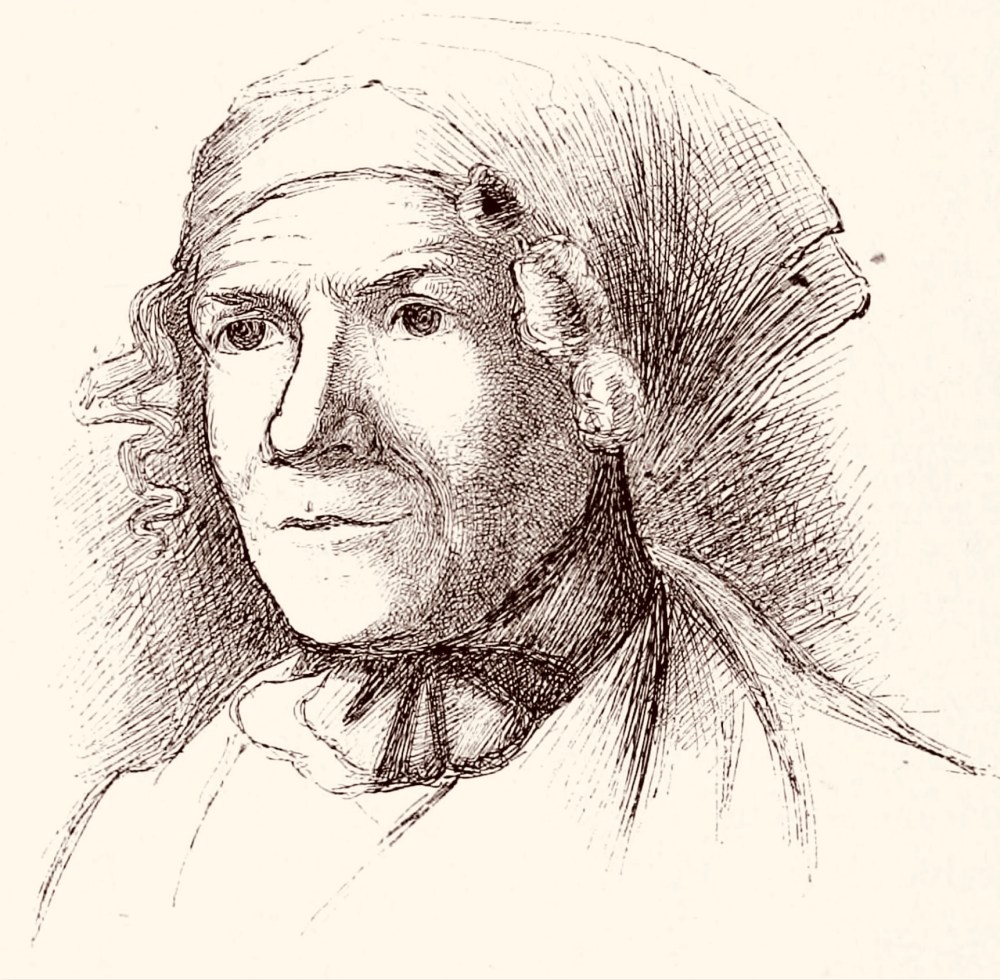
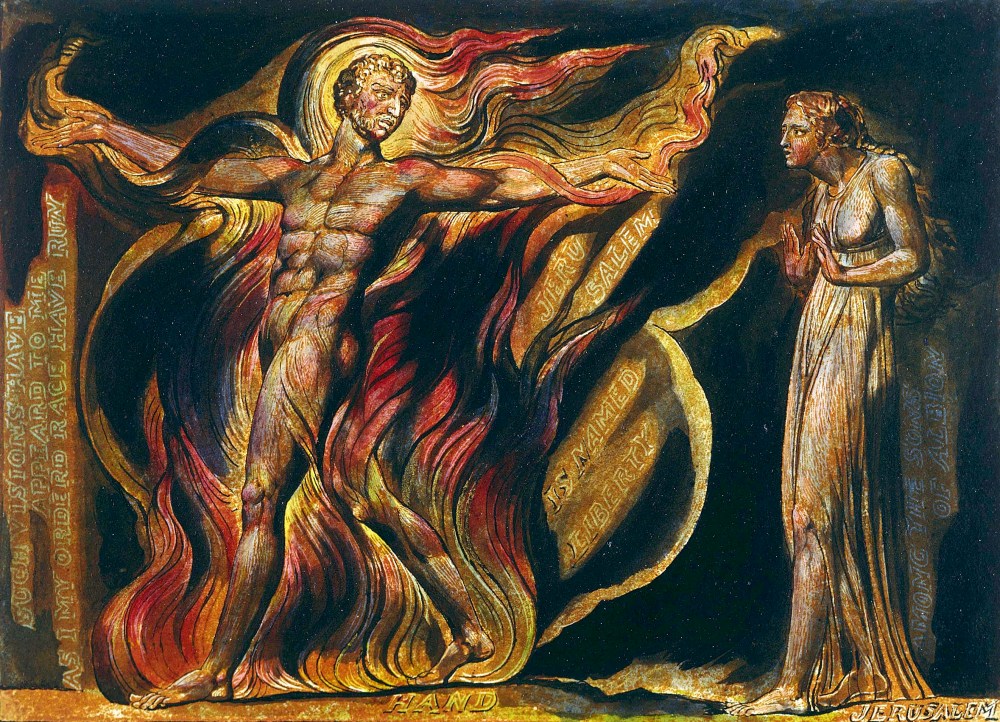
Frederick Tatham’s drawing of Catherine Blake, September 1828. The connection between Blake’s remarkable ideas on emanations, the division of the sexes, Adamic consciousness, and the nature of love and jealousy, and incidents and experiences in his own personal life has been notably under-explored in Blake scholarship. The subtitle of Blake’s abandoned masterpiece of the late 1790s, The Four Zoas, was ‘The torments of Love & Jealousy in The death and Judgment of Albion the Ancient Man’. Torments of Love and Jealousy. The poem itself clearly suggests Blake’s profound existential dismay and horror at how jealousy can poison and destroy both a human mind and a human relationship, and his psychological and spiritual need to get at the root of it. Not much is known about his actual relationship with his wife Catherine. Blake’s earliest biographer Alexander Gilchrist alluded to unspecified troubles in the early years of the relationship, perhaps involving issues of children and free love (Blake, like Mary Wollstonecraft, held that orthodox marriage was a patriarchal institution rooted in property law – the wife being the property of the man – and designed to keep women as slaves). Moreover, one wonders what they talked about, or if indeed they talked much at all. Seymour Kirkup (who had met the Blakes at the home of his patron Thomas Butts) later recorded that Catherine had “told me seriously one day, ‘I have very little of Mr. Blake’s company; he is always in Paradise’”. In many ways, Blake’s later works exploring the psychodynamics of male and female, emanation and projection, rational spectre and demonic possession, are the record not only of his spiritual life but also his personal journey towards the possibility of freedom within love. “This is Jerusalem in every Man, ” he wrote in his great poem Jerusalem. The Emanation of the Giant Albion, “A Tent & Tabernacle of Mutual Forgiveness Male & Female Clothings. And Jerusalem is called Liberty among the Children of Albion.”
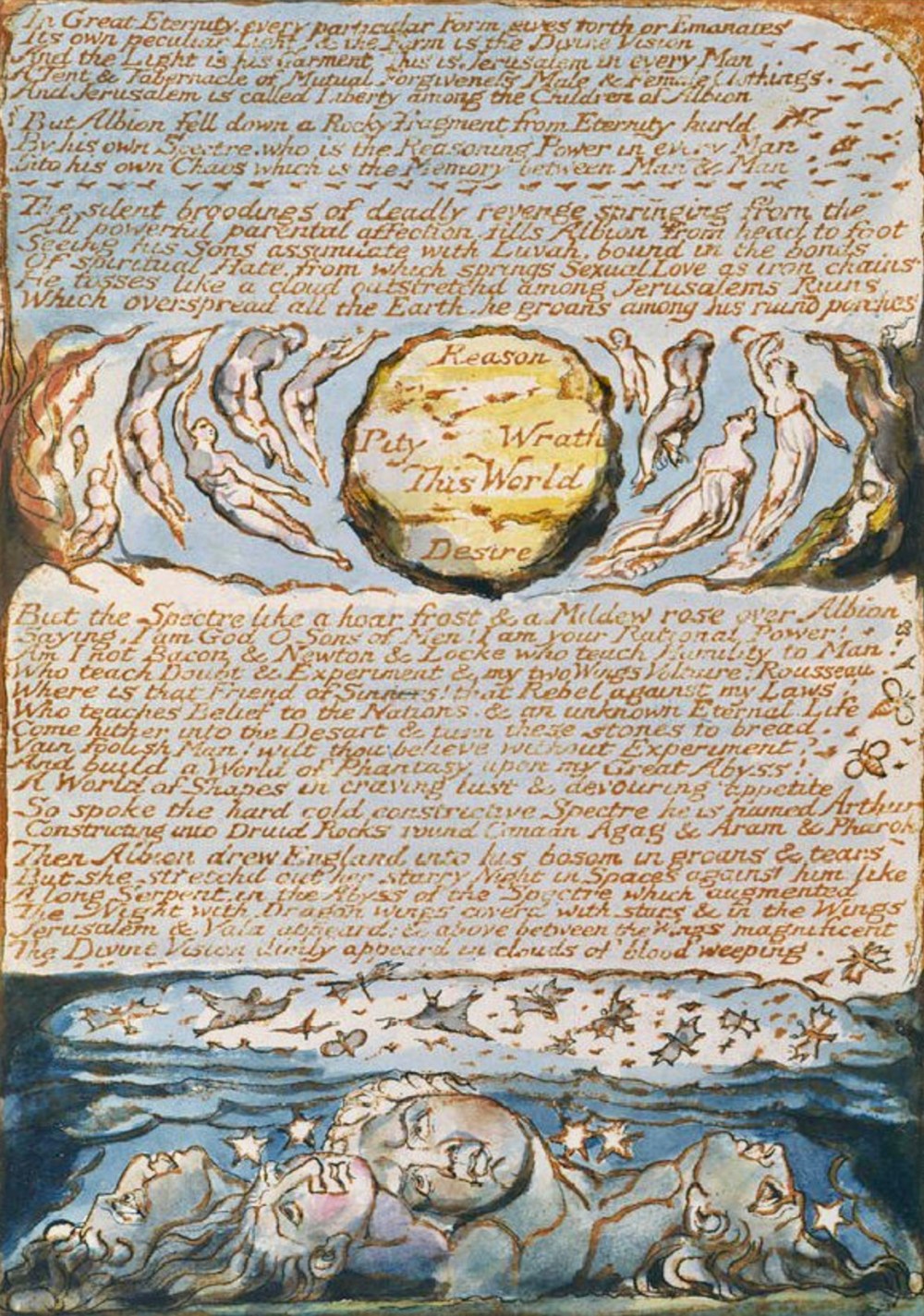
“And Jerusalem is called Liberty among the Children of Albion”
This is an edited version of ‘Divine Imagination: Correlations Between the Kabbalah and the Works of William Blake’, by Mikell Waters Brown. To read the full article, which is available open access by the Graduate School at VCU Scholars Compass, please click here.
 thehumandivinedotorg