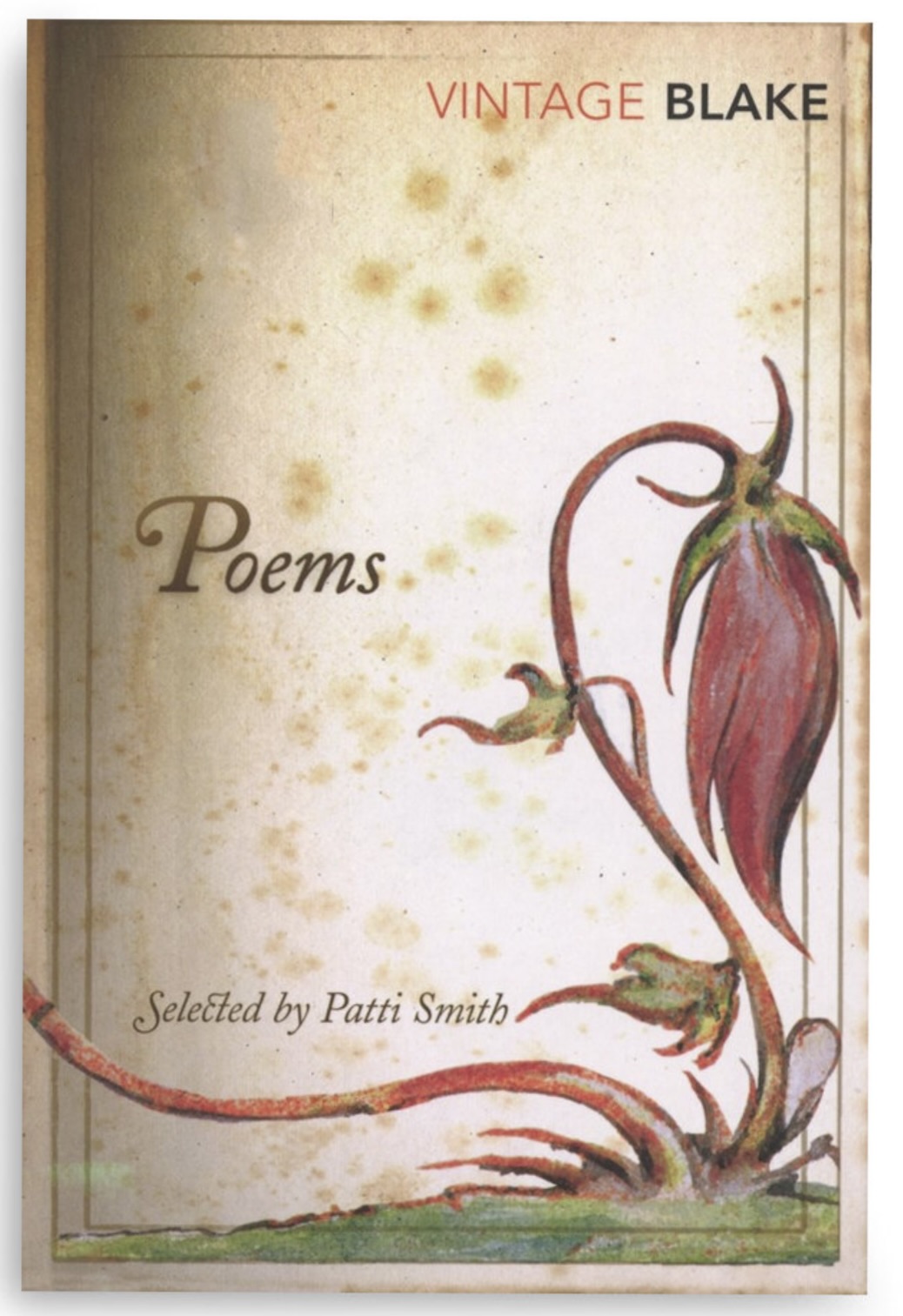
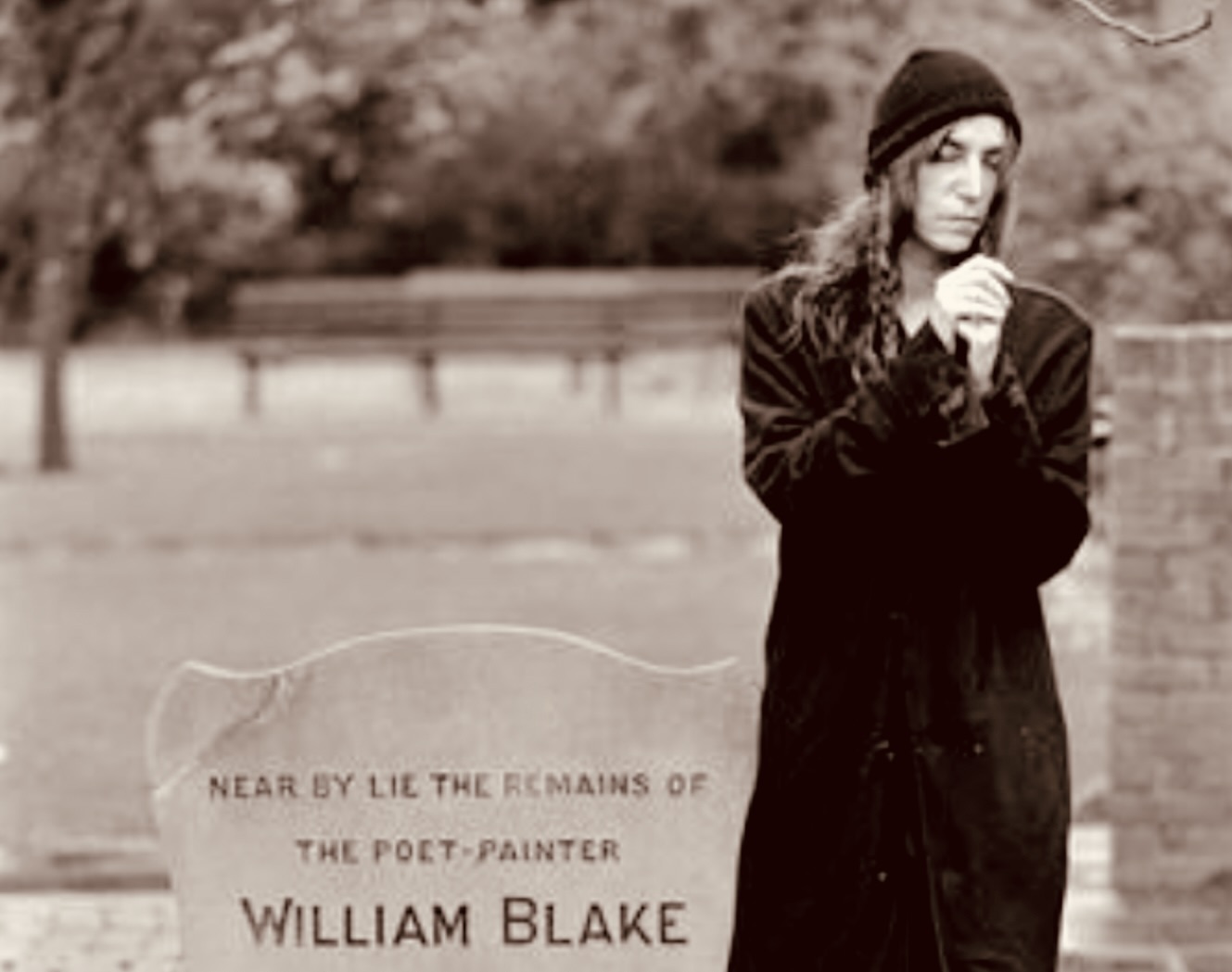
William Blake and Me, by Patti Smith

Embrace what you Fear: Being with Blake
Screen Shot 2021-05-10 at 10.39.26

My Introduction to Blake

“I can’t imagine my childhood without him. His poems were my companions, my friends. I had pneumonia, I contracted TB, scarlet fever, every childhood disease. And my two favourite books were William Blake’s Songs of Innocence and Experience, and the children’s poems of Robert Louis Stevenson.” In 2007, to celebrate the 250th anniversary of Blake’s birth, Smith edited a selection of his verses simply titled Poems — “a bit of Blake, designed as a bedside companion or to accompany a walk in the countryside, to sit beneath a shady tree and discover a portal into his visionary and musical experience.”

My mother gave me Blake. In a church bazaar she found Songs of Innocence, a lovely 1927 edition faithful to the original. I spent long hours deciphering the calligraphy and contemplating the illustrations entwined with the text. I was fascinated by the possibility that one creates both word and image as did Blake, with copperplate, linen and rag, walnut oils, a simple pencil.

My father helped me comprehend this childless man who seemed to me the ultimate friend of children, who bemoaned their fate as chimney sweeps, labourers in the mills, berating the exploitation of their innocence and beauty.

Through my life I have returned to him.

When Allen Ginsberg lay dying, I was among those who sat vigil by his bedside. I wandered into his library and randomly chose a book, a volume of Blake in blood-red binding. Each poem was deeply annotated in Allen’s hand, just as Blake had annotated Milton. I could imagine these prolific, complex men discoursing; the angels, mute, admiring.

William Blake felt that all men possessed visionary power. He cited from Numbers 11:29: “Would to God that all the Lord’s people were prophets’. He did not jealously guard his vision; he shared it through his work and called upon us to animate the creative spirit within us.


Read More

Through the Round Window: Review of Carol Leader’s ‘Blake and the Therapists’, by Rod Tweedy

A Review of ‘Unfolding the Mythological Unconscious: An Illuminated Talk’ by Carol Leader

Screenshot 2022-07-07 at 20.10.46

Screen Shot 2021-05-10 at 10.39.26

Introduction: William Blake and Therapy

“Was William Blake mad?” is the usual question that comes up in any discussion of Blake and therapy. What was fascinating about psychoanalytic psychotherapist Carol Leader’s talk at the Blake Society event at the Freud Museum was the way in which she explored this connection between ‘Blake and the Therapists’ on a new and much more profound level. Indeed, her presentation was so thought-provoking that it makes you wonder why more hasn’t been written on this connection. As Tim Heath noted in his introduction to the talk, “whenever you converse with William Blake, whenever you dive into his work, it immediately becomes apparent why Blake intimated the coming of therapy.”

Read More

FEARFUL SYMMETRY: William Blake and Sacred Geometry, by Rod Tweedy

The Human Form Divine: Sacred geometry and its relationship to our physiology


Section 1: The Nature of Sacred Geometry

Measuring Urizen: The geometry of geometry

This first section explores what is meant by “sacred geometry”, studying and measuring its terms in relation to the study of physiology, the ‘science of life’. It therefore provides a sort of “geometry of geometry”. This seems apposite: the very idea of measuring is after all embedded in the word “geometry”, which comes from the ancient Greek words Geos, meaning “Earth”, and Metron, meaning “to measure”. The act or assumption of measurement is therefore contained within the system that is used to measure reality. Urizen thereby inscribes itself in the very utensils it uses to explore the deep: as Neil Postman acutely observed, “within every technology there is embedded an ideology” (Technopoly: The Surrender of Culture to Technology). These sorts of isomorphic (or “fractal”) repetitions and self-reflections constitute one of the defining characteristics of sacred geometry.

Sacred geometry is usually understood as the science and study of the fundamental patterns, shapes, forms, proportions, and ratios that constitute the basic nature of physical, physiological, and psychological reality. In ancient traditions, these geometries were considered ‘sacred’ because they recurred with such remarkable frequency and on so many different levels, thereby seeming to suggest a ‘hidden order’ to the world. As Skinner notes, “geometry and numbers are sacred because they codify the hidden order behind creation”. As such, they were sometimes considered to reveal the “mind” of God: as Galileo succinctly put it, “Mathematics is the alphabet with which God has written the universe.”

Read More

Poetry and Madness: Blake, Eigen and the Psychotic God, by Peter Anderson

Ecstasy and Psychosis: Who We Really Are

ECSTASY-1

In many ways, I believe that Michael Eigen is attempting to restore to psychology a dimension suppressed by the scientistic ambitions of the academicized discipline, where the drastic attempt to reduce language to a vehicle for hard data makes of language itself nothing but an empty shell, good only to serve as a frame for the apparent objectivity of statistics. Where Freud could only grudgingly wonder at poetry as a form of psychological gnosis, Eigen understands that poetry—and, very possibly, therapy, too—has the function of revealing who we are. “Poetry”, he says, “is dusting off the true self”.

Read More