The Political Self: Understanding the Social Context for Mental Illness

Integrating the Inner and the Outer: How Society Shapes Who We Are

Banksy-artwork-collage

In my 2017 book, The Political Self: Understanding the Social Context for Mental Illness (Routledge), I explore how our social and economic contexts profoundly affect our mental health and well-being, and how modern neuroscientific and psychodynamic research has significantly developed our understanding of these wider discussions. The book therefore looks both inside and outside—indeed one of the main themes of the volume is that the conceptually discrete categories of “inner” and “outer” in reality constantly interact, shape, and inform each other. Severing these two worlds, it suggests, has led both to a devitalised and dissociated form of politics, and to a disengaged and disempowering form of therapy and analysis.

brain-glass

“Rather than separating our understanding of economic and social practices from our understanding of affective development and human development, we need to bring them together, to align them: we need to realise that politics, the external world, is not a world without an ‘inner’.”

Drawing on a number of leading figures in these fields, including Iain McGilchrist, Sue Gerhardt, David Smail, Nick Totton, Joel Bakan, Nick Duffell, Dave Grossman, Joel Kovel, Jonathan Rowson, and James Hillman, the book argues that we need to understand people and their psychological distress in an essentially social and environmental context. Rather than separating our understanding of economic and social practices from our understanding of affective development and human development, we need to bring them together, to align them: we need to realise that politics, the external world, is not a world without an “inner”. And for this to happen, we need a new integrated model for mental health, and a new politics: we need a new dialogue between the political and personal worlds, and a recognition of how psychotherapeutic practice and the psyche both shape and are powerfully shaped by existing structures and interests.

Read More

The Marriage Hearse: Blake, Jesus, and the Critique of Marriage and Family Values

Why Mr Blake Cried: Monogamy, Matrimony and the Mind-Forg’d Manacles
Screen Shot 2021-08-02 at 21.26.33-OK

Screen Shot 2021-07-03 at 23.31.28

Screen Shot 2021-07-01 at 22.47.03-The-Modern-Family

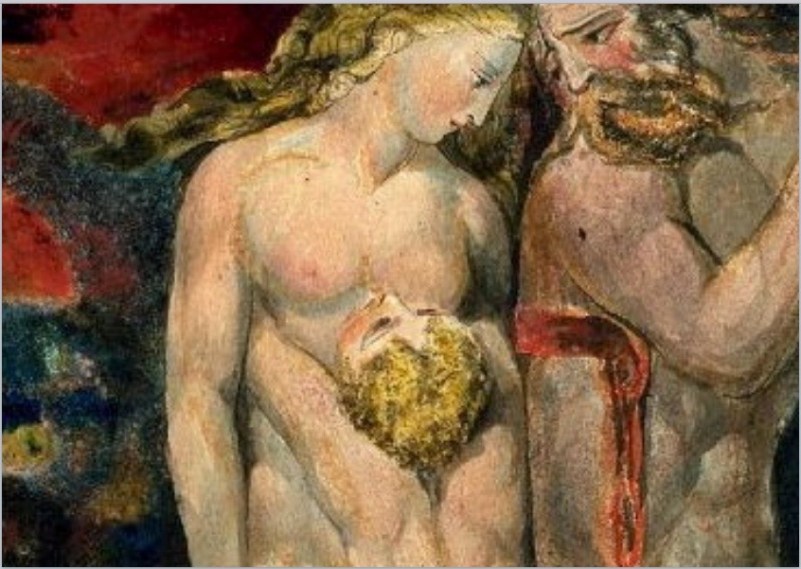
In his fascinating exploration of the ideological status and function of traditional marriage and the role of ‘family values’, American theologian Theodore W. Jennings shows how in the Bible Jesus actually radically subverts these institutions and ways of relating, seeking to replace them with more inclusive, equal, and genuinely socially integrative forms of living. It is interesting in this respect that one of the first things that many spiritual communities do is to replace the atomising, inward-looking, emotionally toxic and politically hierarchical structure of the ‘family’ with more open and egalitarian forms of living. Though in contemporary society, as in Jesus’s day, ‘The Family’ is held up as integral to its power structure and affective organisation of stratified, socially isolated, and authority-based dynamics, which the institution of The Family both transmits and reflects, another way of living, and of being is possible. 

Breaking the ‘mind-forg’d manacles’ that weld us to these old ways of thinking – and more importantly ways of feeling – was one of the central tasks of Jesus’s mission, and was both echoed and developed by the generation of radical poets and thinkers of Blake’s day, including Shelley, Mary Wollstonecraft, Rousseau, and of course Blake himself.  Before a more awakened and liberated form of society can emerge, Blake suggests, we have to transcend our existing shackles (it is no coincidence that Jennings for example calls one of his chapters ‘Marriage, Family, and Slavery’ – echoing Wollstonecraft’s earlier critique of this institution for the regressive and imprisoning situations and spaces it generates). And in order to do that, we first need to understand what the concept of The Family actually is. 
Read More

How Morality Damns Us: Blake and the Tree of Good and Evil, by Erik McCarthy

Going Beyond Good & Evil: Restoring Eden in the Brain 

Screen Shot 2021-06-29 at 15.24.05

Screen Shot 2021-06-29 at 15.13.37-thisScreen Shot 2021-06-29 at 19.42.36

Screen Shot 2021-05-10 at 10.39.26

Introduction: Blake’s Laocoön and the serpents of Morality 

Screen Shot 2021-03-02 at 21.57.19

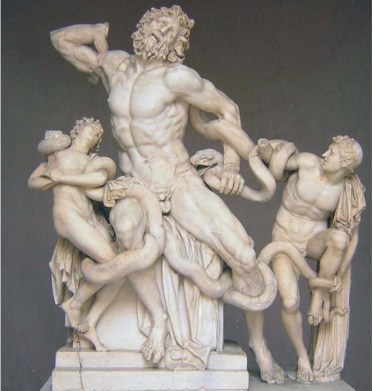
The original Laocoön. In Blake’s reading, the serpents overcoming the priest represent the twin Powers or programs of “Good” and “Evil”, which eventually suffocate him, and his vision of God.

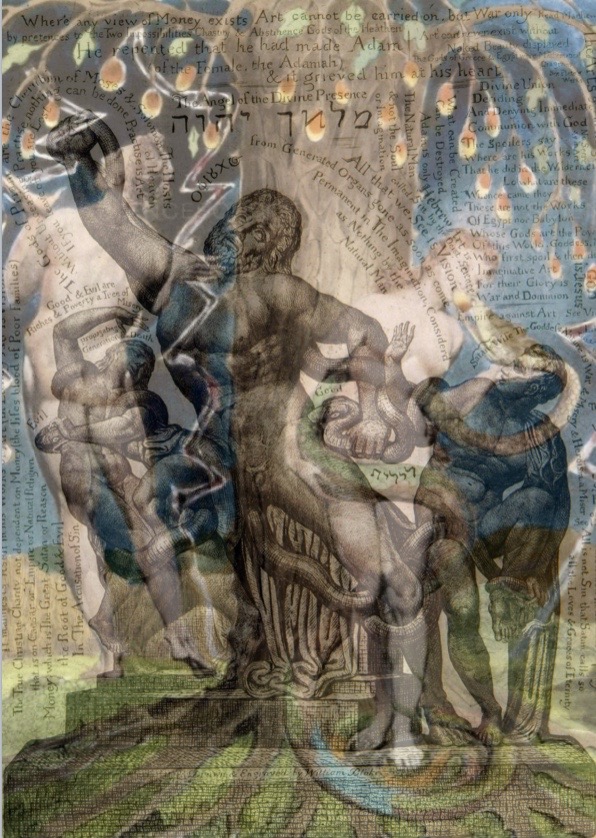
The question, and questioning, of morality, is central to one of Blake’s most iconic and futuristic images, the Laocoön. Even though Blake’s best-known works often combine image and text in a single plate, the Laocoön stands apart as the only one to be centered around a faithful copy of a piece of antique sculpture, a fact which attests to its hold on his imagination.

Another arresting feature of the plate is the atypical density of its textual matter, composed in at least two distinct scripts and three different languages, and the seemingly arbitrary, discontinuous manner of its arrangement on the page. Julia Wright observes, “the design recalls a jigsaw puzzle more than a page from an emblem book, graffiti more than an engraving, and marginal annotations more than aphorisms on art” . 

It resembles no other work by Blake, and he left no instructions on how his wide-ranging statements should be organized, or in what order they should be read. Without an obvious starting point, one could try a conventional approach, beginning with the first line of horizontal text at the top of the page: “Where any view of Money exists Art cannot be carried on but War only”; but then one could just as well start at the bottom, with the caption identifying the three figures as “הי & his two sons Satan & Adam.” Either way, the reader is sure not to get far before having to stop and decide where to begin again; and from there one choice seems as good as another.

Read More

Blake and the Zodiac, by Rod Tweedy

Here Comes the Sun King: Forging the Template of Solar Consciousness

Screen Shot 2021-01-22 at 20.05.21-THIS (1)

Screen Shot 2021-05-18 at 22.35.53

Screen Shot 2021-01-23 at 18.11.23

Introduction: The Forms and the Archetypes of Being

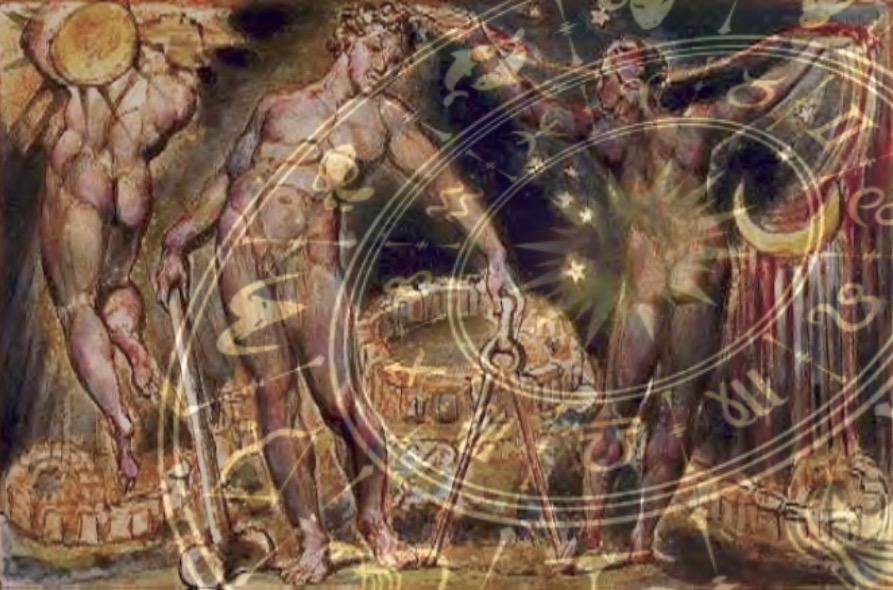
There’s a fascinating tradition of thought that links early formulations of the twelve aspects or ‘faces’ of the Zodiac with Plato’s esoteric theory of the Forms, the fundamental geometries and patterns which generate our world, and which casts an intriguing light on the original meaning of the Zodiacal Signs and their significance.

Read More

William Blake and The Body of Vision, by Rosalind Atkinson

Vision and De-Vision: Sexuality, Slavery, and the Fall of Perception

Screen Shot 2021-05-10 at 10.33.55

Screen Shot 2021-05-10 at 10.33.33

Screen Shot 2021-05-10 at 13.52.03

Screen Shot 2021-05-10 at 10.39.26

Introduction to William Blake’s Visions of the Daughters of Albion

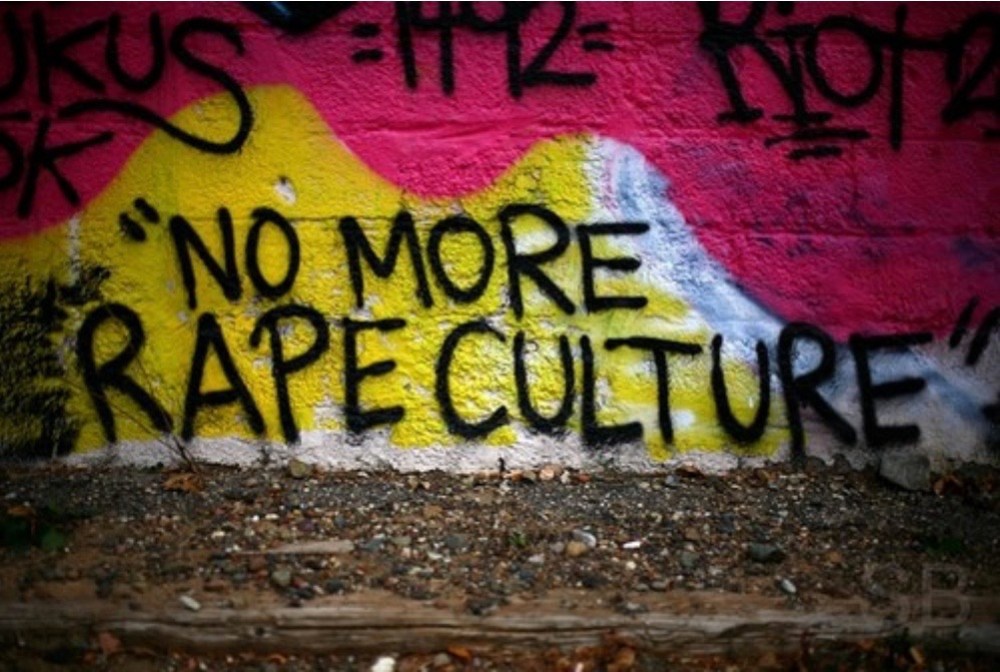
This essay examines how almost the entire critical discussion of Blake’s Visions of the Daughters of Albion enacts the exact dynamics (which we could anachronistically label ‘rape culture’) that the poem itself dramatises in order to dissect. I hope it can be of interest beyond Blake enthusiasts to anyone wanting to understand if being interested in ‘how we perceive’ affects our political and social ideas and positions, and to anyone interested in how dualistic ways of seeing (encompassing transcendence and materialism equally) abuse our bodies and the world.

Read More

William Blake on Self and Soul, by Laura Quinney

William Blake and the illusion of Selfhood

Screen Shot 2020-07-08 at 16.48.26

Screen Shot 2020-07-08 at 16.52.46

MAIN PIC_Screen Shot 2021-04-29 at 18.42.06-David Attenborough

Screen Shot 2021-05-03 at 18.19.47-paragraph-break

Introduction: Blake the Radical Psychologist

It has always been clear that William Blake was both a political radical and a radical psychologist. The most illuminating interpretations of Blake— by Northrop Frye, Harold Bloom, Brian Wilkie, and Mary Lynn Johnson, to name a few— emphasize his subtlety and innovation in the understanding of human psychology.

This article addresses what Blake said about a specific aspect of psychology— a reflexive aspect, deeper and stranger in itself than thought and feeling— the subject’s experience of its own interiority. What is the self’s relation to itself?

Blake thought that under certain conditions, it was bound to be anxious and lonely. That is, he thought that if the self is identified with the main consciousness or “I,” especially the “I” as a center of rationality, it will feel solitary and insecure.

Read More

Creative Imagination and Mystical Experience in the Sufism of Ibn ‘Arabî, by Henry Corbin

God as Imagination: the Image and the Imaginer in the Sufism of Ibn ‘Arabî

Screen Shot 2021-04-21 at 14.31.08

Screen Shot 2021-04-21 at 12.19.30

Screen Shot 2021-04-21 at 14.14.50

screen-shot-2021-04-21-at-17.33.55

.

Introduction: Ibn ‘Arabî and Islamic mysticism

Screen Shot 2021-04-21 at 12.13.24According to Professor Henry Corbin, one of the 20th century’s most prolific scholars of Islamic mysticism, Ibn ‘Arabî (1165–1240) was “a spiritual genius who was not only one of the greatest masters of Sufism in Islam, but also one of the great mystics of all time.”

Imagination (khayâl), as Corbin has shown, plays a major role in Ibn ‘Arabî’s writings. In the Openings, for example, he says about it, “After the knowledge of the divine names and of self-disclosure and its all-pervadingness, no pillar of knowledge is more complete”.

Read More

William Blake, Nick Cave, and the Origins of Creativity

Nick Cave on William Blake: Where does Creativity come from? 

Screen Shot 2021-01-16 at 19.04.40-THIS

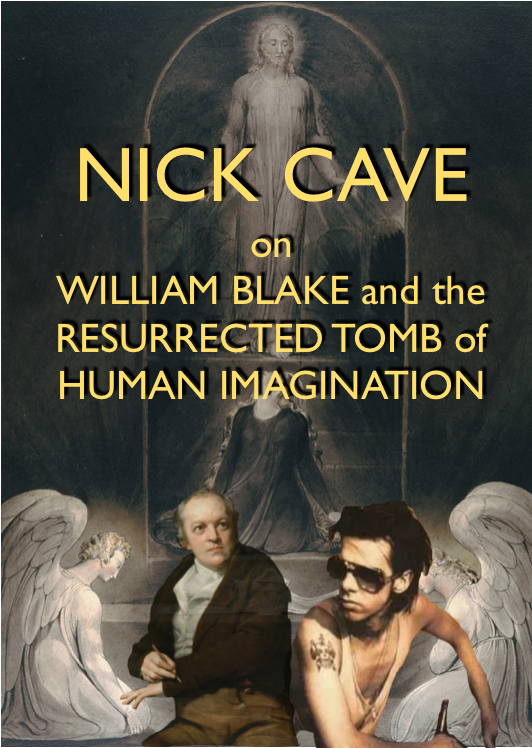
The Australian musician and songwriter Nick Cave, responding on his website ‘The Red Hand Files‘ to the question ‘How do you know when you have written something worthwhile? What is your process?’, remarks that Blake’s insights into the nature of Imagination and the imaginative process were key to him in this:

In Issue #87 I wrote about my favourite line from the New Testament: ‘Mary Magdalene and the other Mary remained standing there in front of the tomb.’ To me, this line seems to sum up, among other things, the process of songwriting. William Blake said ‘Jesus is the imagination’ and these words have always resonated with me. They have bound together the notion of Jesus and the creative act, and lifted it into the supernatural sphere.

The moment of the cave.

This is a surely a fascinating observation, and connection. Why particularly that line from the Bible, that stood out for him so much, amid so many other striking lines? What was it about the image of the tomb, or the sense of both the possibility of emptiness and of emergence, the moment of waiting or expectation, that so resonated with him?  Was it some sort of analogy between the resurrected tomb and the cave of creativity, of ‘Imagination’? Thankfully, Cave himself provided some further illumination:

A large part of the process of songwriting is spent waiting in a state of attention before the unknown. We stand in vigil, waiting for Jesus to emerge from the tomb — the divine idea, the beautiful idea — and reveal Himself.

Cave’s sense that there is something ‘transcendent’ about our creative moments and experiences is very striking, and very unexpected in our commercialised, cynical, post-modern age. And also unexpected in an artist not writing from any orthodox religious perspective (“I’m not religious, and I’m not a Christian,” he once remarked, “but I do reserve the right to believe in the possibility of a god.”) Cave is aware that there is something profoundly strange about creativity, something mysterious (or “supernatural” as he puts it) about the process by which songs, and images, and poetry, emerge out of, apparently, thin air. Cave suggests that Blake is right to connect them not to material or mundane processes in this world but to something altogether deeper and more mysterious.

Read More

Blake, Misunderstood? Review of Olga Tokarczuk’s ‘Drive Your Plow over the Bones of the Dead’

Josephine A. McQuail reviews Olga Tokarczuk’s award-winning Blakean novel Drive Your Plow over the Bones of the Dead (translated by Antonia Lloyd Jones. Riverhead Books, 2009; translation © 2018)

Images from Spoor, the 2017 Polish film directed by Agnieszka Holland, adapted from the novel Drive Your Plow Over the Bones of the Dead by Olga Tokarczuk. Above: Agnieszka Mandat and Miroslave Krobot (Photo: Palk Robert/Next Film); Below: poster for the film (Photo: (WP:NFCC#4).

Olga Tokarczuk won the 2018 Nobel Prize for Literature in 2019 (the prize was delayed, due to various scandals involving some members of the Nobel Prize Committee). Her 2007 novel Flights was translated into English finally in 2018, winning the Man Booker Prize, and paving the way for the Nobel Prize.

Tokarczuk’s novel Flights won the Man Booker Prize in 2018

Tokarczuk speculated, “Sometimes I wonder how my life would have worked out if my books had been translated into English sooner … because English is the language that’s spoken worldwide, and when a book appears in English it is made universal, it becomes a global publication” (quoted in Armitstead). 

As anyone who has read Blake’s Marriage of Heaven and Hell and remembers “The Proverbs of Hell” will recognize, the title of Tokarczuk’s 2009 novel is a quote from William Blake – or technically a paraphrase, as the actual quote is “Drive your cart and plow over the bones of the dead.”

Not to give anything away, but the quote has a lot of relevance to the plot of the novel, as it turns out. Tokarczuk’s protagonist Janina is an elderly woman who has a passion for horoscopes; a skill that comes into play when her neighbors turn up dead.  She lives full time in a country setting in rural Poland bordering on the Czech Republic (as Olga Tokarczuk herself does).  She lives on a plateau, with harsh weather, and pointedly, calls it “the world of Urizen” (p. 56) (Urizen in Blake, or “Your Reason” as it is sometimes pronounced, is a cold, repressive force).

Each of the seventeen chapters has an epigraph by William Blake – quotes (as vaguely indicated in the Author’s Note) taken from “the Proverbs of Hell, Auguries of Innocence, The Mental Traveller and the letters of William Blake” (p. 275). The misattribution of “The Proverbs of Hell” (and not Marriage of Heaven and Hell) is puzzling, and also the lack of mention of The Book of Urizen, which is specifically discussed and quoted in the novel (“What demon hath formed this adominable void?”, p. 71). Like the misquote of the Proverb of Hell in the title, are these subtle signals that we have not the “real” Blake alluded to here, but a “filtered” one?

Read More

Ways of Seeing: John Berger on William Blake

Possessing and Perceiving: William Blake and the Art of Perception 


Introduction: In the Beginning was the Image

“Seeing comes before words.” We are rooted in imagination.

Seeing comes before words. The child looks and recognizes before it can speak.

But there is also another sense in which seeing comes before words. It is seeing which establishes our place in the surrounding world; we explain that world with words, but words can never undo the fact that we are surrounded by it.

The relation between what we see and what we know is never settled. Each evening we see the sun set. We know that the earth is turning away from it. Yet the knowledge, the explanation, never quite fits the sight.

Read More