Blake and Marx

The Humanised Universe of Blake and Marx, by Minna Doskow

Spectre_over_Los_from_William_Blake's_Jeruesalem (1)

Both William Blake and Karl Marx address themselves to the central philosophical problem of their times, the relation of human subjectivity to the external world. Beginning with the new science of Bacon and his followers, and continuing through the philosophers of the Enlightenment, a breach between subject and object developed, between a self-defining subject who knows, wills, and reasons, and a given, objectified nature, including human nature, with which the subject must deal. Nature was seen as “mechanistic, atomistic, homogenizing” and based on contingency as was man, who as part of nature partook of its character. Reacting to this dualistic view, Blake and the other European Romantics of the 1790s sought a way to heal the breach between subject and object and reintegrate man with his world. Building on the Romantic attempt, and Hegel’s critical adaptation of it, Marx, too, a generation after Blake, attempted to heal the rift brought about by the Enlightenment.

Read More

State Religion

The Political Function of State Religion, by Northrop Frye
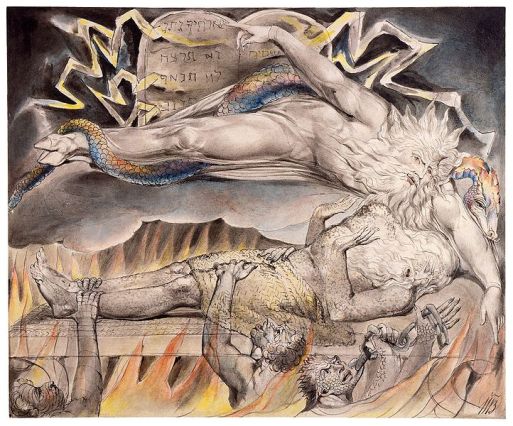
722px-Job's_Evil_Dreams-butts

It is in the God of official Christianity, invented as a homeopathic cure for the teachings of Jesus, that state religion has produced its masterpiece. This God is good and we are evil; yet, though he created us, he is somehow or other not responsible for our being evil, though he would consider it blasphemous either to assert that he is or to deny his omnipotence. All calamities and miseries are his will, and to that will we must be absolutely resigned even in thought and desire. The powers that be are ordained of him, and all might is divine right. The visions of artists and prophets are of little importance to him: he did not ordain those, but an invariable ritual and a set of immovable dogmas, which are more in keeping with his ideas of order. Both of these are deep mysteries, to be entrusted to a specially initiated class of servants. He keeps a grim watch over everything men do, and will finally put most of them in hell to scream eternally in torment, eternally meaning, of course, endlessly in time. A few, however, who have done as they have been told, that is, have done nothing creative, will be granted an immortality of the ‘pie in the sky when you die’ variety.

Read More

Blake and Jesus, by S. Foster Damon

The Nature of the Spiritual Revolution

river-of-life

Jesus the man, according to Blake, was the son of an unidentified human father; he was begotten out of wedlock; thus from the beginning he was an offence against the Law. The girl Mary was “innocently gay & thoughtless” (LJ); her illicit act was one of free love in obedience to the Holy Ghost within her; it was the fulfilment of the purpose of her existence. (In the picture “The Assumption of the Virgin” she flies upward, not towards the Trinity, but towards the Babe.) Joseph understood this, and his forgiveness of his adulterous betrothed was one of the great examples of the Forgiveness of Sins (Jer: 61).

Read More

Church of Blake

Welcome to the Church of Blake, an online community that celebrates William Blake’s vision of Christianity. It seeks to develop and explore the radical and imaginative aspect of Blake’s take on Jesus and what this means for the twenty-first century.