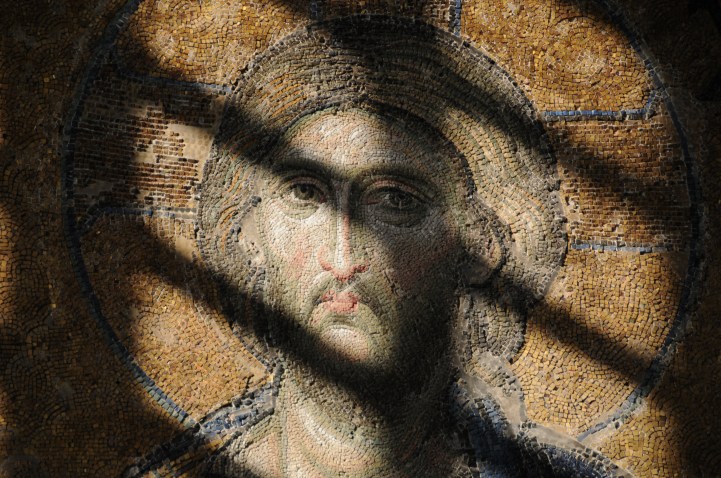
Essay on Christianity, by Percy Bysshe Shelley

Shelley’s Jesus

dsc_5247

Shelley is often thought of as an atheist, the author of the celebrated pamphlet The Necessity of Atheism, for which he was promptly expelled from Oxford. In fact, the pamphlet did not advocate atheism as such but rather argued for its decriminalisation – a philosophical nicety sadly lost on the Oxford authorities. Moreover, Shelley himself at the time was if anything a Deist, as were most progressive eighteenth-century radicals – his letters from this period are filled with arguments trying to find a rational basis for belief in God.

Read More

The Kingdom of God Is Within You, by Leo Tolstoy

Jesus’s teaching of peace, and the Church’s teaching of war 

giphy10

The Kingdom of God Is Within You is a short philosophical essay written by the great Russian novelist Leo Tolstoy. In it he forcefully explains his reasons for rejecting militarism and warfare as solutions to humanity’s problems. Tolstoy had witnessed the brutal and brutalising nature of war firsthand, serving as a second lieutenant during the Crimean war, an experience he dramatically recounted in Sevestapol Sketches (1855) – the work which propelled him to fame. The Kingdom of God Is Within You lays out a new organization for society based on what he saw as the key elements of Jesus’s teachings: freedom, peace, love. It was first published in Germany in 1894, after being banned in his home country of Russia, and become an important text for Tolstoyan, pacifist, and Christian anarchist movements, influencing such pivotal 20th-century figures as Gandhi and Martin Luther King. The book powerfully exposes the hypocrisy of the Christian Church – “professing Christ in words and denying His teaching in life” – as well as recording its complicity in the arms industry, and its role in using Jesus’s words to sanction blood sacrifice.

Read More

Poetry and Madness: Blake, Eigen and the Psychotic God, by Peter Anderson

Ecstasy and Psychosis: Who We Really Are

ECSTASY-1

In many ways, I believe that Michael Eigen is attempting to restore to psychology a dimension suppressed by the scientistic ambitions of the academicized discipline, where the drastic attempt to reduce language to a vehicle for hard data makes of language itself nothing but an empty shell, good only to serve as a frame for the apparent objectivity of statistics. Where Freud could only grudgingly wonder at poetry as a form of psychological gnosis, Eigen understands that poetry—and, very possibly, therapy, too—has the function of revealing who we are. “Poetry”, he says, “is dusting off the true self”.

Read More

The 40 Rules of Love, by Shams Tabrizi

Rumi, Shams, and Whirling Dervishes

Screenshot

Screenshot

Shams of Tabriz was a Persian Sufi and roaming dervish who lived at the end of the twelfth/ early thirteenth century. He was the spiritual teacher and advisor of Rumi, and indeed it’s often said that Rumi was a professor who Shams transformed into a mystic, a lover, and a poet. There are many legends describing their meeting in Konya: Rumi was taught by Shams in seclusion for 40 days, and the period after this is described as Rumi’s ‘mysticism’, where sufis danced, played music (rabab), and drank wine. It is in this time, that the concept of “whirling dervishes” originated.

One day, according to legend, Rumi was reading next to a large stack of books. Shams Tabriz, passing by, asked him, “What are you doing?” Rumi scoffingly replied, “Something you cannot understand” (i.e. knowledge that cannot be understood by the unlearned.) On hearing this, Shams threw the stack of books into a nearby pool of water. Rumi hastily rescued the books and to his surprise they were all dry. Rumi then asked Shams, “What is this?” To which Shams replied, “Mowlana, this is what you cannot understand” (i.e. knowledge that cannot be understood by the learned.) Shams’ forty observations about the nature of love and God, the first ten of which are illustrated here, can be read together (fine but a bit left brain, a bit “learned” as Shams might say) or discretely, each a starting-point for reflection (more right brain, letting the mind wander laterally and make connections). Like life, and love, learning is not a race to the finish, but a voyage to the start.

Please note: this page has now moved to my new website: please click on this link to read the first ten of Shams’ forty illustrated observations about the nature of love and God:

The 40 Rules of Love, by Shams Tabrizi

Rumi, Shams, and the Path of the Heart

Thank you.