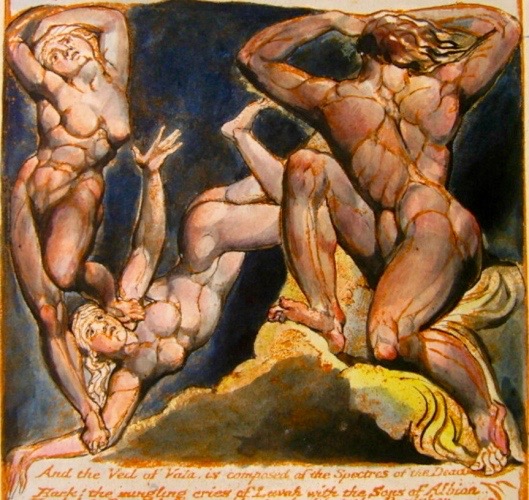
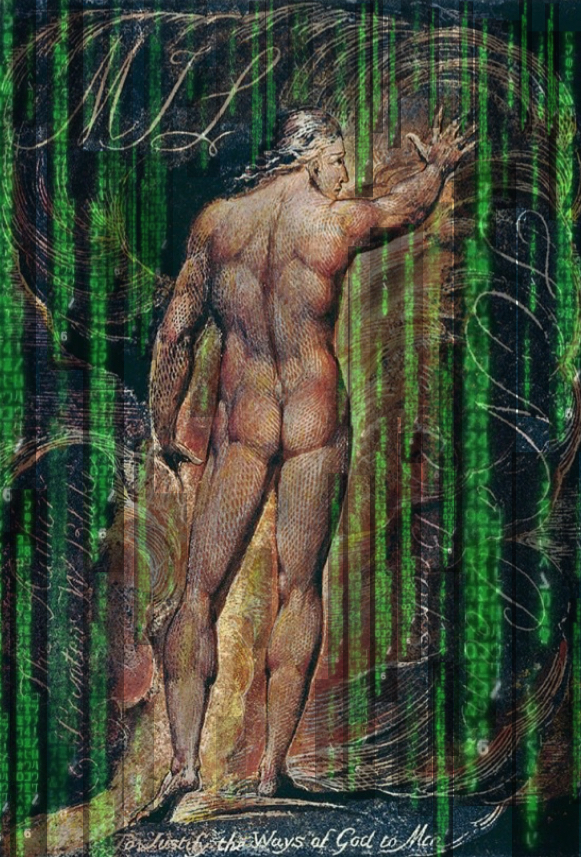
A New Heaven and a New Earth: William Blake and the Everlasting Gospel, by Jackie DiSalvo

Mysticism: The Highest State of Communism, by Jackie DiSalvo
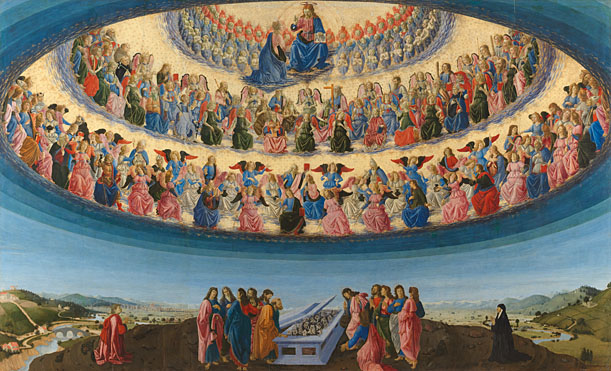
Blake called his Christianity “The Everlasting Gospel”, and as he articulates in that poem, the affirmation of man’s divinity implies a rejection all inequality and authority:

This is the race that Jesus ran

Humble to God Haughty to Man

Cursing the Rulers before the People

Even to the temples highest Steeple …

If thou humblest thyself thou humblest me

Thou also dwellst in Eternity

Thou art a Man God is no more

Thy own humanity learn to adore.

Blake’s humanistic Christianity has been acknowledged by most critics. What must be understood, in addition, is that his use of the myth of Albion, trinitarian doctrine, and the idea of a “mystical body of Christ” demands that we read The Four Zoas as a myth which is simultaneously psychological and social. “What are the Natures of those Living Creatures [the Zoas],” Blake tells us, “no Individual Knoweth” , for they evoke a social reality lost to fallen man.

Read More

Zen and the Art of Alan Watts

On Education, Ego, and Prickles and Goo (Left Brainers and Right Brainers)

Animation of some of Alan Watts’ key ideas, produced by South Park creators Matt Parker and Trey Stone

Alan Watts (1915–1973) was a British philosopher, writer, and speaker, best known as an interpreter and populariser of Eastern philosophy for a Western audience. Born in England, he moved to the United States in 1938 and began Zen training in New York, before attending Seabird-Western Theological Seminary, where he received a master’s degree in theology. Watts became an Episcopal priest in 1945, but left the ministry in 1950 and moved to California, where he joined the faculty of the American Academy of Asian Zen Studies.

vac-portrait_of_alan_wattsWatts gained a large following in the San Francisco Bay Area and wrote more than 25 books and articles on subjects important to Eastern and Western religion, including The Way of Zen (1957), one of the first bestselling books on Buddhism, and Psychotherapy East and West (1961), in which he proposed that Buddhism should be thought of as a form of psychotherapy rather than a religion.
Read More

Building Jerusalem: William Blake and the Counterculture, by Richard Holmes

Radical Agitation, Street Protest and the Poetry of the Underground

flat800x800075t-u1

There are many William Blakes, but mine arrived with the tigers in the 1960s. The first line I ever read by Blake was not in a book, but laid out in thick white paint (or should I say illuminated) along a brick wall in Silver Street, Cambridge, England, in 1968. It was not poetry, but prose: “The tigers of wrath are wiser than the horses of instruction.” It sent a strange shiver down my spine, as it did for thousands of other university students in England and America that year.

Read More

The influence of Jacob Boehme on the work of Blake, by Bryan Aubrey

Blake, Boehme, and Left Brain Verstand 

robert-jpeg

Boehme’s influence on Blake, although often acknowledged, is frequently underestimated and has never been comprehensively investigated. Much modern criticism regards Blake’s work as non-transcendental, even secular. This is partly a reaction against earlier criticism, which was more sympathetic to Blake’s connection with the mystical tradition. The argument of this article, however, is that Boehme exerted a continuous and pervasive influence on Blake, and that recognition of this can illumine some of the most difficult and contradictory elements in Blake’s work. These include the attitude to the body and the senses, and the metaphysical status of the selfhood and the created world.

Boehme’s system represents a synthesis of many different currents of thought, including the Dionysian via negativa, the Hermetic tradition, the Kabbalah and the Lutheran faith. It is emphasized, however, that his philosophy arose from intense mystical experience rather than academic study, and that he chose to express it in symbolic and mythological terms rather than rational concepts.

Read More

From Hell: Alan Moore and William Blake, by E.M. Notenboom 

Psychogeography: Occult London and the City as Psyche

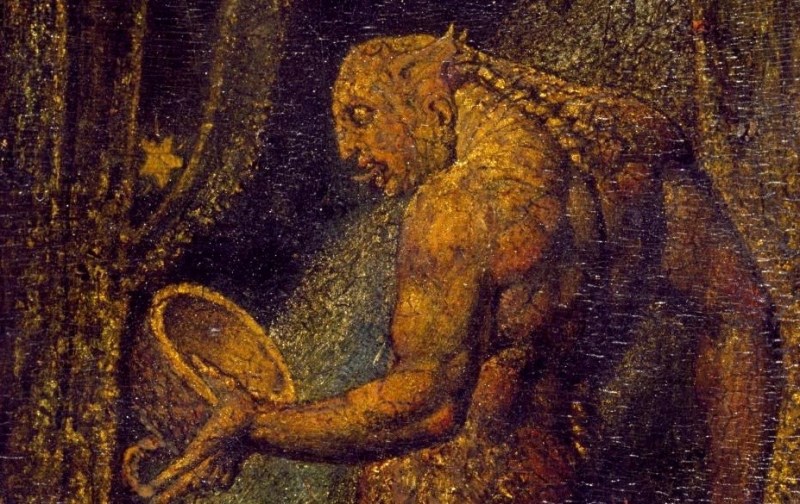
The Ghost of a Flea c.1819-20 William Blake 1757-1827 Bequeathed by W. Graham Robertson 1949 http://www.tate.org.uk/art/work/N05889

Milton, Blake and Moore are philosophical wanderers who share a tendency to connect history, spirituality, and place in their works through philosophers of the past. They journey horizontally through urban, rural, or spiritual locations and at the same time delve vertically through history. As this article will suggest, their legacy is a transformation of familiar landscapes.

Read More

Purity and Danger, by Mary Douglas

Holy Orders: The Reason for Religion’s Obsession with Classifying and Dividing

William-Blakes-The-Ancien-011

I believe that ideas about separating, purifying, demarcating and punishing transgressions have as their main function to impose system on an inherently untidy experience. It is only by exaggerating the difference between within and without, above and below, male and female, with and against, that a semblance of order is created. The more we know about primitive religions the more clearly it appears that in their symbolic structures there is scope for meditation on the great mysteries of religion and philosophy. Reflection on dirt involves reflection on the relation of order to disorder, being to non-being, form to formlessness, life to death.

Read More

Opening the Doors of Perception, by Aldous Huxley

William Blake, Mescaline, and the end of Time

symbolism_symbolic_jacobs_ladder_william_blake-re8ffa684355a4f63b51aa8067301d4b8_zz7zs_324-DOORS-OF-PERCEPTION (4)

Huxley cited his fascination with Blake as a primary factor in his decision to take mescaline, which he hoped would help him transcend the self and see the world without the usual filters on reality: “the drug would admit me at least for a few hours, into the kind of inner world described by Blake.” His book of the experience, The Doors of Perception, is itself eye-opening: one of the most careful and precise deconstructions of “normal” perception ever written: “The function of the brain and nervous system is in the main eliminative”, he observed, “leaving only that very small and special selection which is likely to be practically useful”. The drug allowed him to see that what we normally call “reality” is in fact the product of a massive filtering out of reality, a systematic closing of the doors, leaving only the programs of measurement (“ratio-ing”) and utility – reality as it would necessarily appear “to an animal obsessed with survival.”

Read More

Blake’s Jerusalem as Visionary Theatre, by Susanne M. Sklar

Entering the Divine Body, the Human Imagination

door-jpeg (2)

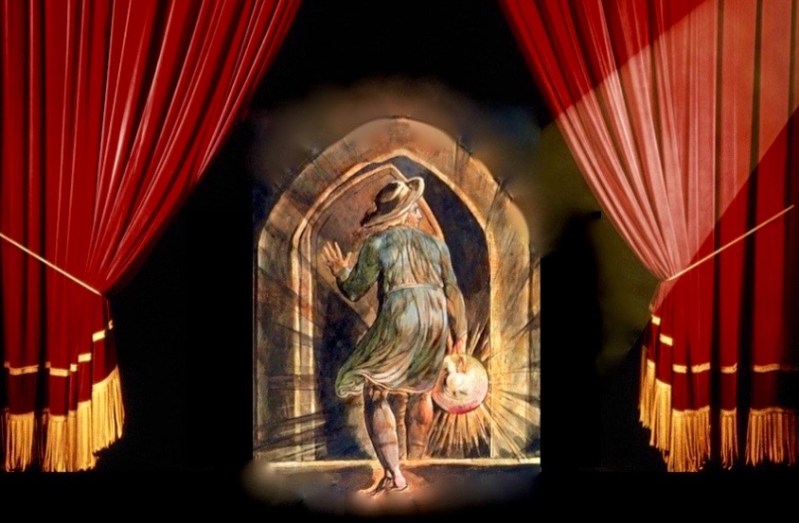
William Blake created Jerusalem: The Emanation of the Giant Albion between 1804 and 1820. Since its conception this epic poem, compromised of one hundred illuminated plates divided into four chapters, has baffled many good readers. In 1811 Robert Southey thought it was “perfectly mad”; in 1978 W. J. T. Mitchell called it “some species of antiform” whose “narrative goes nowhere”; Robert Essick more recently wondered if “it is more than a curiosity shop with some treasures hidden amidst the clutter?” Many reasonable readers think the poem makes no sense.

Read More

Blake and Milton: Paradise Reloaded, by Jackie DiSalvo

Prophecy and Class Consciousness

reloaded-jpeg3

Behind Blake’s particular conception of prophecy there is another which arises from Milton’s but goes beyond it. Henry Parker had enunciated it in the Puritan revolution when he proclaimed that “vox populi was ever reverenced as Vox Dei”. This tradition was related also to a belief that “God hath chosen the weak things of this world to confound the things that are mighty” (1. Cor). When Milton interprets this text, as in his Treatise of Civil Power, it becomes a metaphor, a contrast between a laity’s conscience and the political authority of a state church.

Read More