The Forgiveness Field: Martin Buber, William Blake, and David Bohm, by Rod Tweedy

Quantum Therapy: How Forgiveness restores the relational field

William_Blake_-_Albion_Rose_-_from_A_Large_Book_of_Designs_1793-6 (5)

Forgiveness is the great yes” – Martin Buber


Forgiveness does not mean condoning what has been done. It means taking what happened seriously and not minimising it; drawing out the sting of the memory that threatens to poison our entire existence.” – Bishop Desmond Tutu


“The Spirit of Jesus is continual forgiveness” – William Blake


Always forgive your enemies; nothing annoys them so much” – Oscar Wilde

Screen Shot 2021-05-10 at 10.39.26

Radical Forgiveness

3031353198_b5013103fe_oThe concept of forgiveness is often understood as operating within traditional ethical and philosophical contexts and frameworks involving issues of moral agency, moral standards, and moral virtue. But there’s another tradition of thinking which sees forgiveness as in a sense a transcendence of, or even a radical challenge to, normal or normative ‘moral’ thinking, with its emphasis (as Martha Nussbaum suggests) on the more ‘transactional’ or ‘performative’ aspects of ethical behaviour and decision-making – for example, calculating the pros and cons of forgiving someone, or weighing up the possible health benefits of forgiveness, which seem to imply and draw on a sort of moral ‘logic’ or ethical equation. 

Read More

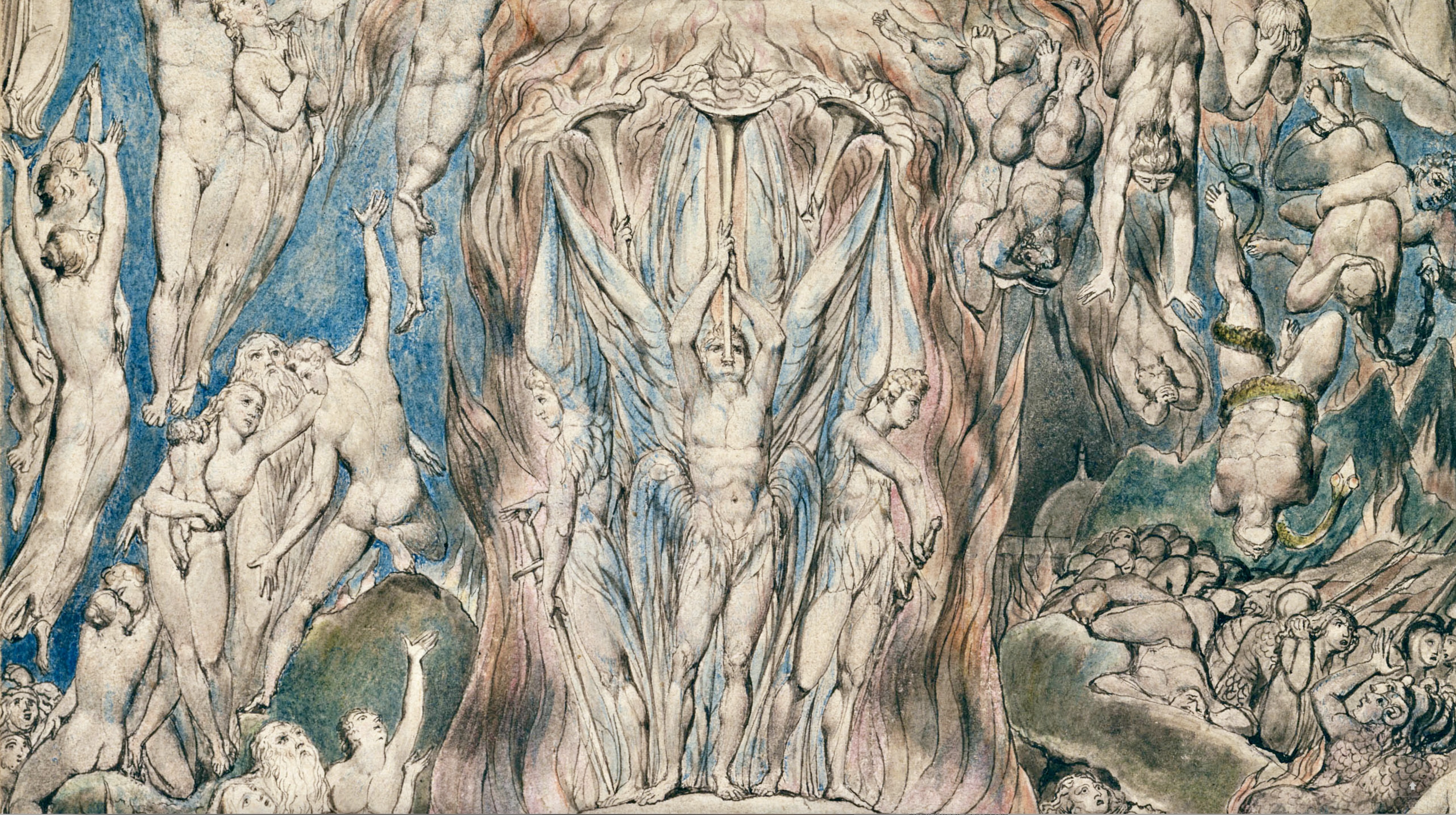
William Blake and the Last Judgment: The Elohim Program, by Rod Tweedy

Seeing without Judging: Passing through the Doors of Perception

Screenshot 2022-10-30 at 17.36.05 5 2-OKKScreenshot 2022-04-12 at 22.12.18

Screenshot 2022-05-07 at 15.35.19

Screenshot 2022-05-07 at 15.19.41

Screen Shot 2021-05-10 at 10.39.26

Introduction: The Last Judgment

The ancient tradition that the world will be consumed in fire at the end of six thousand years is true. as I have heard from Hell.
For the cherub with his flaming sword is hereby commanded to leave his guard at the tree of life, and when he does, the whole creation will be consumed, and appear infinite and holy whereas it now appears finite & corrupt.
This will come to pass by an improvement of sensual enjoyment.

– Blake, The Marriage of Heaven and Hell

In order to see reality as “infinite and holy” Blake’s advice is to let go, to “surrender”: to cast one’s rationalising, judgmental ego or “Selfhood” into the “Lakes of Los”, and to let go of the entire egoic program. We can have no real relationship or communion with reality while we are judging it: to judge something is to stand outside it, and to convert living contraries into dead and conflicting ideas or opposites (“good and bad”, “light and dark” etc).

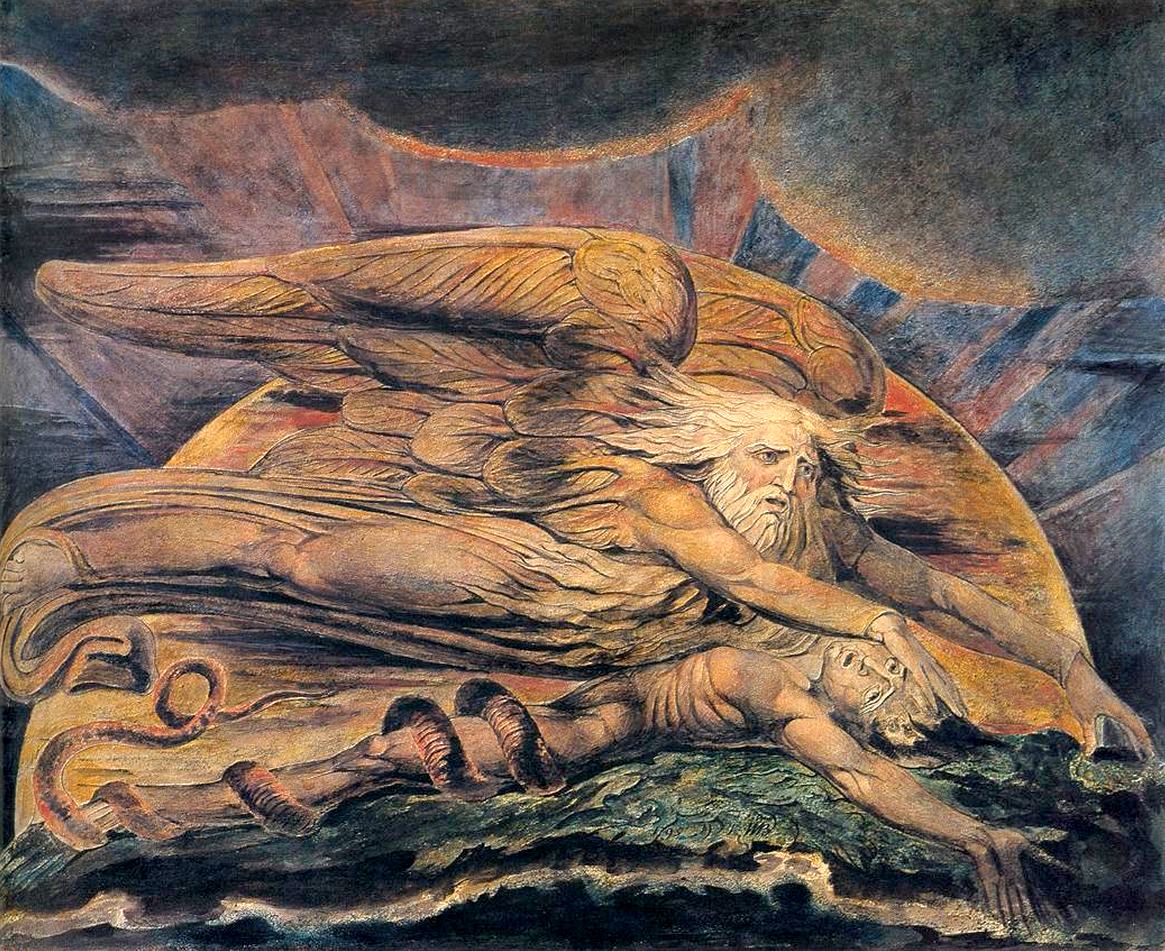
The Hebrew word for “judges” is “Elohim“: it’s the name given to the “God” of the Book of Genesis which presides over our expulsion from Eden, that is from the present moment – from Being.  This is what Judgment does to the human form and the human brain: this is what the Judgment program looks like:
img_1127459_36102374_0

Elohim Creating Adam, by Blake (c. 1795-1805). The Biblical name for the “judge” or “judges” within the psyche of man is “Elohim”, and as such they appear in the Book of Genesis. “And God [Elohim] said, Let us [plural] make man in our image, after our likeness” (Genesis 1:26). It is no coincidence that this moment of “creation” (or rather “division”) is shortly followed by the eating of the tree of “good and evil”, and the even swifter expulsion from “Paradise” (i.e., from integrated Being) as a result. As Blake suggests in the detailed notes he made for his Vision of the Last Judgment (1810), every time a judgment is made about reality, the same “Satanic” process or judgment program (within “Adam”) gets activated.

In many ways, Blake’s whole poetic output has been leading up to this moment: the moment in his work where the individual finally realises the nature of his own psyche, and becomes aware of the pathological nature of the egoic Selfhood that had previously controlled and conditioned him.

In Jerusalem: The Emanation of the Giant Albion (1820), Blake himself directly addresses the human imagination as that agency within man which can give “Error” a form (so that it can be ‘seen’, so that it can be known and rejected), and which also operates above and beyond normal (egoic or rational) consciousness, in order to “Annihilate the Selfhood in me” (J 5:22). With the profoundly unconscious rational Selfhood no longer “God” of the human perceptual and cognitive system, of the left hemisphere of the brain, the individual can finally “awake from Slumbers of Six Thousand Years”.

Note in the picture above that the Elohim’s right hand (i.e., left hemisphere) is directly targeting Adam’s right hemisphere, as if to take control of it, to demobilise and suppress it. The right brain is non-judgmental and relational; it contains the networks and processes of empathy, inter-connectedness, “I/Thou’ relationships, intuition, betweenness, and being itself (through its intimate and extensive connection to the human body, and to embodiment). This act effectively makes the deeper intelligence and awareness of the right brain “unconscious” or as Blake says, “asleep”.

722px-Job's_Evil_Dreams-butts (1)

The cloven hooves of the Elohim Program: the Dividing, Judging Power within the Brain. Image: ‘Job’s Evil Dreams’ from Blake’s Illustrations of the Book of Job. Note the irony, and inversion, of the title: Job’s “Evil” dream is of a “Good” god. How can this be?

The “Creation” – that is, the conversion of the infinite and holy world into a “natural” or material world riven by discrete objects in perpetual conflict – is a moment of profound torment and agony.

Look how unconscious both agents are in this process of conversion. And yet, in another of the inversions that this process (the elevation of the Elohim over Adam, and the left hemisphere into dominance and Mastery), this deep sleep or unconsciousness is what we now call (rational) consciousness – the externalising, rationalising, atomising, “objecting” (as Blake beautifully describes it – deftly combining both its judgmental character and its conversion of the flow of bring into “object representations”, into things) nature of this “Fall into Division”.

The result, suggests Blake, has been “six thousand years” of humanity being “asleep” (this correlates with the ascendancy of these powerful judging, rationalising, and measuring programs of the brain in the cultures of Sumer, Babylon, and Egypt around 4,000 BC).  But now, he notes, we are slowly beginning to realise what’s happened to us, and the false nature of the reality we find ourselves in.

Screenshot 2022-04-05 at 16.44.07

The Whore of Babylon, a key figure or archetype in the process of our estrangement from Being and the processes of judgment and alienation that facilitate it, here shown sitting on the back of the Great Beast. (Image: ‘The Harlot and the Giant’ from Blake’s Illustrations to Dante’s Divine Comedy). As Blake noted in 1798, in contemporary culture and society “The Beast & the Whore rule without controls” (Annotations to Watson). We will see this figure again in Blake’s many Visions of the Last Judgment.

Blake refers to this process, which he also calls “awakening”, as a casting off or a letting go of the Selfhood. The Selfhood is what the Judging program uses to define itself and give it a sense of power (putting itself “up” by judging others and putting them “down”; the vocabulary of up and down, higher and lower, is always a sign of the presence of the Elohim). Awareness is the letting go. As Blake noted, “whenever any Individual Rejects Error & Embraces Truth a Last Judgment passes upon that Individual” (LJ 84).

Screenshot 2022-05-08 at 10.45.26

The old, or orthodox, version of The Last Judgment. This version is, both ironically and appropriately, itself the expression of the Judging power that has usurped its position in the human brain. (Image: ‘The Last Judgment’, or Il Giudizio Universale, by Michelangelo in the Sistine Chapel). As Damon notes, such a view of both Judgment and of Jesus (as Judge) “was utterly opposed to Blake’s belief in the character and teaching of Jesus”. As with his admiration for both Dante and Milton, whose work Blake celebrated but whose erroneous belief systems he corrected, Michelangelo’s imaginative power was an inspiration for Blake, but not a wholly uncritical one.

This shows how radically Blake has reinterpreted and indeed cast off the traditional meaning of the “Last Judgment”. Rather than denoting something that might happen at the end of linear time, or as a punishment, Blake suggests that it happens and is happening now (it is the ending of the linear time “program”), and instead of it referring to a process of accusation and condemnation, it is a release from all programs of accusation. Indeed, the end of linear time can never arrive for the left hemisphere, since to be identified with the left brain is to be inside the linear time construct. As Damon has observed: 

Read More

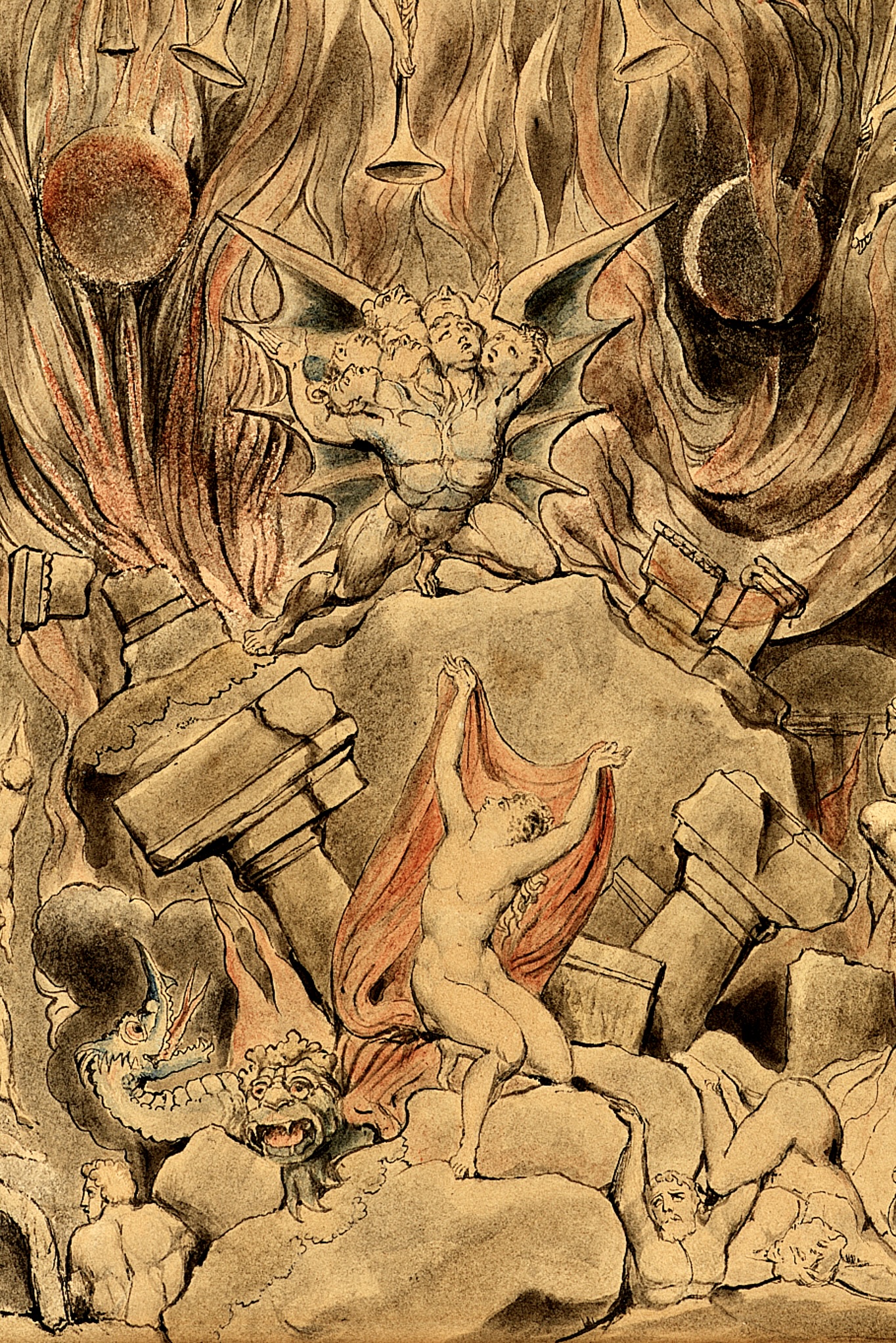
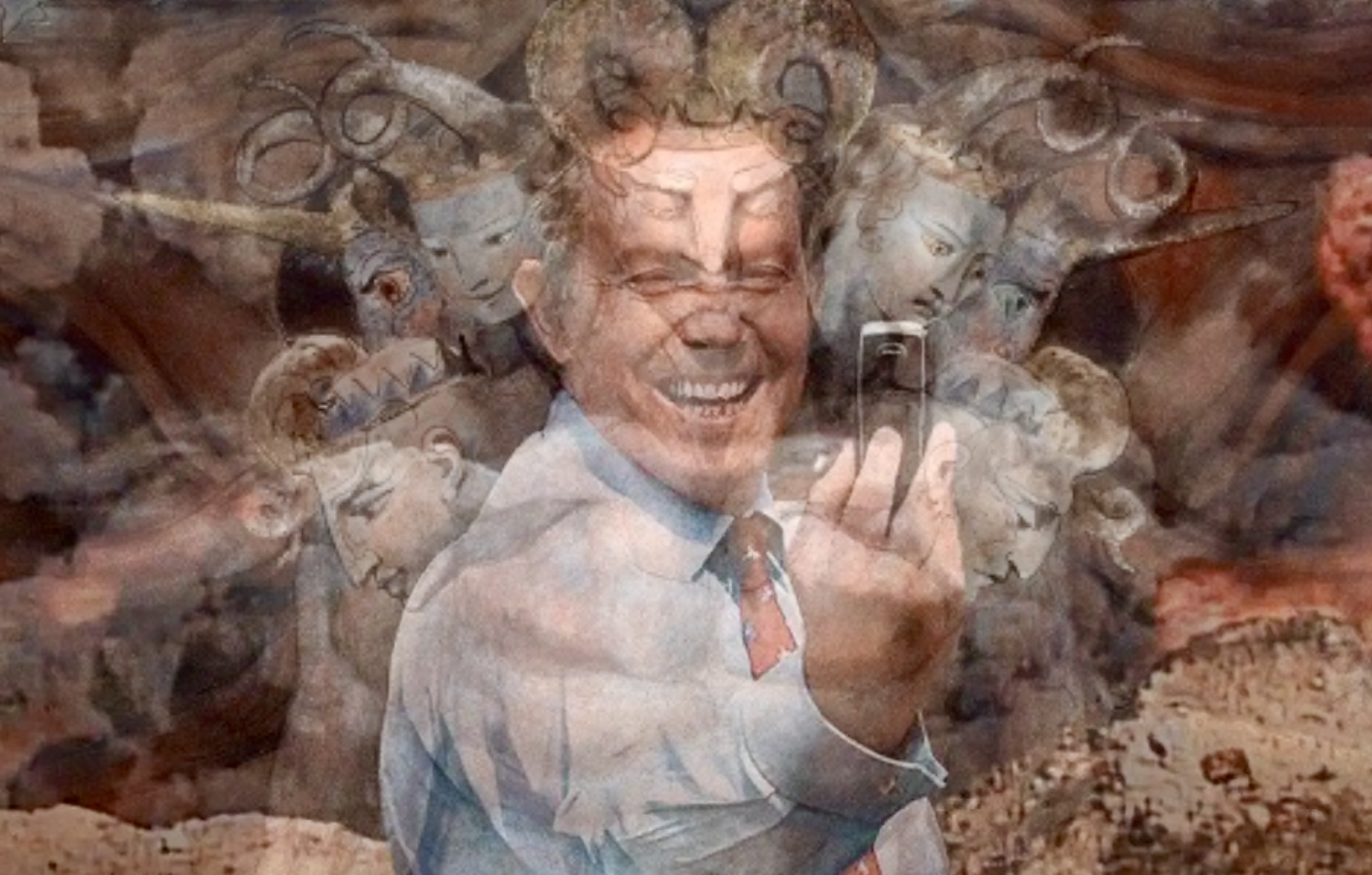
William Blake and the Spiritual Form of Tony Blair, by Rod Tweedy

The Rise and Fall of Urizen: Psychopathy and Rationality

The Spiritual Form of Blair-4 3Screenshot 2022-08-14 at 16.21.23

Screen Shot 2021-05-10 at 10.39.26

Introduction: The Triumph of the Left Hemisphere

In his startling conclusion to his illuminated prophecy Jerusalem: The Emanation of the Giant Albion, Blake depicts Urizen (“your Reason”) in his final, contemporary form: completely dissociated or divided: no longer the originally luminous and enlightening power within the human brain, that he had once been, but now a totally unempathic, ruthless, manipulative drive, obsessed only with power and control. Blake refers to this “debased” or “insane” and dysfunctional form of the former “Holy Reasoning Power” as the “Red Dragon”, “the Dragon Urizen”.

Read More

Through the Round Window: Review of Carol Leader’s ‘Blake and the Therapists’, by Rod Tweedy

A Review of ‘Unfolding the Mythological Unconscious: An Illuminated Talk’ by Carol Leader

Screenshot 2022-07-07 at 20.10.46

Screen Shot 2021-05-10 at 10.39.26

Introduction: William Blake and Therapy

“Was William Blake mad?” is the usual question that comes up in any discussion of Blake and therapy. What was fascinating about psychoanalytic psychotherapist Carol Leader’s talk at the Blake Society event at the Freud Museum was the way in which she explored this connection between ‘Blake and the Therapists’ on a new and much more profound level. Indeed, her presentation was so thought-provoking that it makes you wonder why more hasn’t been written on this connection. As Tim Heath noted in his introduction to the talk, “whenever you converse with William Blake, whenever you dive into his work, it immediately becomes apparent why Blake intimated the coming of therapy.”

Read More

‘Come, You Giants!’: Review of Jez Butterworth’s ‘Jerusalem’, by Rod Tweedy

Albion’s Enslavement: Green and Pleasant Lands vs Chartered Streets 

Screenshot 2022-04-30 at 12.58.00

Screen Shot 2021-05-10 at 10.39.26

In April 2022, Jez Butterworth’s terrific, William Blake-inspired drama Jerusalem returns to London for a special, limited 16-week run. I was lucky enough to see it last night at the press review – red carpet, flashing cameras, which was also kind of fun to see, and a sign of the eagerness with which the revival of this play – often said to be the “greatest British play of the 21st century” – has been greeted.

Read More

Blake and the Zodiac, by Rod Tweedy

Here Comes the Sun King: Forging the Template of Solar Consciousness

Screen Shot 2021-01-22 at 20.05.21-THIS (1)

Screen Shot 2021-05-18 at 22.35.53

Screen Shot 2021-01-23 at 18.11.23

Introduction: The Forms and the Archetypes of Being

There’s a fascinating tradition of thought that links early formulations of the twelve aspects or ‘faces’ of the Zodiac with Plato’s esoteric theory of the Forms, the fundamental geometries and patterns which generate our world, and which casts an intriguing light on the original meaning of the Zodiacal Signs and their significance.

Read More

Man’s fall into Division and his Resurrection to Unity, by Rod Tweedy

The Divided Therapist: Hemispheric Difference and Contemporary Psychotherapy

In The God of the Left Hemisphere I explored the remarkable connections between the activities and functions of the human brain that writer William Blake termed ‘Urizen’ and the powerful complex of rationalising and ordering processes which modern neuroscience identifies as ‘left hemisphere’ brain activity. In The Divided Therapist I extend this analysis, exploring its implications for our mental health and the practice of therapy itself – the regeneration and reintegration of the psyche. If the first book was about the “fall into Division”, this book is about the “Resurrection to Unity”: the restoration of psychic wholeness.

Read More

Blake’s Snakes: The Image of the Serpent in Blake’s Vision

The Symbol of Symbolism: Unravelling the form and nature of the underlying Energy


Introduction: Entering the Serpent

Sometimes it’s good just to look at Blake’s images, and let them approach you, without any verbal text, theory, or explanation.  An encounter with their other-ness. Over the next few weeks this site will be posting a number of articles exploring the meaning and importance of the symbol of the serpent in Blake’s work, which weaves throughout his vision, and twists and turns throughout his images. 

Read More

Frozen Children: Devitalisation, Ice-olation, and Zero Degrees Princesses, by Rod Tweedy

Rod Tweedy explores the pathology of contemporary Disney

Frozen is now the second highest-grossing animated film of all time, and one of the highest-grossing films in any medium ($1.3 billion in worldwide box office sales). 676 million youngsters have viewed and sung along to the YouTube clip of it’s hit song Let It Go, and as Dorian Lynskey notes, “it’s shaped the imagination of a generation”. Beyond the sparkle and CGI patina something about the movie clearly resonates powerfully with children and young people, and I think it’s secret – and what lies at the heart of its appeal – is its potent exploration of themes of childhood anger, ‘ice-olation’, inner devitalisation and self-absorption, which the film both addresses and amplifies.

Read More

Never Leaving Neverland: Stardom and Childhood

What’s Missing?: What Michael Jackson, Wade Robson, and James Safechuck reveal about Childhood, Sexuality, and the Entertainment Industry

https://www.youtube.com/watch?v=a08plX6P3Ls


Introduction: Leaving Neverland

‘Never Leaving Neverland’ might’ve been a better title for this recent high-profile HBO documentary, given its relentless focus on the Neverland ranch as the sole cause of Wade Robson and James Safechuck’s later mental health difficulties.

Michael Jackson and Wade Robson

The exhaustive 4-hour documentary explores allegations made by Robson and Safechuck that they were sexually abused as children by the singer Michael Jackson. Robson and Safechuck are clearly articulate and thoughtful people, which lends their allegations initial credibility and persuasiveness.

But the documentary is equally striking for its one-sidedness, as many commentators (from Rolling Stone to Entertainment Weekly) note. “They have provided no independent evidence and absolutely no proof in support of their accusations. The two accusers testified under oath that these events never occurred.” It’s certainly striking that in 2009 Wade wrote that Jackson was ”one of the main reasons I believe in the pure goodness of human kind”, given what he now claims. His earlier court statements absolutely denying any sexual wrong-doing on the part of Jackson are as convincing as his later statements that Jackson was, in fact, a serial paedophile.

Read More