Blake’s Erotic Apocalypse: The Androgynous Ideal in ‘Jerusalem’, by Diane Hoeveler

From the Hermaphrodite to the Androgynous: Reintegrating the Male and Female

Screenshot 2022-08-25 at 12.11.11 2 2 2Screenshot 2022-08-26 at 11.13.23


Screen Shot 2021-05-10 at 10.39.26

Introduction: Sexual Warfare: The Origins of the Battles of the Sexes

marriageofheavenandhell1

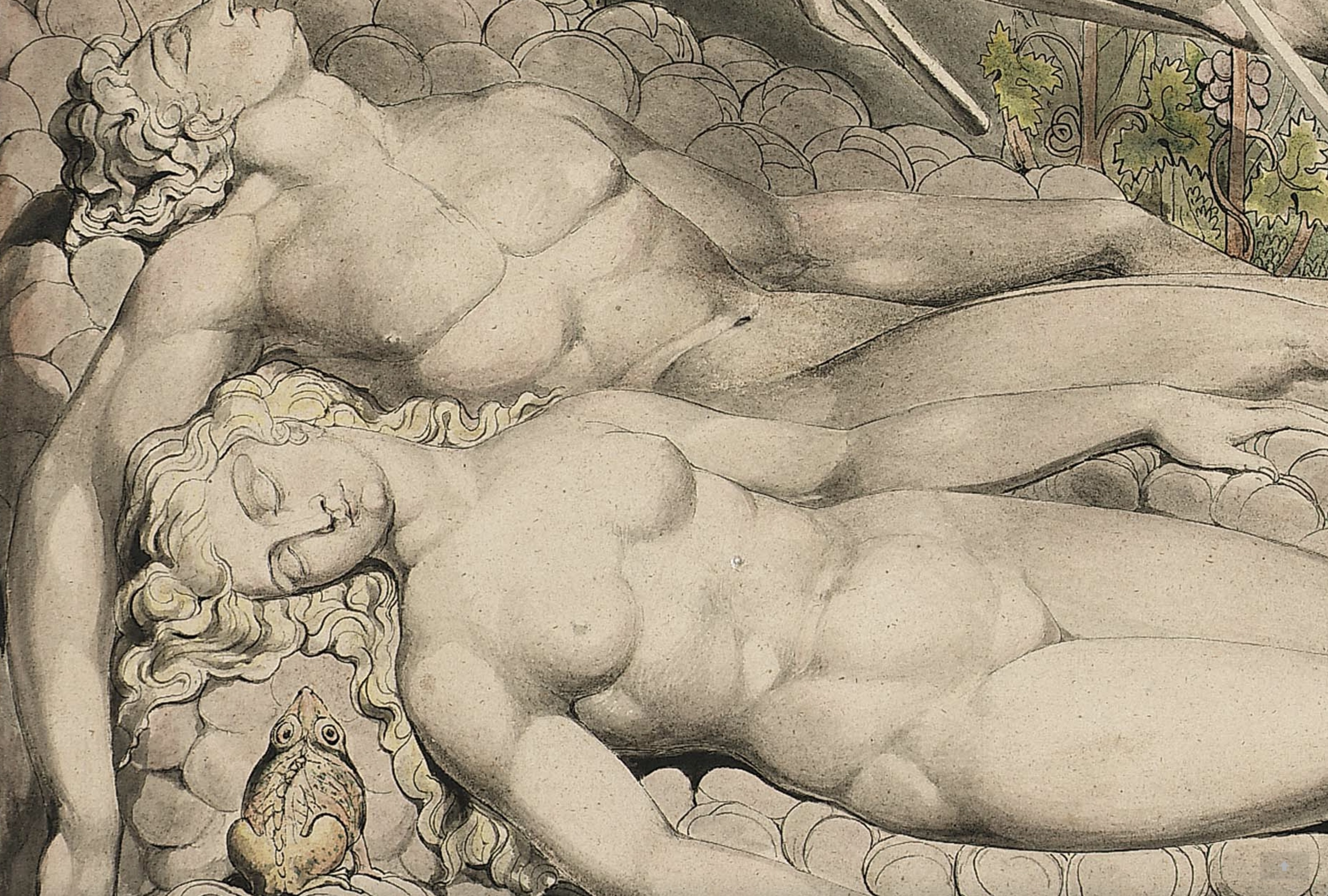
Detail from Blake’s The Marriage of Heaven and Hell. Which is also a marriage of Male and Female – not understood externally, inter-psychically, in the fallen and projected way, but intra-psychically – to overcome the divisions and separations within oneself. Note that the figures here are themselves androgynous.

The imagery of sexual warfare is central to the vision of apocalypse which Blake proclaims as his poetic mission. The political apocalypse of the earlier work, such as The French Revolution, fades as the spiritual gains prominence, for Blake’s vision of the natural world seems to have darkened over the years so that by the time he was writing Jerusalem the only apocalypse he could endorse was one in which the ”sexes must cease and vanish” in the psyche so that humanity can assume its spiritualized “body.” It became clear to Blake that political reform of society could not be effected until an individual and spiritual redemption took place in every heart. To become androgynous, to overcome the flaws inherent in each sex, emerges as the central challenge for all Blake’s characters. 

Read More

Gender and Perception: William Blake and the Fall into Male and Female, by Northrop Frye

The Illusion of Objectivity and the Division of Perceived and Perceiver

Screenshot 2022-08-22 at 22.58.06 2Screenshot 2022-08-22 at 21.23.32Screenshot 2022-08-22 at 22.46.14

Screen Shot 2021-05-10 at 10.39.26

Introduction: Gender and Perception 

There are several accounts of the Fall in Blake but the invariable characteristic of them is Albion’s relapse from active creative energy to passivity. This passivity takes the form of wonder or awe at the world he has created, which in eternity he sees as a woman. The Fall thus begins in Beulah, the divine garden identified with Eden in Genesis. 

Once he takes the fatal step of thinking the object-world independent of him, Albion sinks into a sleep symbolizing the passivity of his mind, and his creation separates and becomes the “female will” or Mother Nature, the remote and inaccessible universe of tantalizing mystery we now see. Love, or the transformation of the objective into the beloved, and art, or the transformation of the objective into the created, are the two activities pursued on this earth to repair the damage of the Fall, and they raise our state to Beulah and Eden respectively. 

Read More

William Blake and the Spiritual Form of Tony Blair, by Rod Tweedy

The Rise and Fall of Urizen: Psychopathy and Rationality

The Spiritual Form of Blair-4 3Screenshot 2022-08-14 at 16.21.23

Screen Shot 2021-05-10 at 10.39.26

Introduction: The Triumph of the Left Hemisphere

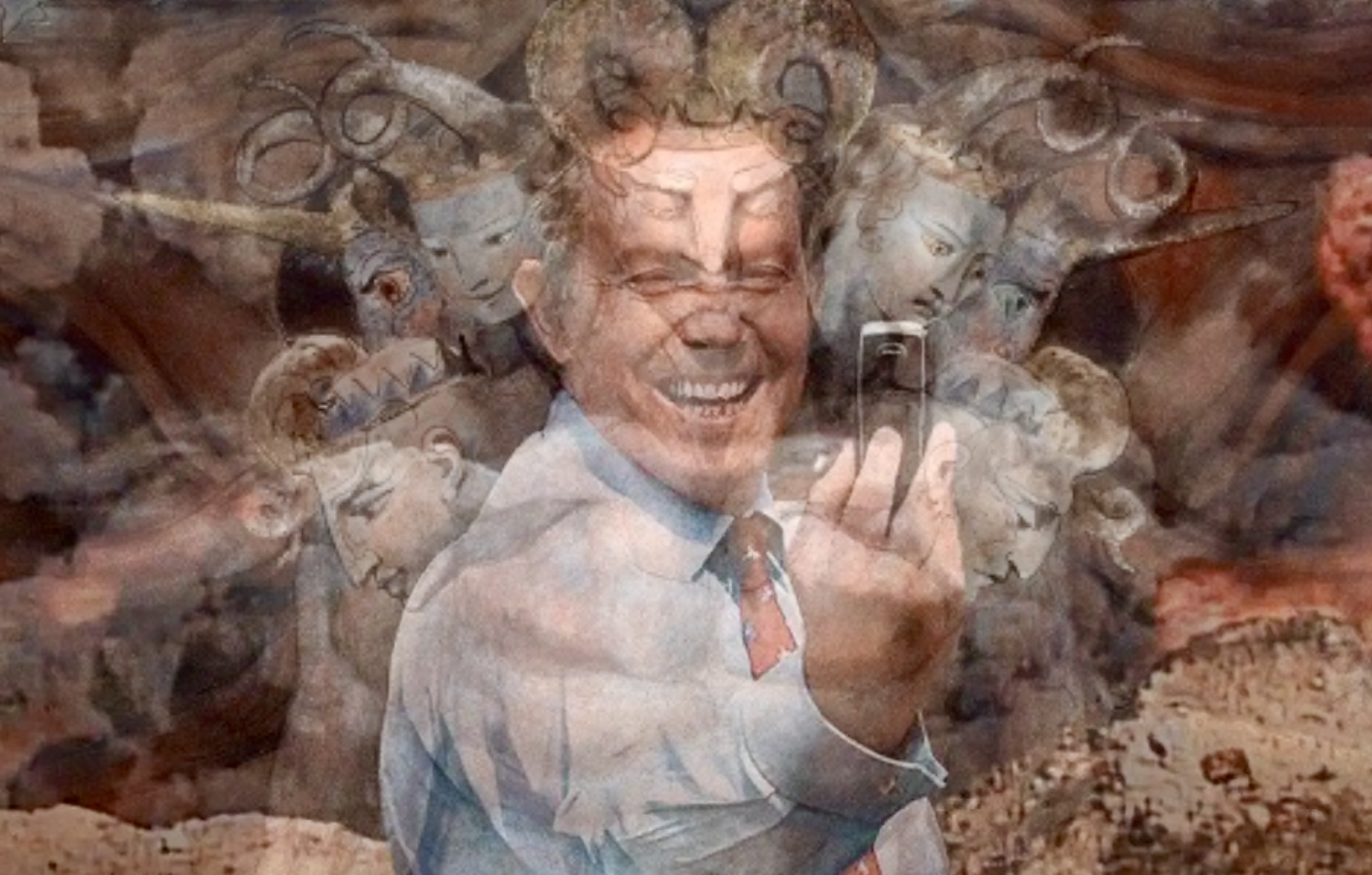
In his startling conclusion to his illuminated prophecy Jerusalem: The Emanation of the Giant Albion, Blake depicts Urizen (“your Reason”) in his final, contemporary form: completely dissociated or divided: no longer the originally luminous and enlightening power within the human brain, that he had once been, but now a totally unempathic, ruthless, manipulative drive, obsessed only with power and control. Blake refers to this “debased” or “insane” and dysfunctional form of the former “Holy Reasoning Power” as the “Red Dragon”, “the Dragon Urizen”.

Read More

Through the Round Window: Review of Carol Leader’s ‘Blake and the Therapists’, by Rod Tweedy

A Review of ‘Unfolding the Mythological Unconscious: An Illuminated Talk’ by Carol Leader

Screenshot 2022-07-07 at 20.10.46

Screen Shot 2021-05-10 at 10.39.26

Introduction: William Blake and Therapy

“Was William Blake mad?” is the usual question that comes up in any discussion of Blake and therapy. What was fascinating about psychoanalytic psychotherapist Carol Leader’s talk at the Blake Society event at the Freud Museum was the way in which she explored this connection between ‘Blake and the Therapists’ on a new and much more profound level. Indeed, her presentation was so thought-provoking that it makes you wonder why more hasn’t been written on this connection. As Tim Heath noted in his introduction to the talk, “whenever you converse with William Blake, whenever you dive into his work, it immediately becomes apparent why Blake intimated the coming of therapy.”

Read More

The Eye Altering: William Blake and the Nature of Observation, by Naomi Billingsley

The Jesus Field: Observation, Participation, and how Images alter the Observer

Screenshot 2022-06-30 at 14.05.08Screenshot 2022-08-14 at 12.15.33Screenshot 2022-06-30 at 14.07.33

Screen Shot 2021-05-10 at 10.39.26

Introduction: Jesus and the Human Imagination

William_Blake_-_Albion_Rose_-_from_A_Large_Book_of_Designs_1793-6 (5)

In All Religions are One (1788) Blake declared “That the Poetic Genius is the true Man. and that the body or outward form of Man is derived from the Poetic Genius” (Principle 1st). Blake here is drawing attention to the great, hidden secret of both reality and the nature of God, which is Form. Forms are not ‘things’ but processes or organising movements. Forms are rooted in and expressions of (creations of) an underlying “former”, which in Blake’s early work he called the “Poetic Genius” to signify its formative aspect, a term which is derived from the same root as the word from which we also get “genesis” and indeed “genetic”. According to Blake it is this that gives each body its individual as well as generic “form”. In contrast to almost all other spiritual traditions, Blake understood that forms are not temporary and unimportant but eternal, continually creating and recreating themselves. They are vast invisible forming fields, similar to what Rupert Sheldrake has more recently termed “morphogenetic fields”.

William Blake believed that Christianity is art and that Jesus Christ was an artist, who is both the model and the source of artistic activity. These ideas are central to his artistic and religious vision, and are expressed in various forms throughout his career: from the early account of the Poetic Genius in All Religions are One, to the late aphorisms of the Laocoön plate.

This article examines why Blake identified Christ as artist and Christianity as art. My central argument is that Blake expresses this theory – or theology – of art through his visual representations of Christ. Blake did not mean that Jesus produced works of fine art, nor that one must do so in order to be Christian; rather, Christ’s identity is Imagination, and as such all his acts and all activity in him are art. Thus, I examine Blake’s depictions of Jesus’ life and ministry, and show that Blake represents these themes as analogous to the work of the artist because Jesus changes the way that we perceive the world.

As Morris Eaves highlights at the end of Blake’s Theory of Art, for Blake, Jesus’ art was his public ministry – his parables and miracles were acts of self-expression, which sought to create a new social order. So too Blake seeks, through his art, to engender a community of Imagination. This community is the Divine Body, which is Jesus, who is Imagination – as expressed in the Laocoön aphorism quoted below:

Screenshot 2022-05-02 at 17.32.04

Thus, Blake’s depictions of Christ are also representations of artistic activity; they include not only images of Jesus’ public ministry, but also of his birth, death and resurrection, as an apocalyptic agent, and in extra-biblical roles.

Whilst Blake’s vision of Christ as the supreme type of the artist was by no means a static concept, it emerged in his works as early as All Religions are One and can be found in works from throughout his career. This article explores how Blake envisaged the life of Christ as manifesting the principles of art through case studies that examine five major themes in Blake’s depictions of Christ in key pictorial projects in his oeuvre: art as regeneration, art as inspiration, art as facilitator, art as eternal, and art as iconoclastic. Imagination alters the way we see the world, and our relationship with it: that is to say, since observed and observed are fundamentally entwined and interdependent (or “entangled”, in the language of modern quantum field theory), imagination alters, or restores, the nature of reality itself – to a unified and integrated (“holistic”) whole, or “vision”.

Screen Shot 2021-05-10 at 10.39.26

Read More

Blake’s Left Foot: William Blake and how to enter new States, by Jennifer Keith

“And did those Feet?” Radical incarnation and the Spirituality of Physiology in Blake’s Milton 

Screenshot 2022-06-23 at 15.41.09

Screen Shot 2021-05-10 at 10.39.26

Introduction: The Mental Traveller

In a work with the spiritual aspirations of Blake’s Milton, the pedestrian topic of feet may seem less than deserving of critical attention, but because Blake himself repeatedly focuses on the foot in his brief epic, surely the reader should attend to this lowest part of human anatomy.

As an anatomical feature, the foot automatically assumes importance given Blake’s declaration in Milton that “more extensive / Than any other earthly things, are Mans earthly lineaments.” In verses noted for their narrative convolutions and complex imagery, Blake’s poetic feet figure among Milton‘s most memorable fancies: “covered with Human gore,” Zelophehad’s Daughters’ feet treadle the loom (29.58); a “Vegetable World” appears on Blake’s left foot (21.12); and Albion’s enormous feet cover a good portion of southern England (39.36-40).

Read More

Logic and Mysticism: William Blake, Bertrand Russell, and Allen Ginsberg

The Way to Truth: The Lamb or the Tyger?

Screenshot 2022-03-01 at 12.30.31

The Ancient of Days over Bikini Atoll, where America exploded a massive hydrogen bomb in 1954. It was a thousand times more powerful than the atomic bomb dropped on Hiroshima. On witnessing the first detonation of a nuclear weapon on July 16, 1945, a piece of Hindu scripture ran through the mind of scientist Robert Oppenheimer: “Now I am become Death, the destroyer of worlds”

Screen Shot 2021-05-10 at 10.39.26

Introduction: Blake and Bertrand Russell

Screenshot 2022-03-01 at 14.50.18

Entrance to the rooms Russell occupied as a Fellow of Trinity College, Cambridge University, where he first heard the sound of Blake’s Tyger.

In the first volume of his autobiography, Nobel Prize laureate Bertrand Russell recalled being stopped dead in his tracks while trying to descend a staircase in Trinity College Cambridge by his friend Crompton reciting Blake’s poem The Tyger. He wrote:

One of my earliest memories of Crompton is of meeting him in the darkest part of a winding College staircase and his suddenly quoting, without any previous word, the whole of “Tyger, Tyger, burning bright.” I had never, till that moment, heard of Blake, and the poem affected me so much that I came dizzy and had to lean against the wall.

The encounter with Blake’s Tyger seems to have made a lasting impression on the mathematician and philosopher. Russell returned to him again in his 1918 essay Mysticism and Logic, where he suggested that the search for truth could be reached both through hard science and pure speculation. In the essay Russell contrasts two “great men,” Enlightenment philosopher David Hume, whose “scientific impulse reigns quite unchecked,” and poet William Blake, in whom “a strong hostility to science co-exists with profound mystic insight.” It’s interesting that Russell chooses Blake for an example.

Read More

Brandpsycho: The Hidden Psychology of Brands, by Max Jakob Lusensky

Jung, Magic, and the Manipulation of Eros: How Capitalism Controls Us

Screenshot 2022-03-01 at 20.44.52

Screenshot 2022-03-01 at 20.38.54

Screenshot 2022-03-06 at 18.40.44 2

Screen Shot 2021-05-10 at 10.39.26

Introduction

Screenshot 2022-03-06 at 21.01.38

Bernay’s classic work, Propaganda (1928) explored the psychology behind manipulating masses and the ability to use symbolic action and propaganda to influence politics and effect social change. Bernays’ thesis is that “invisible” people who create knowledge and propaganda rule over the masses, with a monopoly on the power to shape thoughts, values, and citizen response. “Engineering consent” of the masses, he argued, would be vital for the survival of capitalism.

In this post we explore how the psychology of Carl Gustav Jung and Sigmund Freud’s psychoanalysis have been used by the marketplace to transform products into magical brands that we subconsciously connect with. 

What (Freud’s nephew) Edward Bernays and his fellow marketers did was to introduce eros to the marketplace and to explore a new technique to infuse products with its energy. Products started to transmute into pseudo-symbols when charged with psyche, libido, emotional appeal, and the promise to still the desires constantly stirring within the consumer’s unconscious. 

Influenced by the insights of psychoanalysis, a new method of marketing was born, one that would reshape the field of advertising and form a psychological framework for the industry that today is referred to as branding.

The word brand derives from Old Norse, a Viking language spoken in Scandinavia until the fifteenth century. Brandr meant ‘to burn’. Later in history, the word came to identify the process of marking cattle, criminals, and slaves using a hot iron, a precursor to the logo.

Brands today are more than mirrors for our unspoken, often unconscious, psychological wants and desires. 

Read More

‘Come, You Giants!’: Review of Jez Butterworth’s ‘Jerusalem’, by Rod Tweedy

Albion’s Enslavement: Green and Pleasant Lands vs Chartered Streets 

Screenshot 2022-04-30 at 12.58.00

Screen Shot 2021-05-10 at 10.39.26

In April 2022, Jez Butterworth’s terrific, William Blake-inspired drama Jerusalem returns to London for a special, limited 16-week run. I was lucky enough to see it last night at the press review – red carpet, flashing cameras, which was also kind of fun to see, and a sign of the eagerness with which the revival of this play – often said to be the “greatest British play of the 21st century” – has been greeted.

Read More

Against the Grain: Civilisation as a Slave State, by James C. Scott

The Sleep of Six Thousand Years: The Fall of Man and the Rise of Agriculture, Cities, and Civilisation

Screenshot 2022-03-31 at 10.20.28

Screenshot 2022-03-31 at 10.04.03

Screenshot 2022-04-05 at 15.17.24

Screenshot 2022-04-05 at 16.44.07

Screen Shot 2021-05-10 at 10.39.26

Introduction: Six Thousand Years

Screenshot 2022-03-31 at 09.31.05

Give Us Today Our Daily … “A state can be defined as a territory over which an elite exercised coercive power maintaining itself by taxing the population either through its produce or its labour. Scott provides a fascinating insight into just how they worked. He argues that for a state to exist it needed to be reliant on a staple that could easily be taxed – and grain was the ideal. Another advantage of grain to the state was that it had a higher value per unit volume than most other foodstuffs and was easy to store in the protection of the city, from where it could be doled out to slaves and soldiers or used to feed the population when under siege. Through taxation the state became the quartermaster and producers became subjects” (Guardian review of Scott’s book, by Barry Cunliffe).

Recent anthropological research suggests that a significant and dramatic shift occurred in human cultures around six thousand years ago, resulting in the relatively sudden and massive advances in technological and linguistic innovations which were such a prominent characteristic of the extraordinary new civilisations of Sumer and Babylon, as well as in equally sudden and massive advances in social inequality, war, hierarchy, and accountancy.

The emergence of these developments around six thousand years ago is of particular relevance in a discussion of Blake as he repeatedly alludes to the cultures of Babylon, Tyre, and Egypt (Mesopotamia) as being of significance in the “fall into Division” that he recounts in his long prophetic poems (“the Works/Of Egypt and Babylon Whose Gods are the Powers of this World”; Laocoon). This psychological or dissociative “fall”, he remarks, originates in or is coeval with these centres, considered both as historical locations and metaphorical states, and even more interestingly in this context, Blake notes that this fall has lasted for a period of “Six Thousand Years”, a phrase that recurs in his longer poems almost like a heart-beat.

Awake Albion awake! reclaim thy Reasoning Spectre …
Let the Four Zoa’s awake from Slumbers of Six Thousand Years

Milton 39:10–13

Screenshot 2022-03-31 at 10.14.44

Blake suggests that these giant sleeping energies within man are beginning to awaken, and with them the awareness of history and of man’s real state. “Six Thousand years are passd away the end approaches fast”, sings Los (Mil 23:55), and with it the end of the unconscious Urizenic processes currently nailing down man’s intuitive awareness.

I behold the Visions of my deadly Sleep of Six Thousand Years

Dazling around thy skirts like a Serpent of precious stones & gold
I know it is my Self

Jerusalem 96:11–13

Read More