Aldous Huxley and the Doors of Perceiving

Introduction: Opening the Flower of Mescaline
His interest piqued by psychological research on the drug, in 1953 Aldous Huxley swallowed four-tenths of a gram of mescaline with the hope that his experience would lead to a better understanding of the mind’s role in human perception.
Mescaline is a relatively innocuous hallucinogen found in several species of cacti, the most well-known being Peyote, a small plant that many of the native peoples of the American Southwest and Mexico respect as a divine gift. Western science has approached the drug’s effects more pragmatically, studying the chemical and psychological changes that accompany mescaline intoxication, but for the more personally-driven experimenter it has not lost its philosophical allure.

Heaven in a wild flower: Mescaline is a naturally occurring psychedelic that comes from the Mexican peyote cactus (Lophohora williamsii)
“This is how one ought to see, how things really are” – Aldous Huxley
Huxley approached his experiment conscious of both the scientific and philosophical issues surrounding the alteration of consciousness, and recorded his analysis of the experience in two short books, The Doors of Perception and Heaven and Hell. A discerning glance at the titles of these two works suggests a direct relationship with Blake’s The Marriage of Heaven and Hell, but the degree to which Blakean concepts actually form the foundation for Huxley’s reflections has not yet been thoroughly examined.
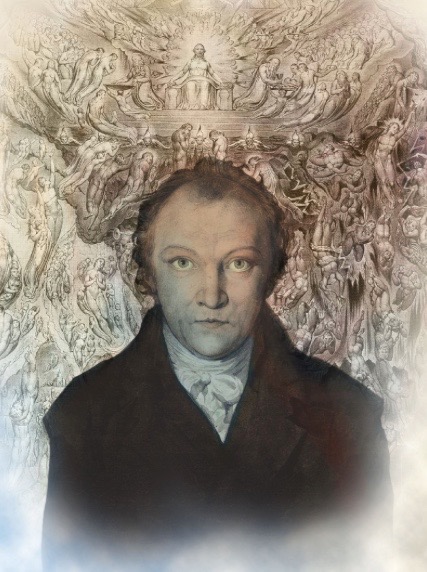
“Blake’s way of seeing”. Huxley cites his fascination with Blake as a primary factor in his decision to take mescaline.
Huxley cites his fascination with Blake as a primary factor in his decision to take mescaline, and whether or not one agrees with him that hallucinogenic experiments can be a legitimate expression of intellectual curiosity, Huxley did encounter something closely akin to what he considered to be Blake’s way of seeing.
A large part of what makes this text fascinating in the context of the Blake legend is the way in which Huxley appropriates Blakean terminology to explain his experience, and in locating the points at which his argument echoes and diverges from Blake’s own. Such analysis shows that Huxley was working with a strongly legendary model of Blakean perception.
Ironically, Blakean language is most clearly present when Huxley’s argument is somewhat contrary to Blake’s own, but when he reaches his essentially Blakean conclusion he fails to recognize the closeness of his thoughts to those of Blake. More specifically, Huxley does not recognize that his conclusions concerning the necessity of contraries in human perception correlates almost perfectly with Blake’s ideas. This essay will compare the two authors’ notions of perception and enlightenment, mostly those found in Blake’s The Marriage of Heaven and Hell and Huxley’s The Doors of Perception, and show the presence of the legend in Huxley’s understanding of Blake.
To See a World in a Grain of Sand: The World of Quantum Blakean Mechanics
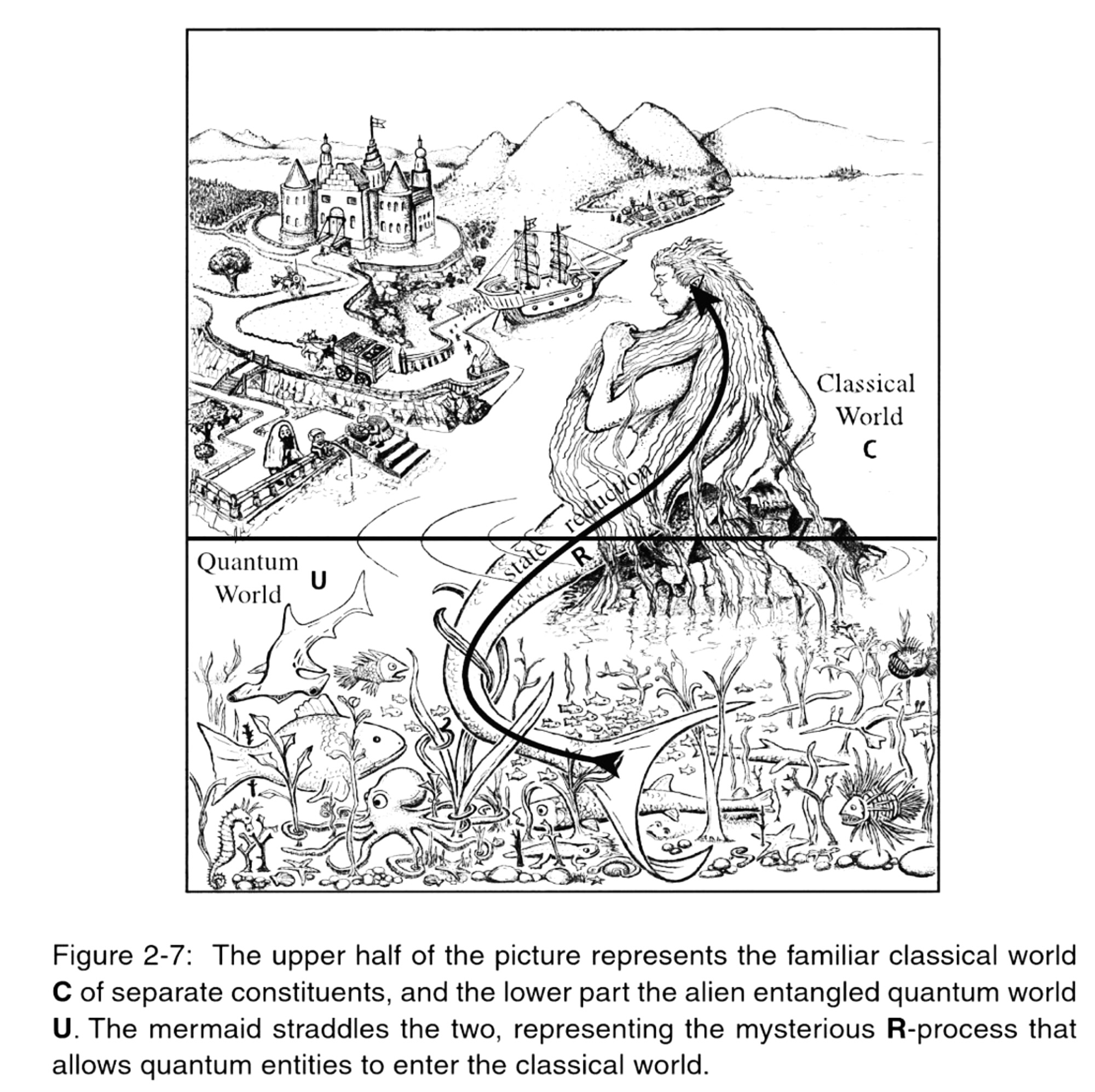
Penrose’s image of the mermaid to illustrate micro/macro relations. “The mermaid straddles the two, representing the mysterious R-process that allows quantum entities to enter the classical world.”
In October of 2003, the renowned Oxford physicist Roger Penrose delivered a lecture at Princeton University on quantum mechanics, or more specifically, what he thinks are the shortcomings of current quantum theory.
He used an illustration of a mermaid sitting on a rock with her tail end in the water and her upper body above water as a visual metaphor for the relationship between the way we understand the quantum world, and the way we perceive our physical surroundings. The fuzzy fish and plants below the waterline represented the non-deterministic quantum world, and lacked the clarity and sharp definitions that characterized the above-water scene, which represented the deterministic world of physical perception.
The problem with quantum mechanics is that quantum particles behave in a manner that belies our basic physical assumptions. A unit of matter that we recognize as a single particle, for instance, can be split, and theoretically exist in two different places. As of yet, the terminology employed by the field fails to reconcile what we hold to be true on a sub-atomic level with the reality of sensory perception, and will consequently remain theoretical and fuzzy unless a new vocabulary is adopted. Quite simply, there is a gap between the abstractions of theory and the concrete substantiality of experience, which quantum mechanics cannot yet adequately explain.
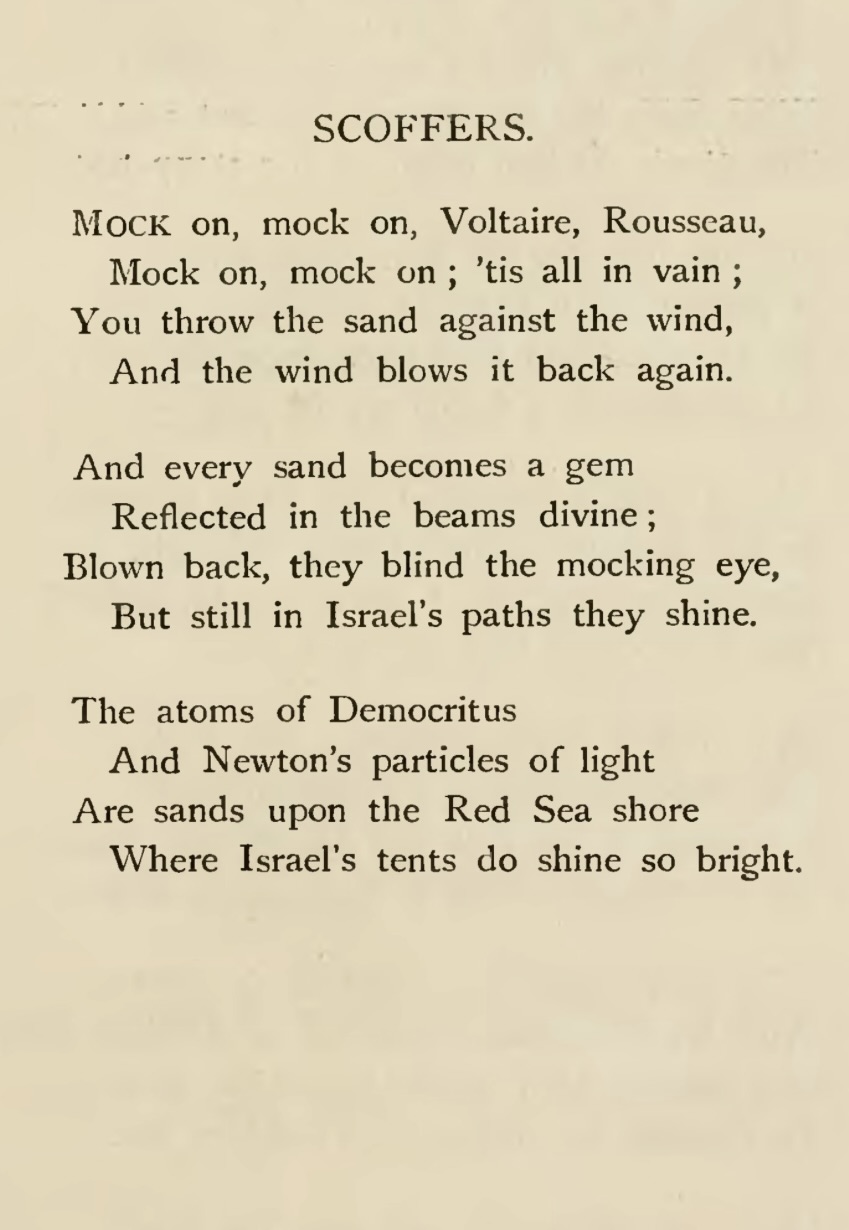
“The Atoms of Democritus/ And Newton’s Particles of light/ Are sands upon the Red sea shore/ Where Israel’s tents do shine so bright” – from Blake’s Notebook (E 477), printed in Gilchrist’s Life of Blake. In a late letter, Blake referred to “An Atom”, the basis of the building-block materialist mechanism universe, as “A Thing that does not Exist” – as indeed it does not, in the literal sense (a-tomos, meaning “not cuttable” or dividable). A ‘sub-atomic’ particle may be a way of rescuing this desperate desire to believe in some sort of fundamental building blocks – the Urizenic Rocks which are the basis of its world – but is an etymological nonsense. The question is, then what are they? Are they anything? Are they openings?

“Calling the Rocks Atomic Origins of Existence” (Blake, Jerusalem, Plate 67). “They call the Rocks Parents of Men” (Jerusalem). Mechanistic scientists believe that we are made out of – assembled from – such basic units – whether they are atoms, or DNA, or even triangles (as Plato supposed). Unable to comprehend living wholes – forms – they can only analyse parts, and as Blake here suggests, Urizenic scientists – the “Sons of Urizen” – can only think – and see – in parts, in terms of atoms.
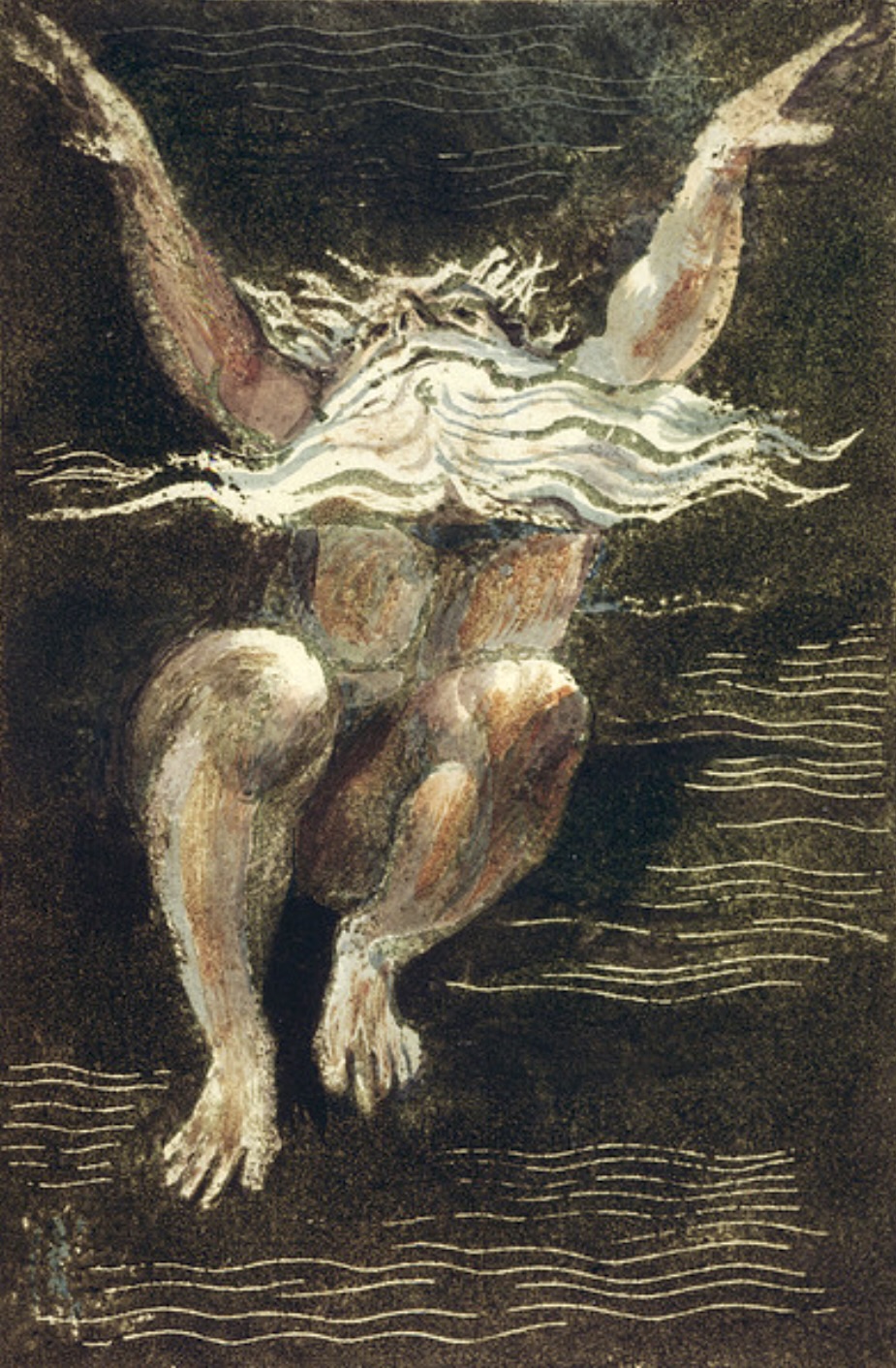
Poor old Urizen. Finding itself in a world of constant flow and living fluidity – rather like being in an LSD trip – in which each part is contained in all, and all parts are infinite, and we’re in all of them as well, the rational egoic thinking program feels utterly overwhelmed – as we see here – and starts to laboriously construct an Ark – actually a mind-forged Prison – to protect itself from life. The design may depict Urizen’s report that he “repell’d / The vast waves, & arose on the waters / A wide world of solid obstruction” (Plate 6). Urizen sees the world now as something to overcome – to fight, control, struggle against – he transforms it into a vast threatening Dragon – and sees itself as a noble, pure, disembodied (or ‘spiritual’) Reason whose business it is to harness, control, and drain that sea.
In his essay, “The Education of an Amphibian,” Huxley employs a strikingly similar metaphor to describe the disparity between theoretical and sensory perception. “Whether we like it, or not” writes Huxley, “we are amphibians, living simultaneously in the world of experience and the world of notions, in the world of direct apprehension of Nature, God, and ourselves, and the world of abstract, verbalized knowledge about these primary facts” .

Caught between worlds. Our minds are frogs, part submerged in the total wave of being, part standing outside of it and afraid of merging back with it. But in fact we never stop being part of it.
Huxley employs the structuralist argument that all knowledge rests on a system of symbols that are intended to represent the “primary facts” of direct experience, but no matter how clever or complete those symbols are, they can never actually be the idea or object that they stand for. The difficulty with quantum theory then, is quite similar to the difficulties faced by philosophers trying to gain a deeper understanding of God, or the soul—one deals with a world too small for direct comprehension, the other with a world that is too large.
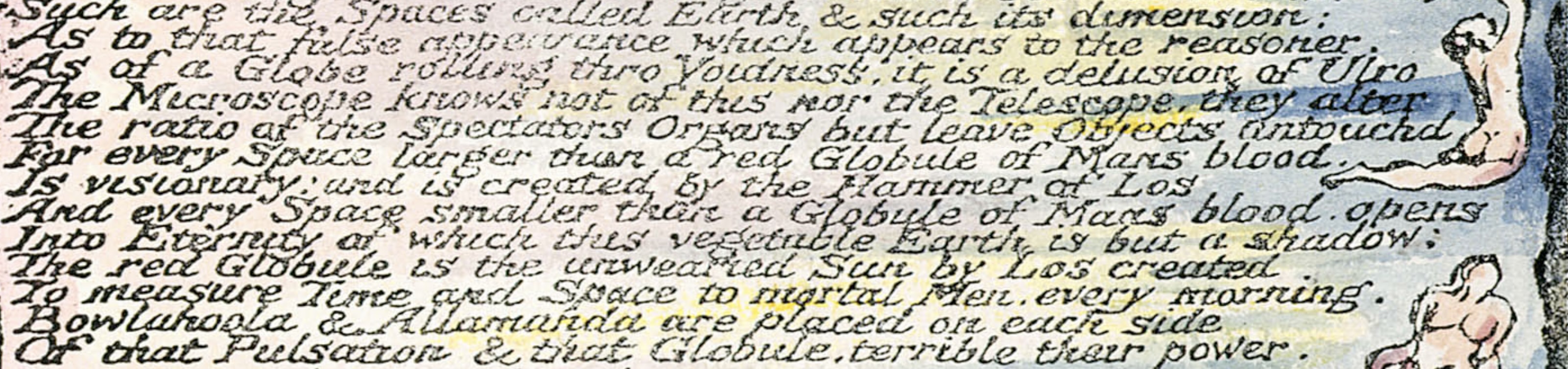
Eternity inside a globule of blood: “The microscope knows not of this nor the telescope: they alter/ The ratio of the spectator’s organs, but leave objects untouch’d. / For every space larger than a red globule of Man’s blood / Is visionary, and is created by the Hammer of Los; / And every space smaller than a globule of Man’s blood opens / Into Eternity” (Blake, Milton, Plate 28). As John Higgs suggests, Blake’s perception of such a domain beyond the ratios of memory and the conditioned conceptual mind (‘urizen’) bears striking similarities with some aspects of modern quantum field theory, such as a space “where Contrarieties are equally true”, where the observer altering his eye alters the objected perceived, and where issues of time, finitude, and measurement no long apply (Higgs, William Blake vs the World).
What is Perception?
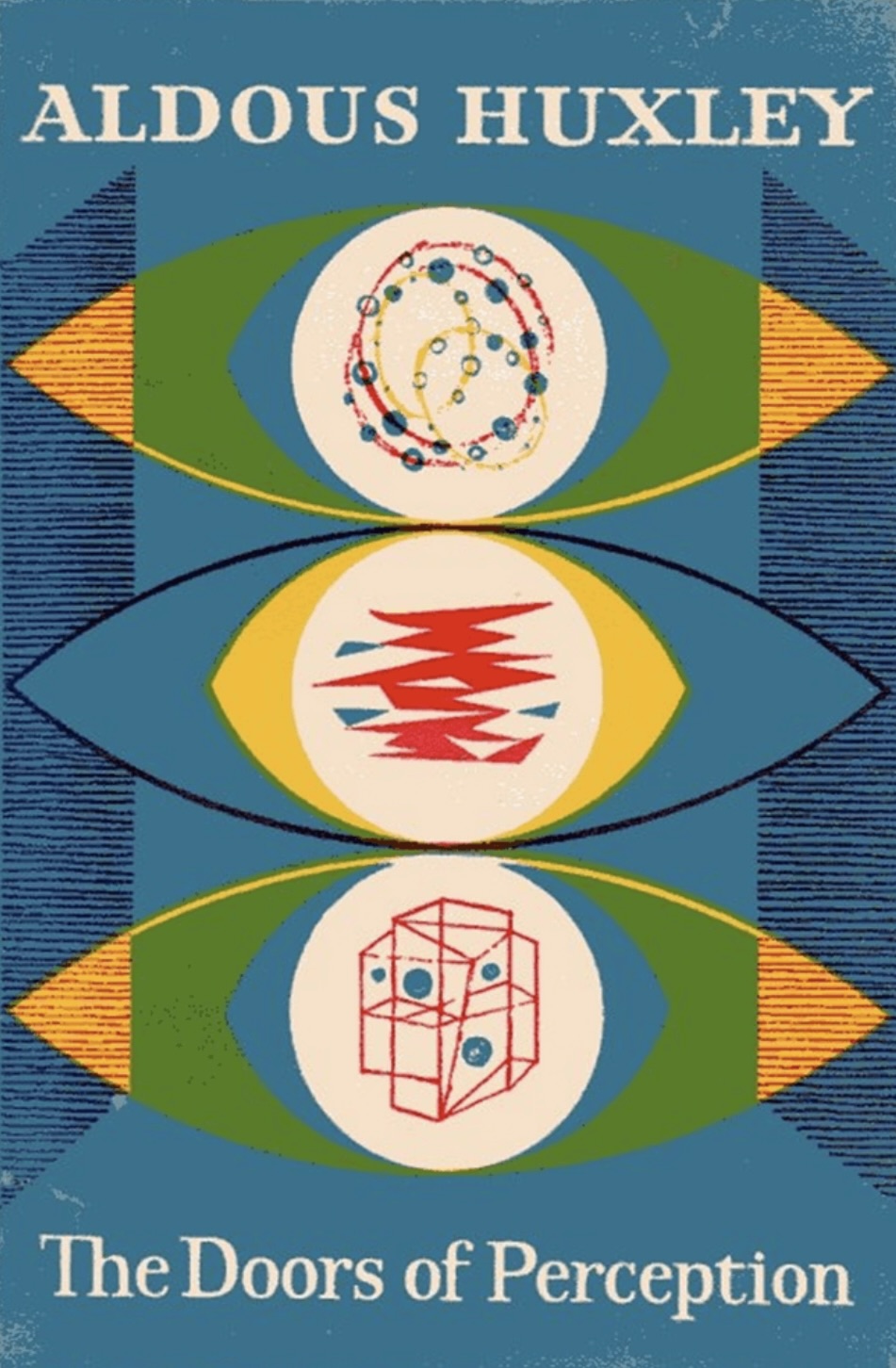
Huxley’s The Doors of Perception, his work bringing together Blake and modern pharmaceuticals.
For Huxley, immediacy of experience is essential for true, internalized learning to take place; unfortunately, the subjective element in each individual’s construction of reality makes the transfer of experience from one person to another extremely difficult, if not impossible. The question in The Doors of Perception is whether or not the subjective boundaries of perception can be eclipsed temporarily to provide a glimpse into an objective enlightenment.
Huxley begins similarly to the way a scientist would conduct an experiment, pragmatically describing the problem of human subjectivity and how he hoped mescaline would help him to transcend his normal, limited state. Subjective existence is described in fairly bleak terms: “We live together, we act on, and react to, one another; but always and in all circumstances we are by ourselves. The martyrs go hand in hand into the arena; they are crucified alone … Sensations, feelings, insights, fancies—all these are private, and except through symbols and at second hand, incommunicable”. Every individual is essentially an “island universe,” arranging the world into personal sets of symbols and connotations, that are at once broad enough to be called a “universe” and at the same time severely bounded by an inability to move outside of oneself, and therefore an island.
Perception, then, is paradoxical, a limited infinity which Huxley attempts to reconcile by separating experience into two spheres, one which is inside, the other outside. The inside sphere refers to immediacy, that which can be understood first-hand, the personal segment derived from the greater objective reality which constitutes the outside. What is outside, be it subatomic matter, God, or another person’s universe, lies beyond immediacy and can only be truly understood to the degree that it can be made to fit into the extant set of symbols.
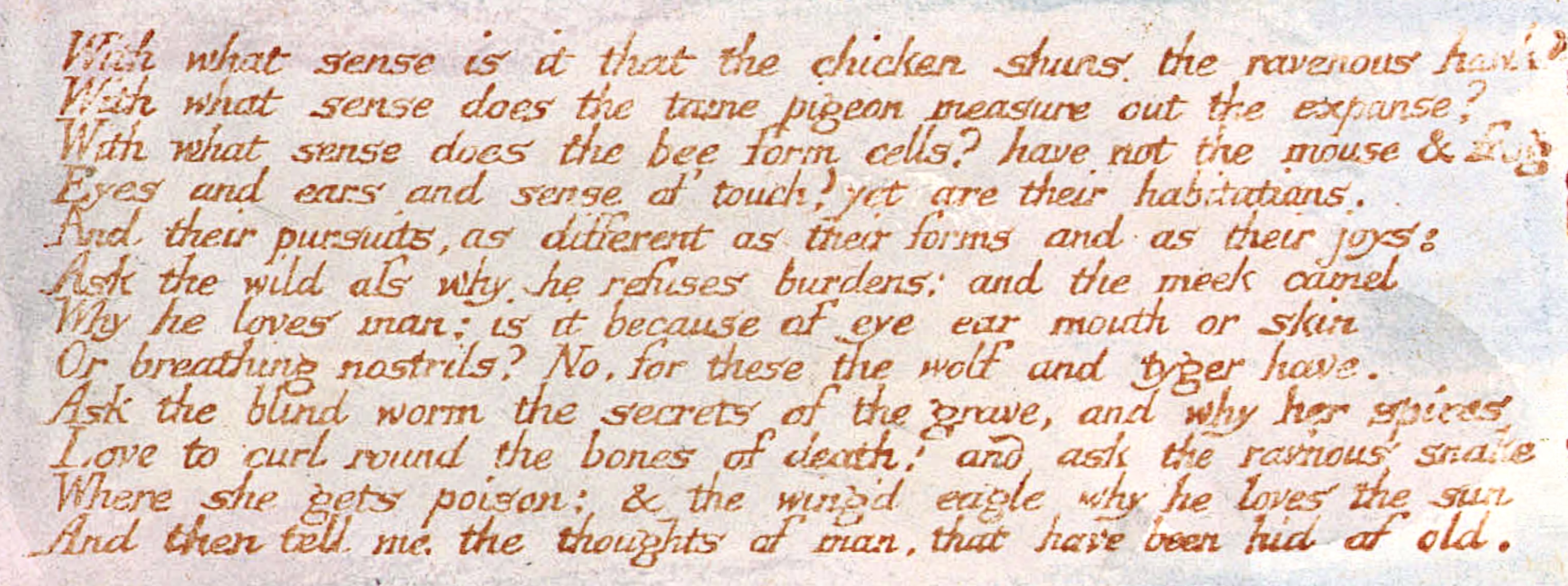
“With what sense is it that the chicken shuns the ravenous hawk? With what sense does the tame pigeon measure out the expanse? With what sense does the bee form cells? have not the mouse & frog Eyes and ears and sense of touch? yet are their habitations. And their pursuits, as different as their forms and as their joys:” – Blake, Visions of the Daughters of Albion. We all have multiple senses, many more than the usual ones usually allowed and allotted to us by the program that can only measure and record explicit, quantifiable, units.
Moving beyond finite subjectivity into an infinite objectivity is a desirable goal for Huxley, but to do so requires the removal of the main eliminative agents that form consciousness—the mind and the self—a task that Huxley admits is most certainly impossible. Their role however, can be reduced, and even if he can never know exactly “what it feels like to be Sir John Falstaff or Joe Louis”, the personal universe can be expanded. “It had always seemed to me possible,” writes Huxley, “that, through hypnosis, for example … or else by taking the appropriate drug, I might so change my ordinary mode of consciousness as to be able to know, from the inside out, what the visionary, the medium, even the mystic were talking about”.
Mescaline, Huxley hoped, would be the appropriate drug that could help him to transcend the self and see the world without his usual filters on reality, that “the drug would admit [him] at least for a few hours, into the kind of inner world described by Blake”.

Huxley’s ‘problem’ is that he starts off by assuming that we are all separate, isolated, units (“we are by ourselves”), with an “inner’ world somehow completely cut off and separated from an “outer” world – and then of course the rational mind (the “Abstract objecting power” as Blake terms it) has to try and work out how it can be that we might actually be mutually co-arising, inter-dependent infinite beings, and that both worlds constantly flow into one another. Huxley studied intensively at Oxford University, which maybe in part explains his difficulties with Urizen.
Blake’s Eyes
“We are led to Believe a Lie / When we see not Thro’ the Eye”- Blake. Our current educational system is designed to perpetuate that lie.
The question is, what defines Blakean perception, and why did Huxley admire it so deeply? Furthermore, are the ideas of the two authors consistent enough with one another that Huxley’s experiences can be considered characteristic of Blake’s inner world?
One might begin by examining Huxley’s belief in an objective reality that exists beyond human perception, a reality that can be accessed when the ego filters are eliminated. Blake sought to move beyond the meaningless distinction between subject and object, so there is a major divide between the two authors concerning the character of what is “out there.”
The processes, however, by which Huxley’s “island man” can transcend his condition to a blissful objectivity, and Blake’s myopic nature-worshiper could realize his own imaginative potential, are quite similar. In his early poem, There is No Natural Religion, Blake writes “He who sees the in-/finite in all things,/ sees God. He who/ sees the Ratio only/ sees himself only”, and in doing so makes two assumptions that have already been shown to be of fundamental importance to Huxley. First, the idea that one can see either God or oneself in all things rests on the basic presumption that there are different levels of perception, one enlightened and the other limited. The second assumption is that the inability to achieve the enlightened state is a function of the ego and its need to package the world into a self-created set of symbols. Huxley and Blake share these assumptions, but disagree on the value of the outer world.
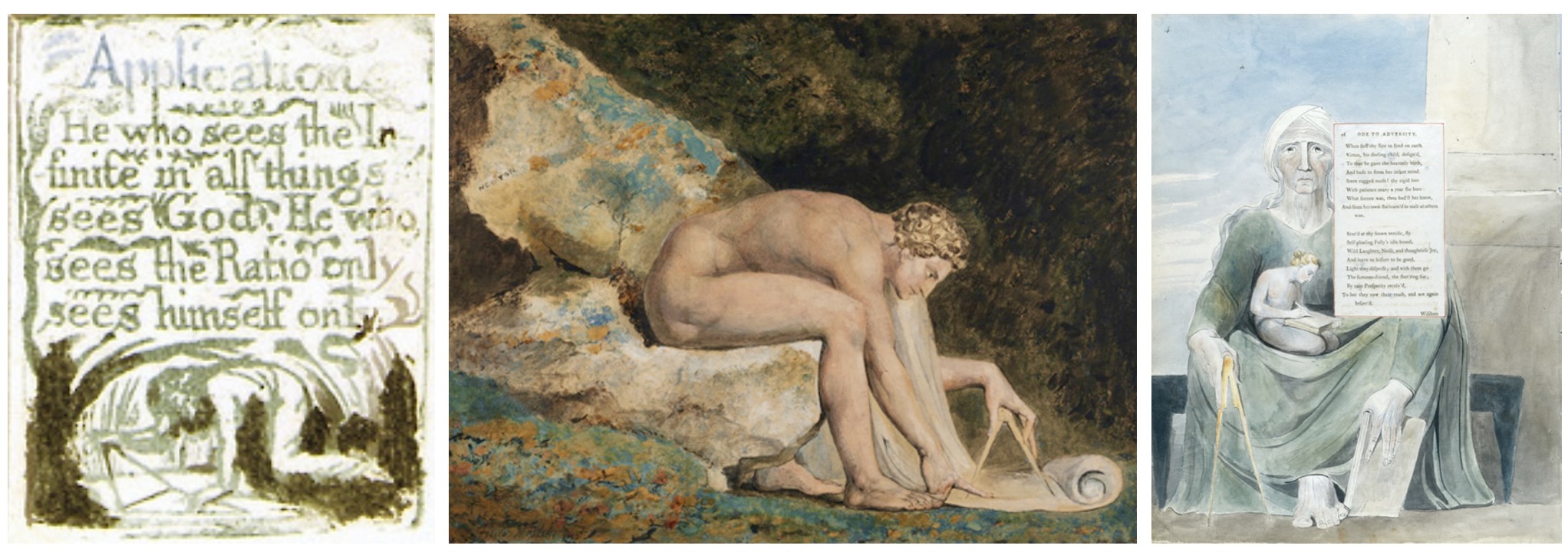
Teaching us how not to see – to see only ‘with’ not through the eye. To only half see reality. The compasses or dividers are always a symbol in Blake for this sort of bent-over, constricted, limited seeing – narcissistic, self-promulgated, narrowing: “Blake’s myopic nature-worshiper”. It is the left brain mode of seeing par excellence – as McGilchrist notes, in his excellent gloss on this passage in Blake: “He who sees the Infinite [looks outward to the ever-becoming with the right hemisphere] in all things sees God. He who sees the Ratio only [looks at the self-defined world brought into being by the left hemisphere] sees himself only [the left hemisphere is self-reflexive]” (The Master and his Emissary).
There are many peripheral correlatives between the two authors’ works, but The Doors of Perception is especially convenient for comparative purposes because of its direct and conscious relationship to Blake. In order to divulge more thoroughly the textual, accepted fundamentals of Blakean thought, as well as Huxley’s understanding of Blake, it is necessary to provide a brief overview of The Marriage of Heaven and Hell, Blake’s most comprehensive philosophical poem and the text to which Huxley’s work can be most appropriately compared.
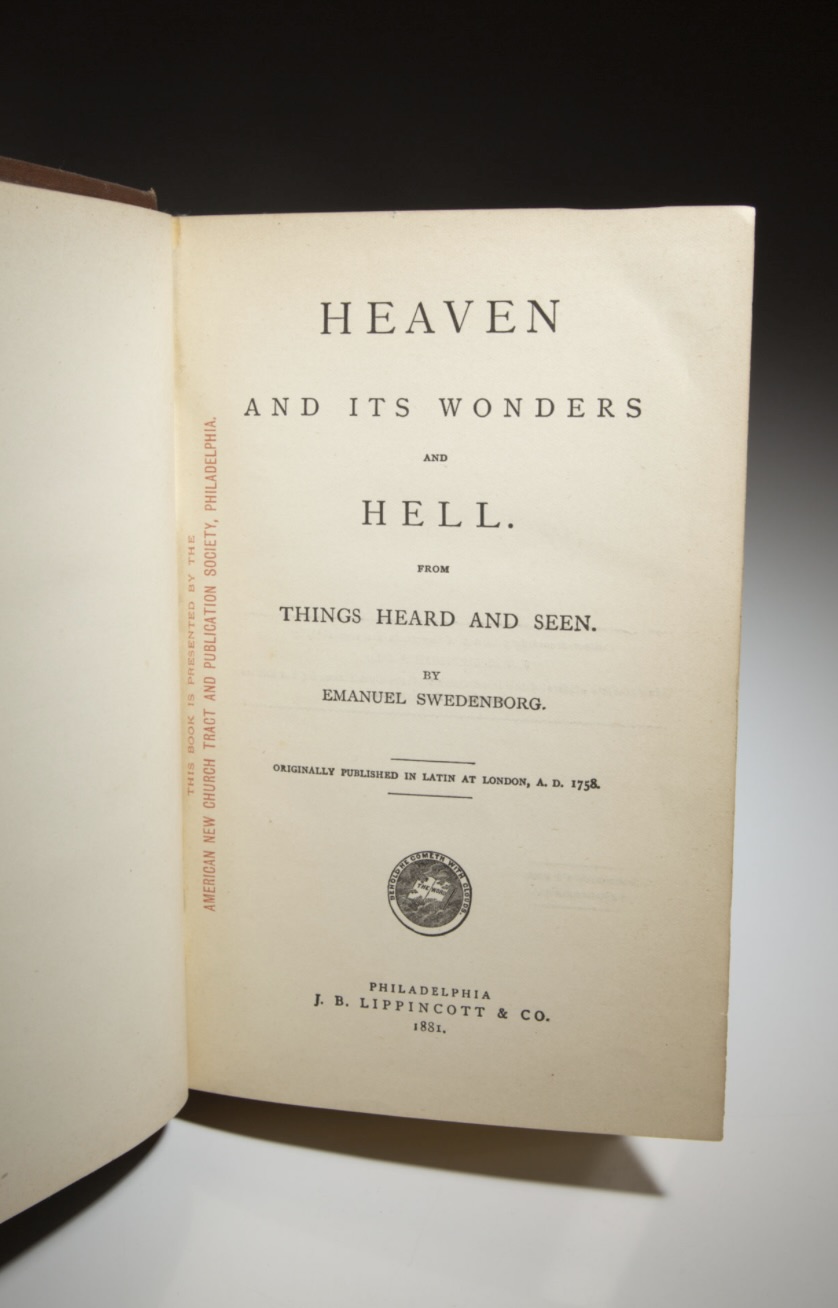
All Heaven and no Hell makes Emanuel a dull boy. “The Swedenborgian model of good and evil, that holds human desire to be the source of all that is iniquitous.” Blake’s task was to correct this one-sided, lop-sided, angel-sided appraisal of the contrary states.
The Marriage of Heaven and Hell is a satiric parody of Emanuel Swedenborg’s Heaven and Hell. Consisting of twenty-seven illustriously engraved plates, it represents Blake’s rejection of the Swedenborgian model of good and evil, that holds human desire to be the source of all that is iniquitous. Drawing from a dogmatic reading of the Bible, Swedenborg writes, “it is plain from the first chapter of Genesis,—where it is said … ‘God saw everything that He had made, and behold it was very good,’—and also from the primeval state of man in Paradise, that everything God created was good. And it is plain from the second state of Adam … that evil arose from man”. The logical extension of this mode of thought, that mankind’s free will and creative abilities are curses rather than blessings, and should be restrained, is a notion that Blake found reprehensible.
The premise of Blake’s rebuttal is that while free will and passive adherence to God’s will may represent opposite forces in mankind, it is not morally superior to be governed by one and not the other—both are necessary in their opposition to one another.
Beneath a depiction of the liberated soul rejoicing in the infernal flames, Blake writes on the third plate—“Without contraries is no progression. Attraction and repulsion, Reason and Energy, Love and Hate, are necessary to Human existence / From these contraries spring what the religious call Good and Evil. Good is the passive that obeys Reason Evil is the active springing from Energy”. The idea that contraries are the essence of human progression is central to Blake’s thesis, and carries with it the fascinating intimation that the triumph of good over evil is not a desirable end, although this point has frequently been misinterpreted. Clearly the labels “good” and “evil” are being applied sarcastically to restraint and desire, as the necessity of both negates the worth of any absolute value judgment. Rather than creating moral distinctions, Blake’s work deconstructs what Swedenborg considered evil, and finds it to be the soul of creation, and the primary source of vitality in human existence.
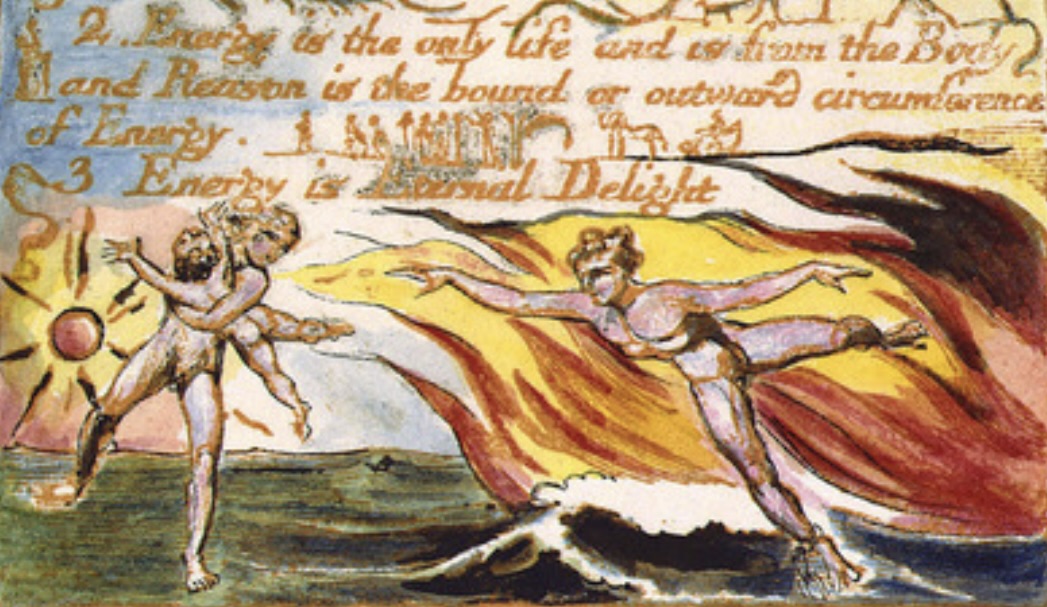
“rejoicing in the infernal flames”
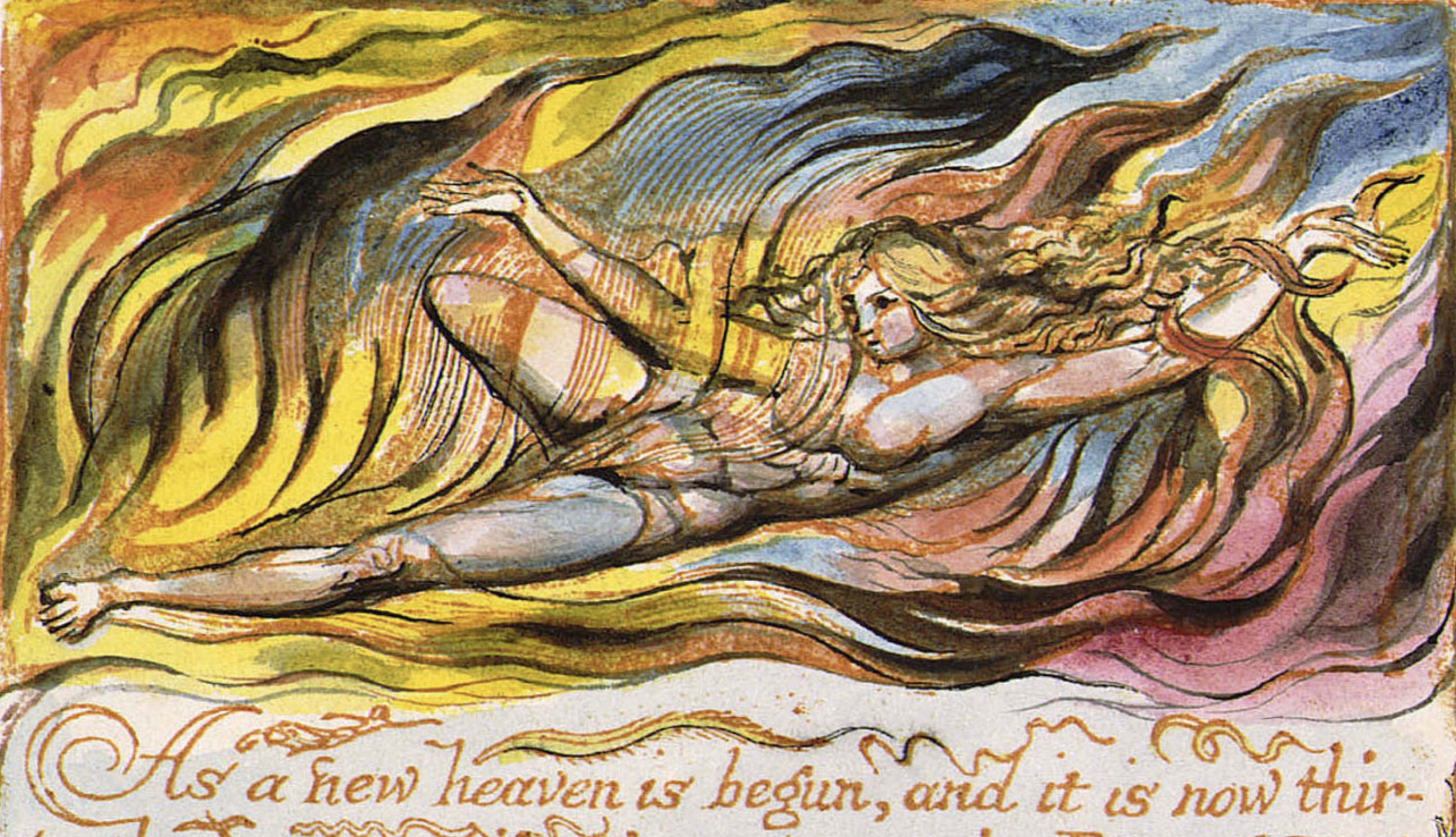
Eternal Delight: this was to be the new definition and materialisation of the idea of “heaven”. A new earth and a new heaven. And a new hell, of course.
Blake’s famous painting of Isaac Newton in which the mathematician is depicted in a hunched position, drawing painfully small diagrams with a compass, is his artistic representation of his disdain for the idea that the entirety of the universe can be explained through mathematical ratio.
As previously noted, seeing the ratio will lead only to seeing the self, and a solipsistic perspective misses the infinite grandeur of creation. Likewise, Blake felt that Newton’s notion of explaining the world through mathematical theory was narrow, and the minute scope of Newton’s focus is intended to look pitiful.
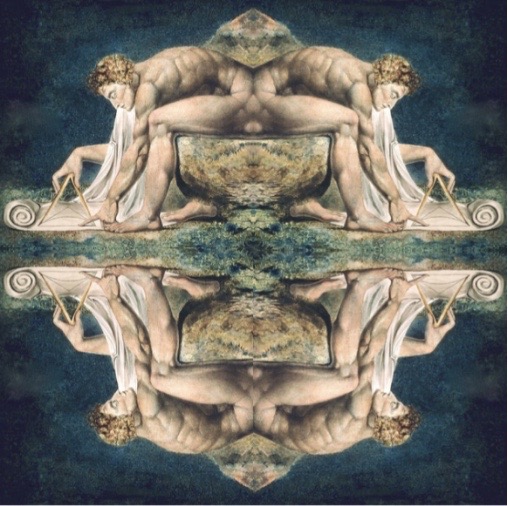
“Seeing the ratio will lead only to seeing the self, and a solipsistic perspective misses the infinite grandeur of creation.” To see “objectively”, for this sort of program, ironically means seeing yourself in all the objects you count and “measure” – because measurement itself is part of its subjective mind-set. It is also a mode of perception based almost entirely on the past, on previous assumptions and “knowledge”. It is in fact, as Krishnamurti acutely notes, the Past which is the observer in these systems.
A miniature version of Newton’s compass reappears on the fifth plate of The Marriage of Heaven and Hell under the passage, “Those who restrain desire do so because theirs is weak enough to be restrained … and being restrained it by degrees becomes passive until it is only the shadow of desire”. Passivity is always negative in Blake, as it implies a manner of receiving rather than creating, or reception rather than perception. Newton’s adherence to ratio and Swedenborg’s belief in the morality of restraint are joined as finite, and limiting, contraries to man’s infinite desire for life and creation. When man’s natural creative energy is suffocated and replaced by reason or nature worship, he becomes a mere shadow, and like Huxley’s island universes, will wallow in self-absorption, having no choice but to view everything through a pre-existing and narrow set of symbols.
The Importance of Being Heavenly
Even though Blake positions himself on the side of Hell and is, at times, contemptuous towards his contrary, he would not make the mistake of trying to eliminate it. It is important to note that much of The Marriage of Heaven and Hell is written sarcastically, from a narrative perspective that is not Blake’s own; he is writing to establish the infernal side of the contrary set of reason and energy, so it is easy to confuse Blake’s attempt to demonstrate with an attempt to convert. Reason and Energy are contraries, and as such are dependent upon one another. “Two classes of men are always upon the earth,” explains Blake, “& they should be enemies; whoever tries to reconcile them seeks to destroy existence”.
The symbiotic conflict between these two classes of men is also an internal conflict within every individual, and is symbolized on plate sixteen in Blake’s discussion of the “prolific” (energy) and the “devourer” (reason/ratio). The relationship between the two is the perfect model of Blakean contraries, as the two are entwined in an interminable state of conflict in which the prolific perpetually creates in the immediate media of life and energy while the devourer deadens his creations by imprisoning them in a system of symbols.
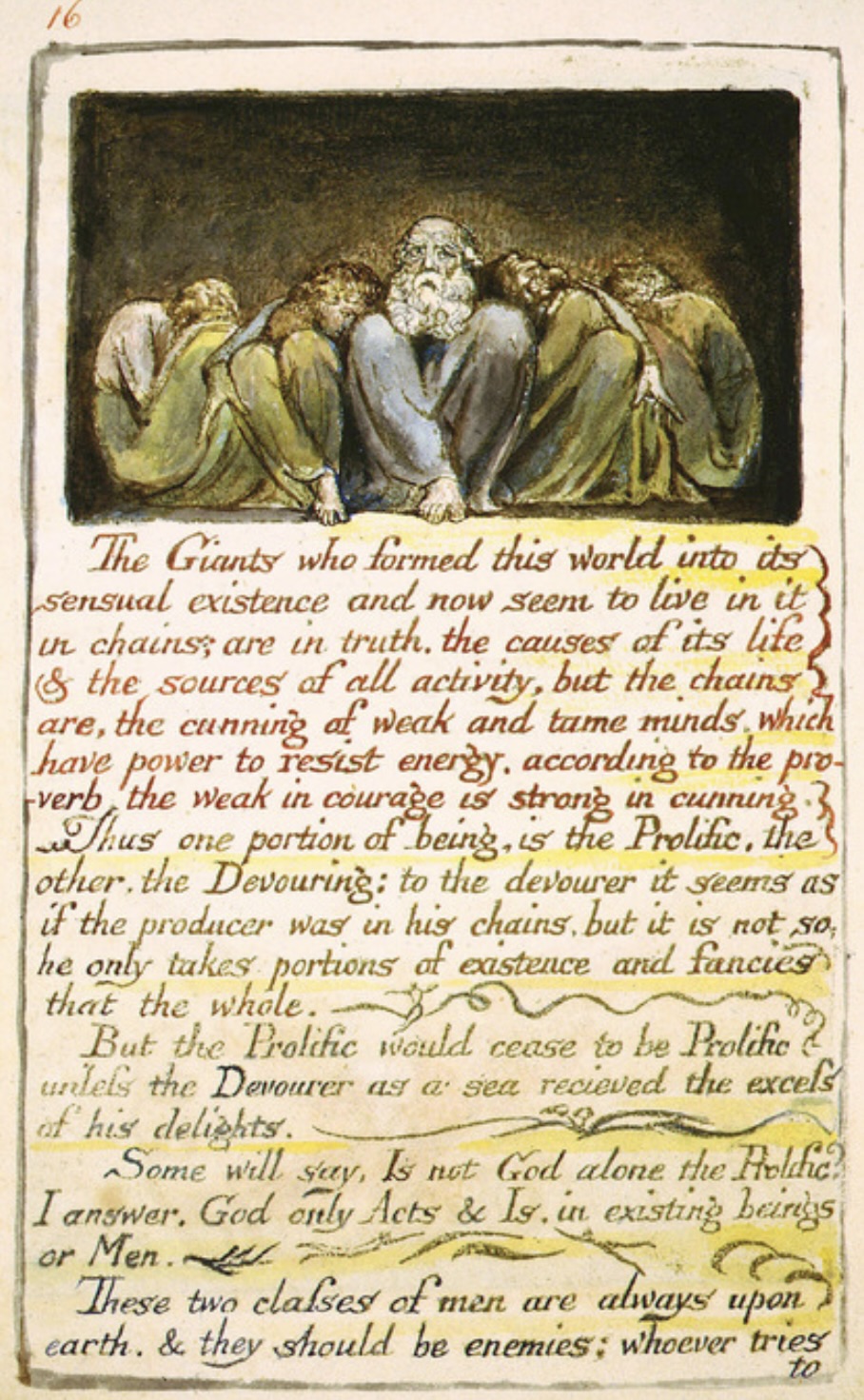
“The symbiotic conflict between these two classes of men is also an internal conflict within every individual, and is symbolized on plate sixteen in Blake’s discussion of the ‘prolific’ (energy) and the ‘devourer’ (reason/ratio).” The relation or dynamic between the two is never static or fixed, and they are perpetually brought into being by each other, a constant interplay between energy and form, container and contained. No one can control this, because control is itself only one part of the dialectic.
The creative force of the prolific was a destructive force according to Swedenborg, and Blake’s apparent exaltation of the prolific over the devourer is his attempt to rebalance the contrary. It is important not to confuse the ostensible polarity of this passage with Blake’s deeper message, since oppositional forces are dependent upon one another, and the glorious prolific “would cease to be the prolific unless the devourer as a sea received the excess of his delights”. In a more practical sense, the pure creation that takes place beyond the level of symbolized knowledge, or even in spite of it, requires its less virile contrary as a vessel of expression, even if that vessel obscures meaning with symbols.
What is removed by the vessel, however, can be restored by a perception that transcends symbols and encounters the idea immediately. By arguing that mortal creation takes place on some level beyond finite perception, Blake is making the weighty claim that human perception can also exist on an infinite, or even divine, plane. This claim is in direct contention with the dogmatic vision of the Swedenborgian devourers of the world, who hold sacred the separation of man and God. Blake addresses his critics, asserting, “some will say, Is not God alone the Prolific? I answer, God only acts & Is, in existing beings or Men”, and in doing so exposes a flaw in Swedenborg’s reasoning: if all of God’s creations are good, and man is God’s creation, is not man’s desire also created by God and therefore good? That man is the possessor of infinite desire, and can conceive of a God, is proof enough for Blake that there is a portion of God in man because nothing infinite could be contained by something that is solely finite.
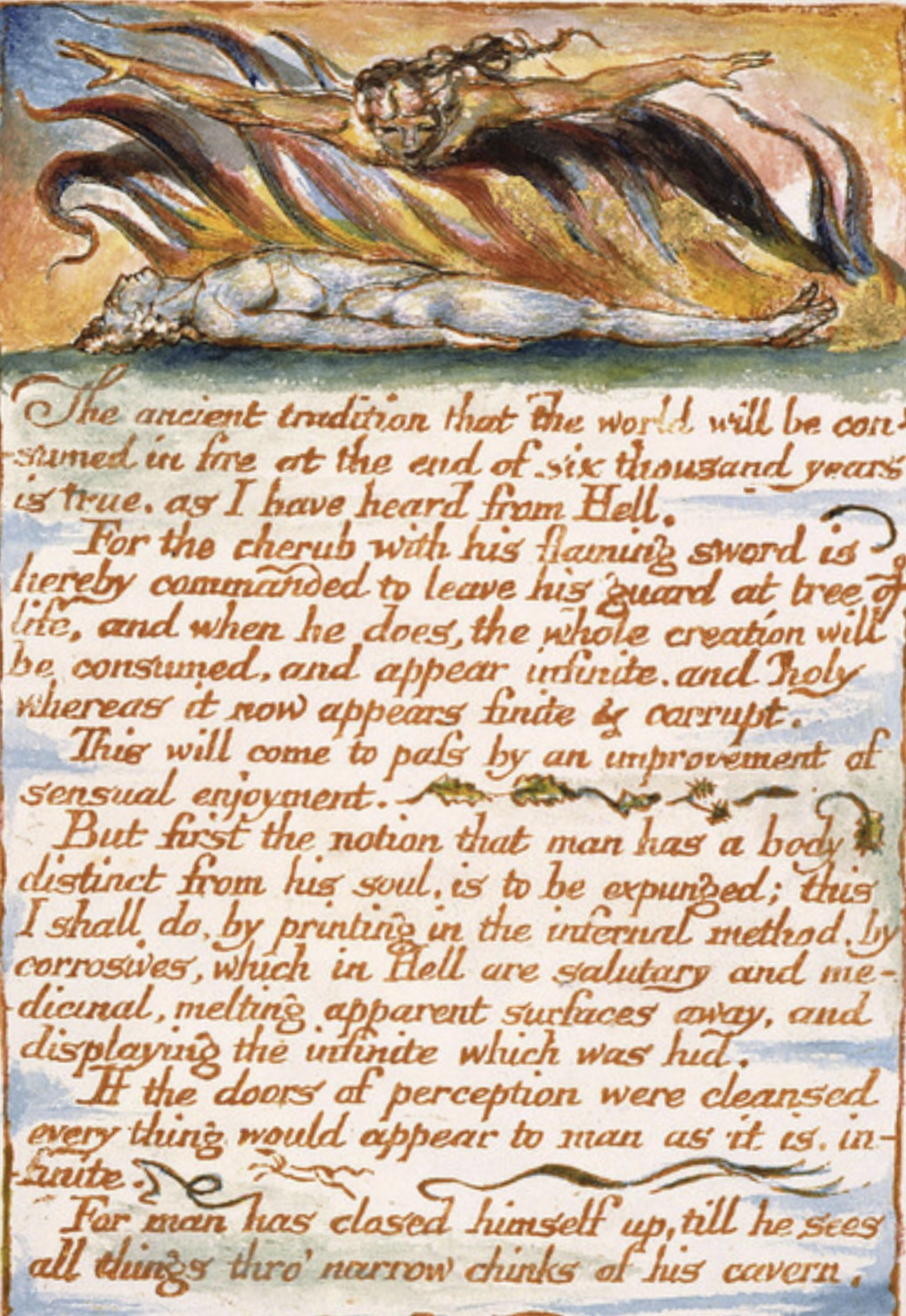
It is the presence of the Sworded Cherub (St Michael, St George, the Logos, Urizen) that is preventing us from seeing reality as it truly is – alive, responsive, infinite, and sacred. Rationality in that sense is a form of “covering”, a film of familiarity, that descends over our eyes and minds, limiting and distorting everything we see with them. The term for this process of dissolving or uncovering in the Bible is “apocalyspe’, from apo “off, away from” + kalyptein “to cover, conceal”. That’s all the apocalypse is – us having our eyes imaginatively open.
Most people operate only on the finite level, believing in the totality of their own created forms, but for humankind to reach its full creative potential it must regain contact with the infinite. Blake describes this process in the apocalyptic vision found on the fourteenth plate from which Huxley extracts the title Doors of Perception: “The ancient tradition that the world will be consumed by fire at the end of six thousand years is true, as I have heard from Hell, / For the cherub with his flaming sword is hereby commanded to leave his guard at the tree of life, and when he does, the whole creation will be consumed, and appear infinite. and holy whereas it now appears finite and corrupt. / This will come to pass by an improvement of sensual enjoyment. / But first, the notion that man has a body distinct from his soul, is to be expunged; this I shall do, by printing in the infernal method, by corrosives, which in Hell are salutary and medicinal, melting apparent surfaces away, and displaying the infinite which was hid, / If the doors of perception were cleansed every thing would appear to man as it is, infinite— / For man has closed himself up, till he sees all things through narrow chinks of his cavern”.
To recapture the infinite, man must be willing to leave behind his self-created, restraining system of symbols, because to adhere to such a code is to wallow in the ratio. Such self-absorption leads to a secondhand existence in a cavern of restraint, a condition which man should strive to rise above, as it prevents him from seeing that portion of the infinite which exists in all things, or more appropriately, exists within every mind and can be used to perceive all things.
To cleanse perception then, is to destroy the subjective and limiting cavern, whose walls are built by the ego, and reveal the infinite through creative vision. In A Vision of the Last Judgment, Blake captured the difference between imaginative and unimaginative perception by noting two separate manners of describing the sun: one could say that the sun is a flaming disk that looks rather like a guinea, or one could see the sun as the heavenly choir singing hallelujah. The guinea sun, as Northrop Frye has pointed out, is only a lowest common denominator that merely abstracts a plain physical description, and in doing so, constricts the sun to that one way of being seen. The Blakean comparison to the heavenly choir, however, sees the sun imaginatively rather than physically, and invites a degree of play to the symbol which the unimaginative mind tried to eliminate. The distinction here is not unlike that which Coleridge drew between the fancy and imagination in his Biographia Literaria.
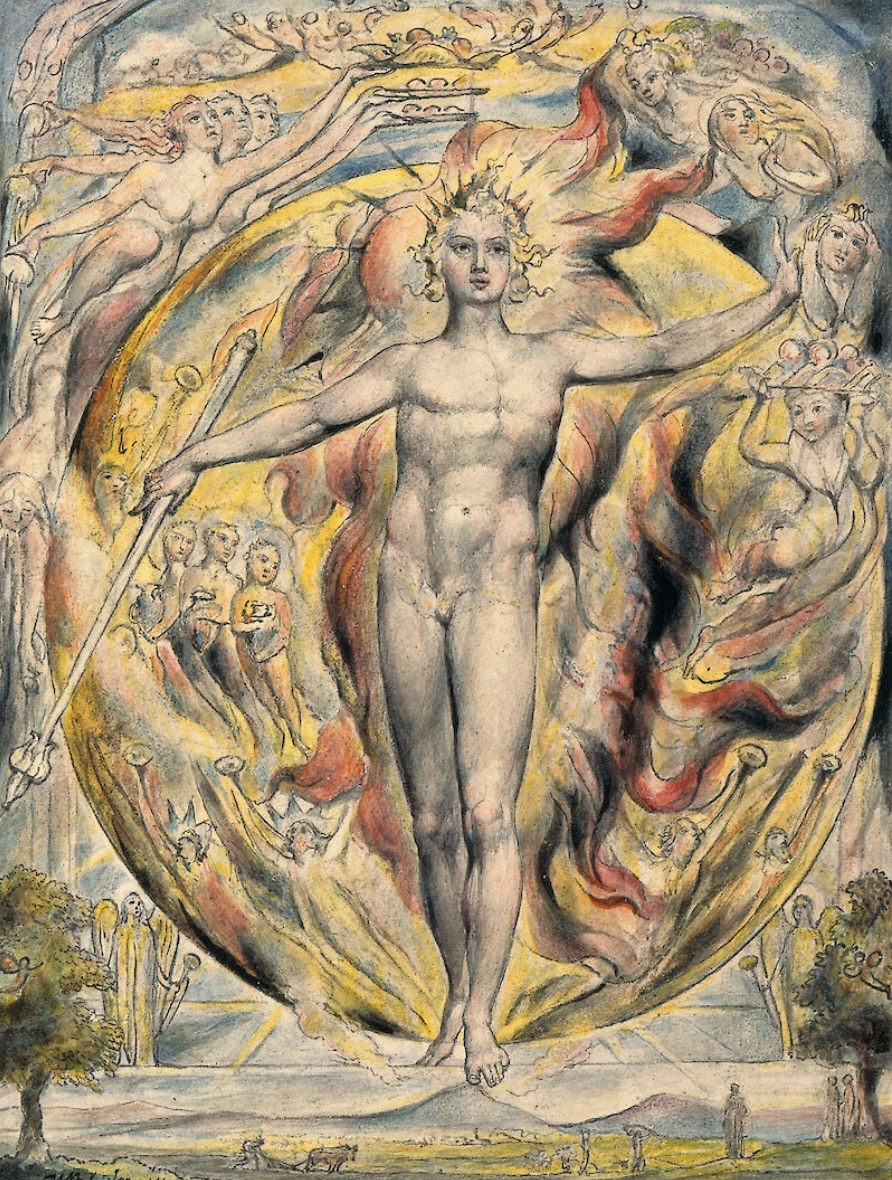
‘The Sun at His Eastern Gate’, from Blake’s Illustrations to Milton’s ‘L’Allegro’ and ‘ll Penseroso’, suggesting what imaginative perception might look like, and what might be behind it. Energy, delightful energy.
To summarize the preceding points, Blake saw human perception as a limited sliver of a possible imaginative paradise of vision; symbols and forms are the results of an eliminative creation, in which the mind turns into a filter for the purpose of creating a manageable, but stale inner world. When the sense of self is allowed to assert itself, it fortifies the barrier between subject and object, until the dead landscape is accepted as the whole of creation, and any conception of the infinite is lost.
To see only the self instead of the infinite is confining, and turns one into a devourer who “only takes portions of existence and fancies that the whole”. Diminishing the role of the ego in perception frees the mind through the elimination of the self/other, subject/object dichotomy, and thus reveals the infinite potential of a perception that creates rather than accepts. When man sees himself and the whole of creation as infinite he will recognize the necessity of contraries, and with this recognition will transcend the dogmatic vision of good and evil that is disseminated by the corrupt religious. The religious notion that good can, or should, vanquish evil is for Blake incorrect and he is careful to separate the teachings of the clergy from those of Christ for whom he had the utmost respect. As an enlightened man, Christ understood the presence of the infinite, and concerning the all-important contraries, desire and restraint, “Christ did not wish to unite but to separate them, as in the Parable of sheep and goats! & he says I came not to send Peace but a Sword”.
From Presence to Re-presentation: Symbols and Words as Coverings
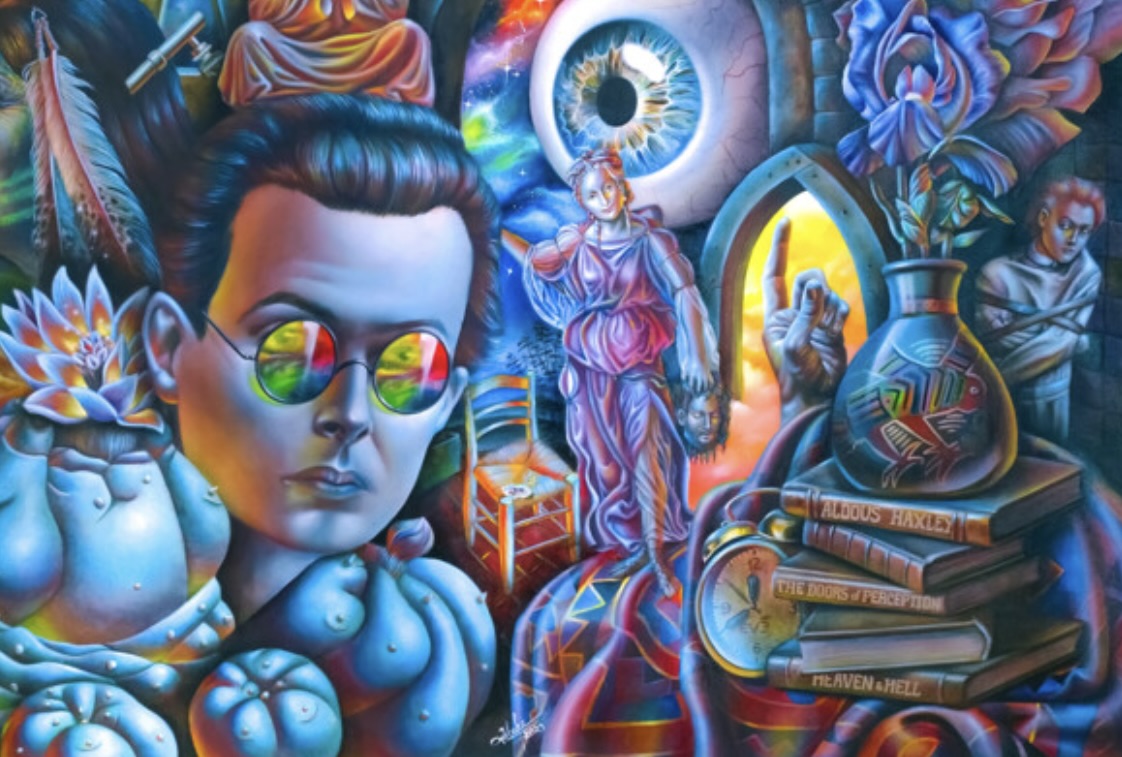
“Huxley believed that mescaline would help him to relieve himself of the ego and its limits on perception”. While mescaline might lower the ego’s defensive structure and allow greater sensual realisation, in order to really see with the “inward Eye”, as Blake called it, required seeing what the “outward Eye” was doing – that is, understanding the structures of the ego (or what Blake termed “Selfhood”), understanding how thinking and rationality trapped the mind, and equally importantly how imaginative perception was something that had to be worked on, practiced, developed, and strengthened – as with any exercise. As a contemporary of Blake recalled, “He said to me that all children saw ‘Visions’ and the substance of what he added is that all men might see them but for worldliness or unbelief, which blinds the spiritual eye” (cited in Ackroyd, 1995).
Huxley had gathered from his research on the drug that mescaline would help him to relieve himself of the ego and its limits on perception, and he also knew that this would move his own world closer to that envisioned by Blake. He had, however, expected Blake’s world to be different from what he found it to be. Because Blake was a visionary mystic who claimed to have conversed with angels and to have seen cities made entirely of gold—and because these claims were frequently taken to describe objects that he found in the landscape—Huxley expected his diminished ego to reveal a world of hallucinogenic splendour. Dismissing his pre-existing conception of what his experience would be, Huxley writes: “But what I had expected did not happen. I had expected to lie with my eyes shut, looking at visions of many-coloured geometries, of animated architectures, rich with gems and fabulously lovely … trembling perpetually on the verge of ultimate revelation”.
It is important that Huxley was able to deflower himself of his own expectations because they represented an intellectual, and therefore selfish form, and stubbornly to force his experience into this mould would be counterproductive. In his altered state Huxley found that the inner world which he had expected to be extraordinarily transformed was of little importance compared to what existed beyond himself. The “slow dance of golden lights” and “sumptuous red surfaces swelling and expanding” that Huxley saw with his eyes closed were “cheap” and not especially revealing. “It’s as though one were below decks on a ship,” he responded when asked about his visions, “A five and ten cent ship”.
The below decks of the ship is comparable to Blake’s cavern, the shapes and patterns being self- created, and existing in a subjective realm that forges a place within the greater infinity of the world “out there.” What was important, Huxley realized, was the change that took place “in the realm of objective fact. What happened to [his] subjective universe was relatively unimportant”. Basically, Huxley experienced a Blakean diminished ego, but understood and described his experience in distinctly non-Blakean terminology. He realized that the change in how he perceived the outside world was a product of his own vision, but he saw that vision as a means of finding something new, rather than a process of creating something new.
The importance of the inner world was reduced because Huxley was experiencing for the first time what he had previously only been able to read about. Significance is usually a function of personal attachment in the sense that the significance of objects and events is variable; assigning significance is a way for the self to impose itself on the outside world, as what is deemed important is done so based on its position relative to the self and its preferences and pre-conceived notions. Subjectivity is marked by such judgments which by their very nature must be selfish, so it follows that moving into the objective realm is not, as some would expect, the same as having one’s judgments be invariably correct, but to cease making judgments in the first place.
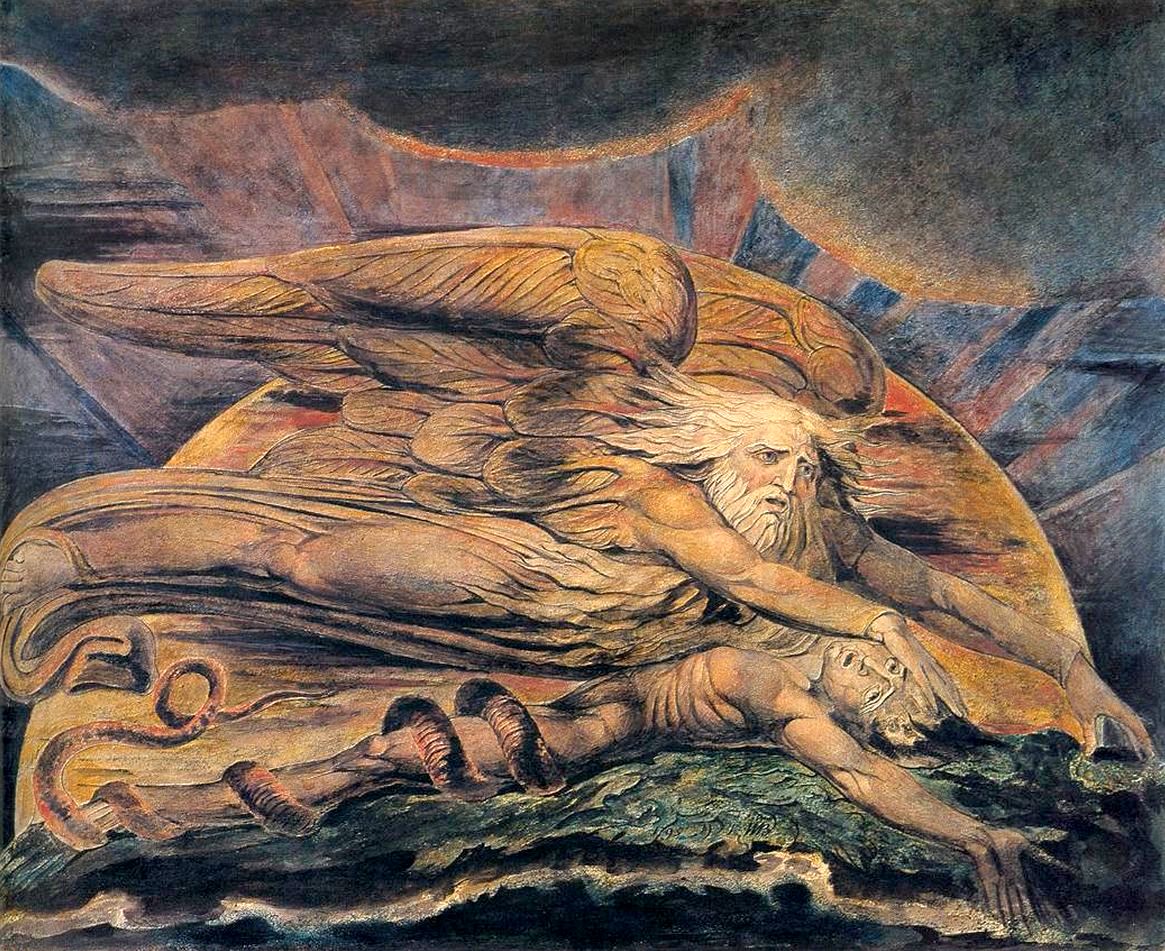
“Moving into the objective realm is to cease making judgments in the first place”. Image: Elohim Creating Adam, by Blake. The Biblical name for the “judge” or “judges” within the psyche of man is “Elohim”, and as such they appear in the Book of Genesis. “And God [Elohim] said, Let us [plural] make man in our image, after our likeness” (Genesis 1:26). What Blake terms the “Last Judgment” is when we cease judging reality – when we let go of this Elohim program within us: when the outer, literalising eye no longer inhibits or controls the imaginative or spiritual eye, which is the true source of seeing. Ending judging is only the pre-requisite for vision though, the lowering of the judgmental program that kicked us out of Eden. This then allows for a deeper co-arising to take place.
After several hours, Huxley left the house and traveled to the World’s Biggest Drug Store, where he leafed through volumes of artwork and came to the conclusion that painted representations of the infinite, just like verbal representations, are limited. Reflecting on Van Gogh’s “The Chair,” Huxley recognized that the way in which Van Gogh perceived of the chair was similar to the way Huxley himself was beginning to see the world. To transfer this way of seeing onto canvas, however, “was a task to which the power even of genius proved wholly inadequate”. The chair was not the chair of ordinary perception, but like a word or a formula, it was still a symbol and as such it could only ever suggest the infinite. Van Gogh and other gifted artists who shared the ability to see things in their true nature are, in the Blakean sense, infernal. To print in the “infernal method,” is to use corrosives, to erode rather than reinforce the surface of an object, and in doing so reveal “the infinite which was hid.”

Outward chair; inward chair. The chair seen with the inward Eye contains the other chair within it: this is what Blake means by “twofold vision”, just as the right hemisphere comprehends the left hemisphere, but the left hemisphere, stuck in its single, objecting, gaze, can only see itself – can only see half of the chair.
In the ‘Memorable Fancy on the fifteenth plate’, Blake visits a printing house in Hell and sheds further light on the process of infernal creation.
The printing house is divided into six chambers: “In the first chamber was a Dragon-Man, clearing away rubbish from a caves mouth”; in other words, he is preparing the senses for a cleansed perception by removing the ego’s “rubbish” (Harold Bloom). The second chamber holds a Viper, representing the devourer, wrapping itself around the cave and placing stones around the perimeter to limit its capacity. The Viper of course, is missing the point, and even though he thinks that he is successfully restraining energy, his concept of space and limitation is only a ratio, and inside the third chamber is an Eagle who is flapping his wings and expanding the Viper-bounded cave to infinite proportions despite its spatial limits.
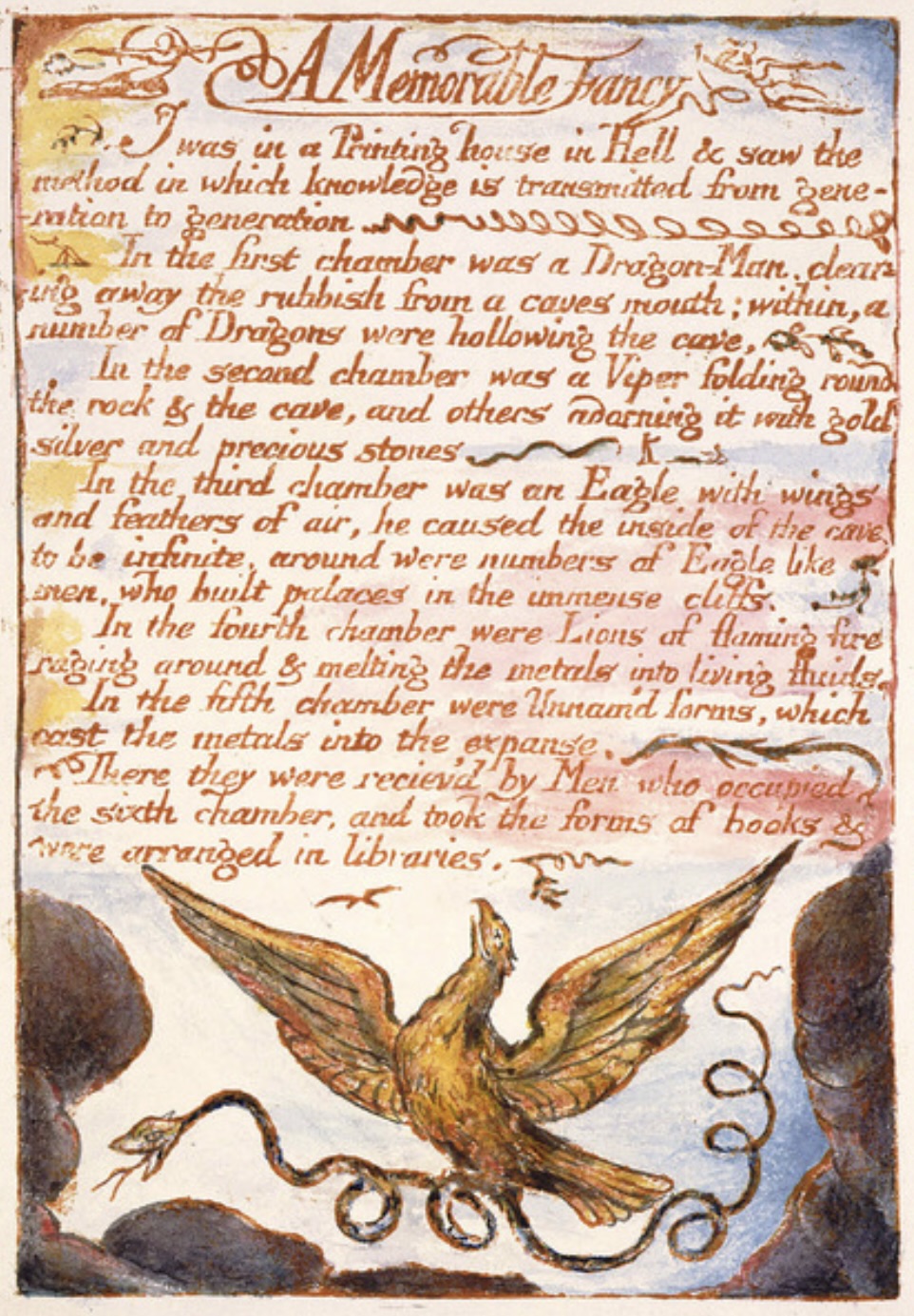
The Marriage of Heaven and Hell, Plate 15. The same levels or ‘chambers’ that go into the process of making say a book – say, Blake’s book – are the same that go into generating any imaginative perception of the world – it is a constant process of clearing away, dissolving and corroding (the past, the memories, the labels, the concepts, the film of familiarity, the covering), requiring a containing or bounding form and limit, and then the magic of the ‘eagle’, bridging and opening the worlds through the crystallisation of the moment, and then the final mysterious process of transmission and reception.
A further clue to understanding the third chamber is provided in one of the Proverbs of Hell in which Blake writes, “When thou seest an Eagle, thou seest a portion of Genius; lift up thy head!” The giant Eagle is assisted by Eagle-like men, who represent artists like Blake or Van Gogh who make up the human portion of genius. In the fourth chamber are “Lions of flaming fire raging around & melting the metals into living liquids”, in a symbolic victory of desire over restraint. Again the Proverbs of Hell provide useful insight, as lions are established opposite the fox as emblems of the prolific. Two proverbs set up the relationship specifically: “The fox provides for himself, but God provides for the Lion”, and “If the Lion was advised by the Fox, he would be cunning”. The word “cunning” is used several times in The Marriage of Heaven and Hell, each time in relation to the devourer, who like the Fox, is content in a selfish world apart from the divine presence. The metals that the lions are melting down are the same systematic stones that the restraining Viper had placed around the cave, and in doing so the lions are returning them to their true and pliant state which the “Unnam’d forms” residing in the fifth chamber cast into the expanse, where they are received by men and moulded into books and presumably other forms of expression such as paintings, or sculpture.
“This is how one ought to see,” Huxley repeated several times during his experiment, “how things really are”. In normal perception, the ego forces the brain to be aware that it is part of a self- conscious being whose primary concern is physical survival. Consequently, utilitarian objects and ideas appear significant while those of less immediate use seem unimportant. While on mescaline, Huxley found himself less inclined to worry about practicality, and was content to sit and stare at the folds of his trousers, or to contemplate the glowing significance of a painting. Even his concern for time disappeared almost completely; when his investigator asked how he felt about it, he replied simply, “there seems to be plenty of it”. The problem with his cleansed perception was that he could have spent days simply looking at these “things the way they ought to be” and been perfectly content. “Just looking,” he recalls, “just being the divine Not-self of flower, of book, of chair, of flannel. That would be enough”.
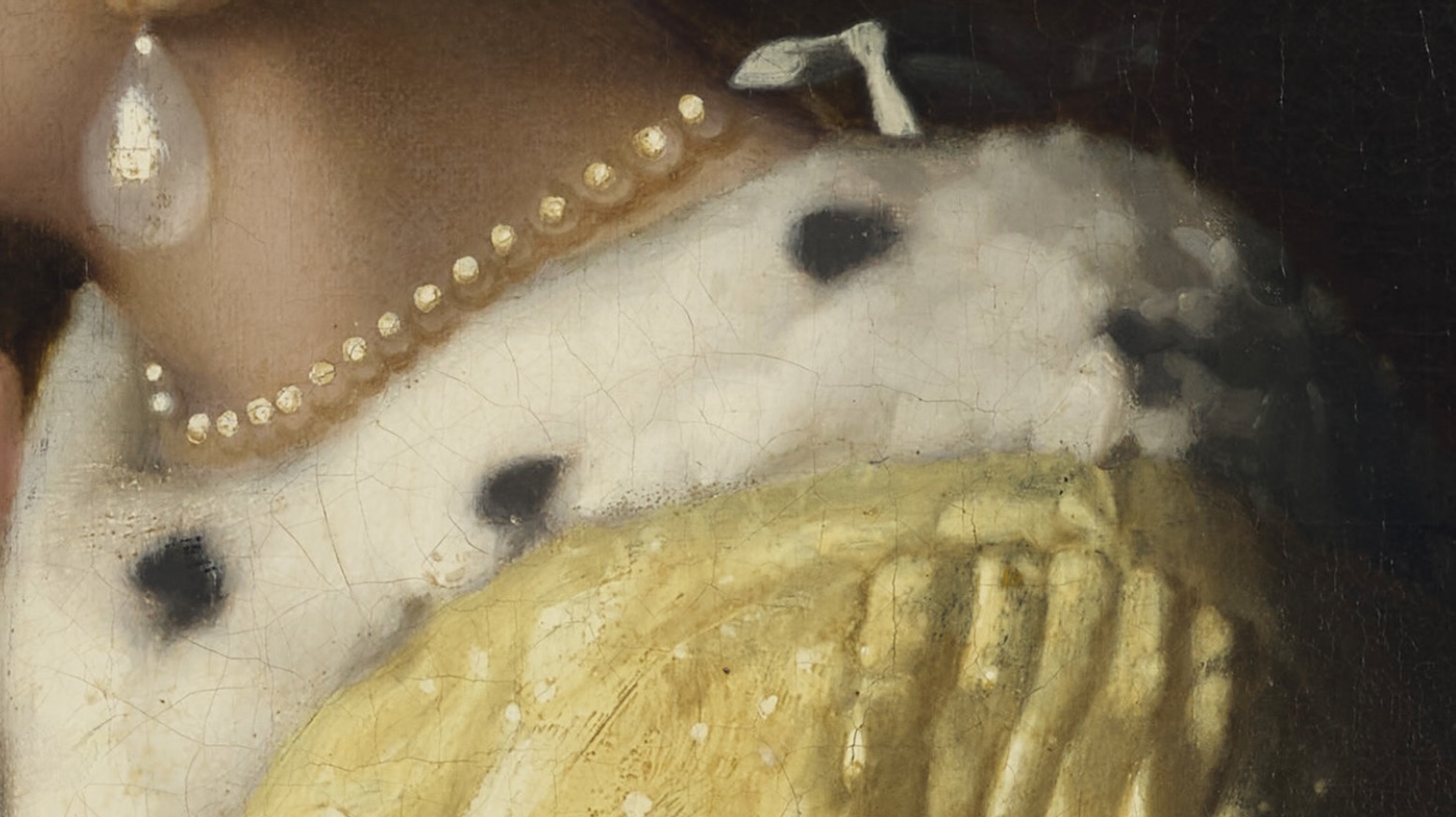
Lost in the moment. Huxley draws on the example of Vermeer, as an artist who powerfully suggests the infinite, through the erasure of himself and immersion in the perception. Image: ‘Woman with a Pearl Necklace’, by Vermeer (c. 1664), detail.
There are, of course, needs that would not be fulfilled if he were to stare at his chair for eternity, and the thought that his cleansed perception would prevent him from being a productive member of society haunted his experience. “What about human relations? In the recording of that morning’s conversations I find the question constantly repeated … How could one reconcile the timeless bliss of seeing as one ought to see with the temporal duties of doing what one ought to do and feeling as one ought to feel?” The question of how to reconcile the mescaline state with the productive state is the climactic problem in The Doors of Perception, and leads Huxley to a discussion of contraries, during which, oddly enough, he does not directly invoke Blake despite the strikingly Blakean nature of both his question and conclusion. In contrast to his nearly constant presence throughout the rest of the essay, Blake’s almost complete absence at this critical juncture suggests that Huxley may have misunderstood Blake’s infernal voice to be the voice of Blake himself.
Mescaline, as a means of cleansing perception has its worth, but after praising the drug and the experience, Huxley is careful to qualify that his altered state was still only a partial cleansing and should not be confused with enlightenment. There are two poles—for lack of a better word—to human perception: on one side is heightened contemplation stemming from an awareness of the infinite, on the other is the belief in the totality of finite forms and systems.
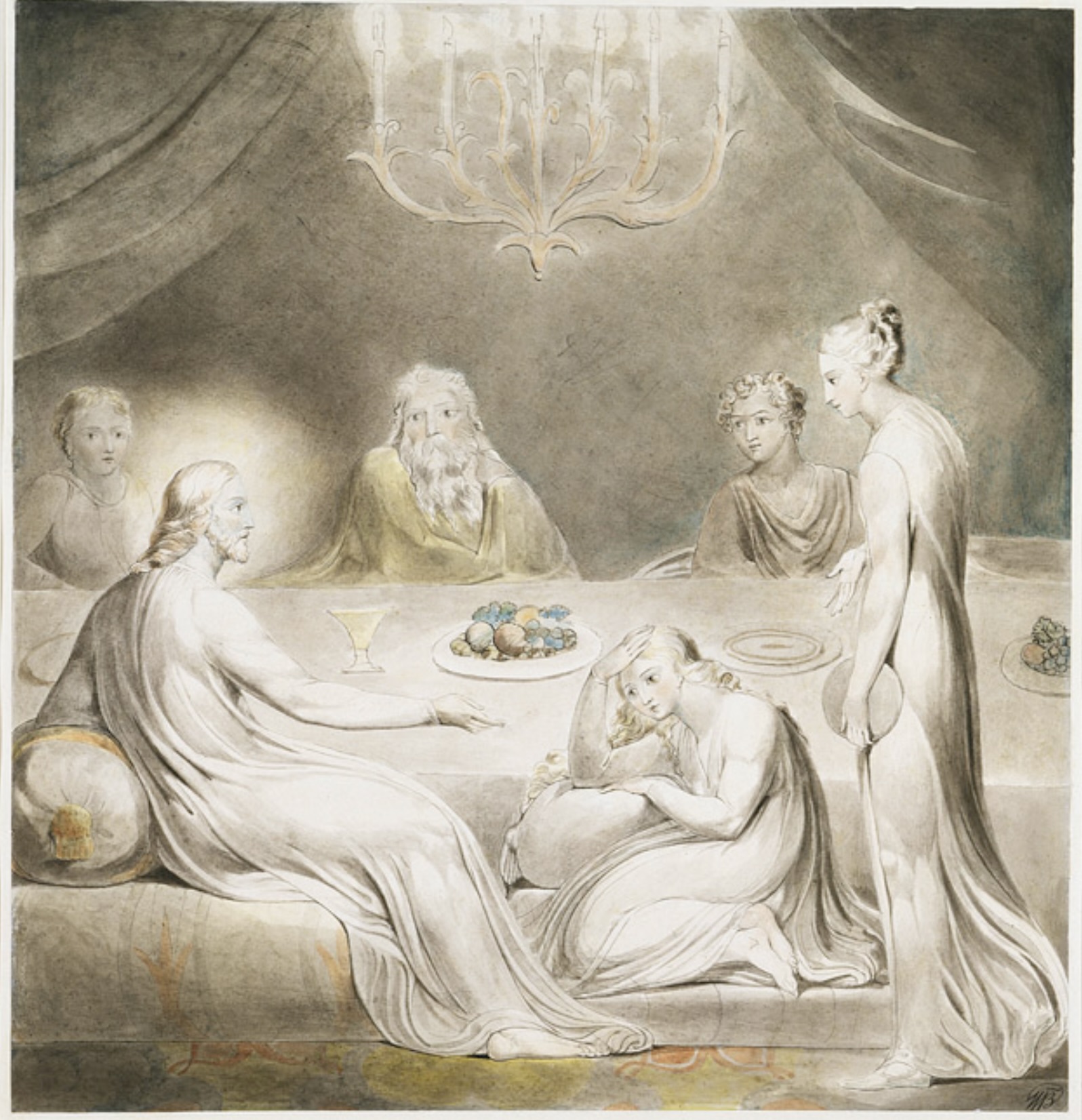
“Mescaline opens up the way of Mary, but shuts the door on Martha”. Image: ‘Christ in the House of Martha and Mary: “But Martha Was Cumbered About Much Serving”‘, by Blake. This again suggests the twofold or dual aspects that are going on within perception all the time.
Clearly Huxley agreed with Blake that seeing the infinite is seeing truth. He also agreed with Blake that the ideal in perception does not forsake the finite pole, although Huxley does not recognize their agreement on this point. Mescaline allowed Huxley to experience contemplation at its height—“At its height, but not yet in its fullness. For in its fullness the way of Mary includes the way of Martha and raises it, so to speak to its own highest power”. The word “fullness” suggests a multidimensional realm as opposed to the one dimensional measurement of “height.” The problem with mescaline is that it “opens up the way of Mary, but shuts the door on Martha”. To move past height and into fullness, the contrary poles of perception must be married, not in the sense that they are blended into one moderate consciousness, but in the sense that both must be accessible. Higher level contemplation would be useless without the necessary symbols and systems to interpret the experience. When those same symbols and systems are confused with solid representations of some concrete thing, however, they also become worthless.
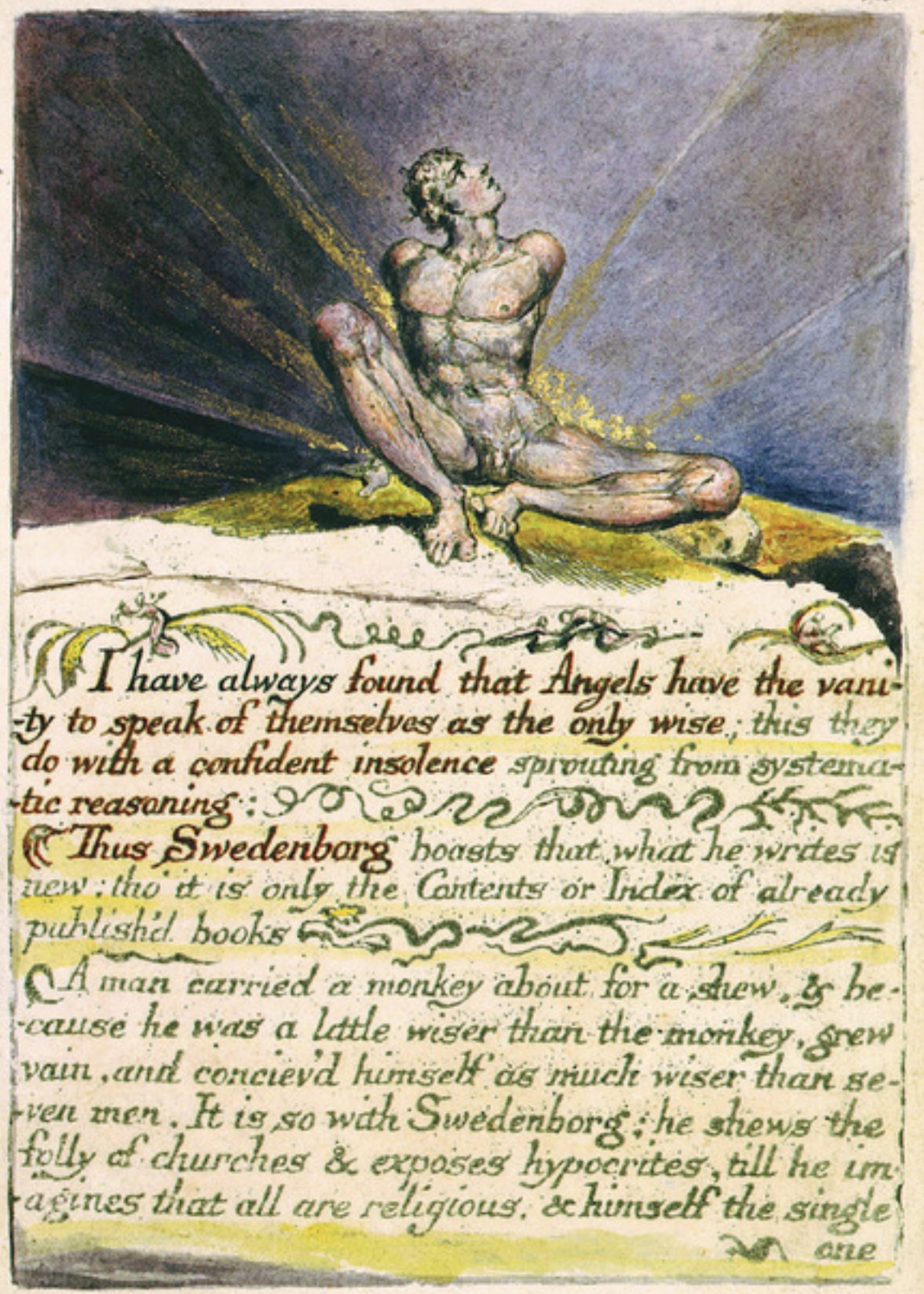
“I have always found that Angels have the vanity to speak of themselves as the only wise; this they do with a confident insolence sprouting from systematic reasoning”. The energy of Blake’s humour is evident on every page of The Marriage of Heaven and Hell, and is contained even in its title, a deliberate pop at Swedenborg, Christian Rosenkreutz, the Bible, the marriage service, and pretty much everything else. He realised that the pompous and sombre reign of rationality and morality had to be punctured, and punctured hard – hence the terseness and extraordinary vigour of his images and thought here.
As previously mentioned, Blake’s intention was to present the contrary to Swedenborg and other conventional thinkers, so he writes mostly from an infernal point of view, but he did not intend for this perspective to be regarded as a moral superior to its opposite. The Marriage of Heaven and Hell is a satire, blatantly ironic and often funny, so it is of utmost importance to be able to separate those times when Blake is writing as a devil from those times when he is writing candidly, as Blake. When the proper distinction is made, it becomes clear that Blake is not condoning energy with no restraint, nor an awareness of the infinite with no base in the finite, in society or the individual. It is crucial that in Hell’s printing house the Viper, who represents restraint and places restrictive stones around the cave, is as important to the printing process as the symbols of creative genius, for it is the Viper’s stones that are eventually melted by the lions and turned into true knowledge.
Blake states his case quite clearly at times, writing in his initial set of assumptions “without contraries is no progression”, and again while describing the relationship between the creative genius and systematic restraint when he explains that “the prolific would cease to be prolific unless the devourer as a sea received the excess of his delights”. The prolific is certainly glorified in comparison to the devourer, but only because Blake is consciously creating a contrary to the prominent Swedenborgian ideology, which needed no further reinforcement.
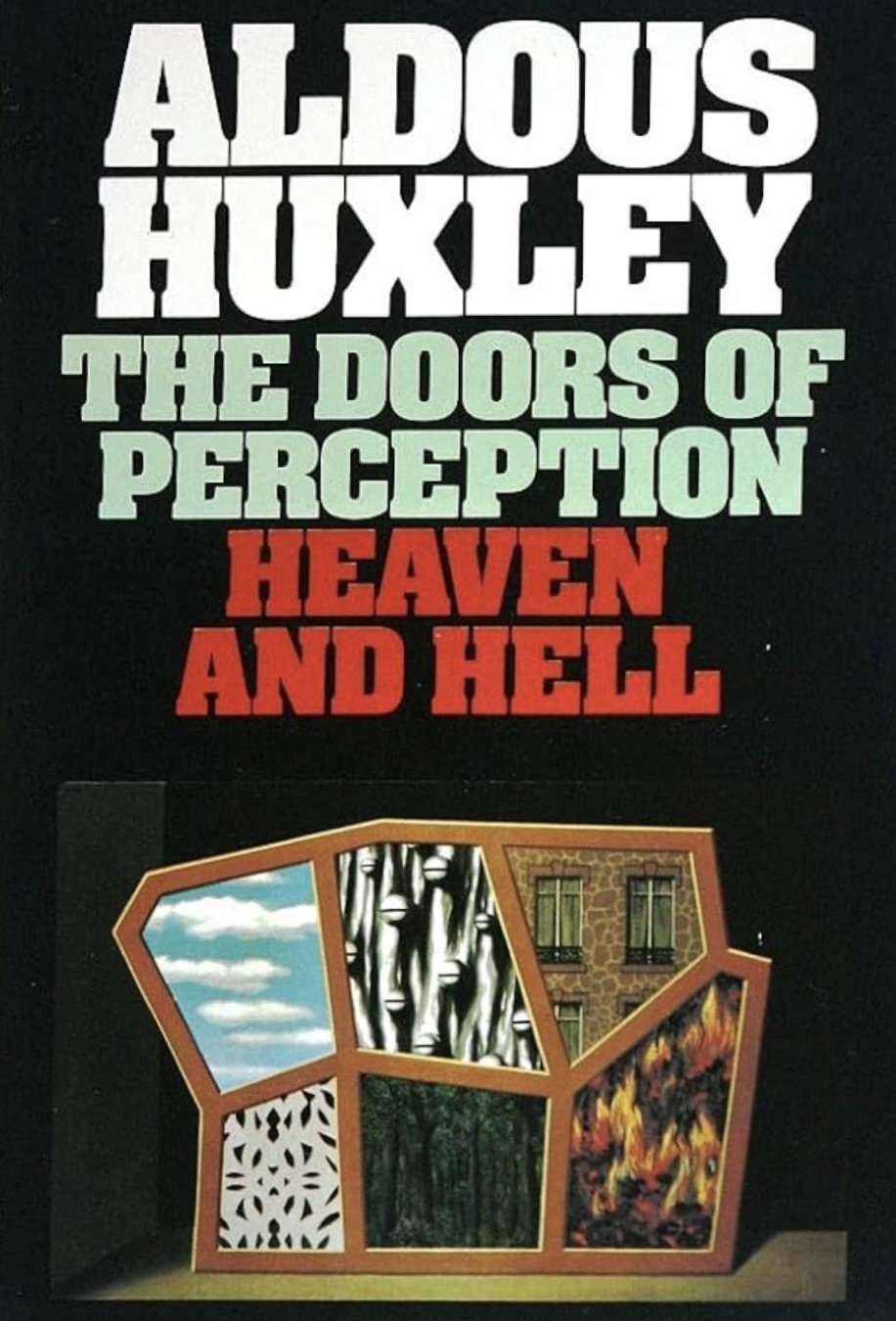
Huxley somehow makes even the phrases ‘heaven and Hell’, and ‘The Doors of Perception’ seem story and lifeless, hinting at the nature of the enclosed, island, hyper-rationalised mind that sought mescaline for exact. But giving LSD to Urizen is hardly likely to result in an awakening, only a depending of the self-estrangement trauma.
Gifted as he was in the art of interpretation, Huxley fails to comprehend the extent to which his argument has taken a Blakean form, otherwise he surely would have made at least a passing mention of the heavy emphasis that Blake placed on the necessity of both contraries. After using Blake’s phrase as the title of his work, and analyzing his experience through a Blakean lens, it seems odd that Huxley would retreat from Blake’s terminology at the very point at which Blake’s influence should have been most resonant. Apparently, Huxley allowed himself to become entangled in the legend and in the remarkable nature of Blake’s argument, thereby missing its true depth, as Keynes and others did as well.
Despite the fact that Huxley possessed an extraordinary ability to understand and appreciate artwork of many genres, or maybe because he had such a vast body of knowledge, it is not surprising that he could have fallen into the traditional misreading of Blake. Huxley’s awareness of Blake extended beyond Blake’s texts into the realm of legend, where Blake is usually placed strictly on the side of his devils.
This is an edited version of ‘Cleansing the Doors: Sense perception and imagination in William Blake and Aldous Huxley’, by Matthew L. Miller. To read the full article please click here.
 thehumandivinedotorg